
A ridge vent has adequate soffit intake when the low vents supply enough unobstructed net free ventilation area to balance the ridge exhaust, based on the attic design and applicable code. A long ridge vent does not guarantee useful airflow if soffit openings are blocked by insulation or are too small. A roofer can calculate the attic floor area, identify actual vent products, compare their published net free area, and check for continuous air paths. North Alabama heat alone is not proof that more ridge vent is needed.
What 'balanced' intake and exhaust actually means
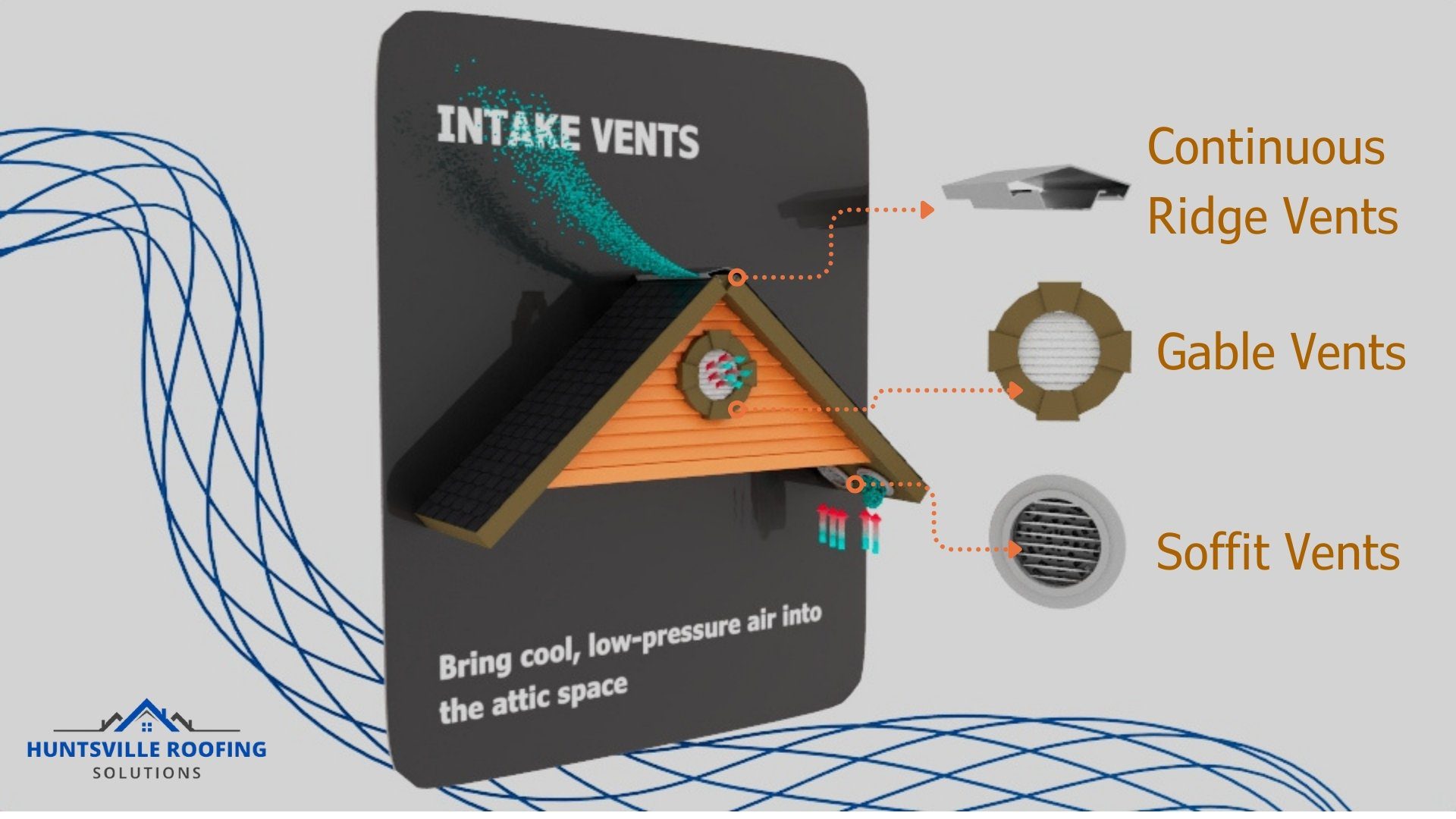
In a typical vented attic, air enters low near the eaves and exits high near the ridge. The exhaust opening should generally not exceed the available intake, otherwise the ridge may not receive enough replacement air. Vent manufacturers specify net free area (NFA), the open area through which air can move, rather than the external dimensions of a grille. Paint, insulation, dust, or poorly cut slots can reduce actual free airflow even when vents look plentiful.
An illustrative ventilation calculation
For an attic with 1,200 square feet of floor area, a 1:300 design basis represents 4 square feet—576 square inches—of total net free ventilation area, ideally divided about equally: approximately 288 square inches intake and 288 exhaust. This is an example, not a certified design for a particular house. Other code provisions can call for a 1:150 ratio, which doubles the total requirement. Product NFA, climate-control design, vapor control, and local adoption must all be checked.
How to spot blocked soffit vents
Common obstacles include insulation pushed into the eaves, missing baffles, painted-over vent holes, and soffit panels that do not connect to a clear rafter channel. A homeowner may notice little visible intake under the overhang even though a ridge vent is present above. An attic inspection can check for proper baffles without damaging insulation. Do not cut new openings or remove protective screens before confirming the roof and attic ventilation design.
Why adding more ridge vents may make things worse
More exhaust without matching intake can worsen imbalance. Mixing exhaust types—such as an operating power fan with continuous ridge venting—can alter airflow patterns and may pull air from unintended openings. Roof design also matters: a short ridge, multiple isolated attic zones, or cathedral ceilings may need a different solution. The contractor should show the NFA calculation and explain how air reaches each roof cavity.
What North Alabama humidity adds to the discussion
Ventilation can help manage heat and moisture in properly designed vented attics, but it cannot substitute for sealing warm, moist indoor air leaks or routing bathroom exhaust outdoors. If staining or mold is present, test whether the source is rain entry, condensation, or both. A hot attic on a summer afternoon is normal to some degree; comfort concerns also depend on the ceiling air barrier and insulation, not just roof vents.
What to request from the roofing contractor
Ask for a diagram of the intake and exhaust locations, the roof area being ventilated, the NFA for each vent product, and photos of any blocked eave paths. The recommendation should state whether the attic is meant to be vented; conditioned or unvented assemblies follow different rules. Keep the measurement sheet with the roof records. Avoid paying to replace a ridge vent merely because the attic feels warm without testing the intake side first.
Further reading and next steps
For the related decisions and roofing components, these published Huntsville Roofing Solutions guides offer additional context:
- existing ridge versus box vent comparison
- attic ventilation and shingle lifespan
- attic insulation and roofing relationship
- roof ventilation-related moisture symptoms
Industry reference: GAF balanced ventilation calculator. Confirm product-specific instructions and applicable local requirements before making changes.
Huntsville Roofing Solutions serves Huntsville and surrounding North Alabama communities. An educational article cannot diagnose a particular roof without inspection; a repair recommendation should be supported by observed conditions, appropriate materials, and a written scope.

Jordan is the founder and owner of Huntsville Roofing Solutions, a locally owned, fully licensed and insured roofing company serving Huntsville and North Alabama. He and roofing supervisor Barry Minor have handled residential and commercial roofs across the region — replacements, repairs, storm damage, and insurance claims — earning a 4.9-star Google rating along the way.