

Homeowners often think of attic insulation as an energy-bill issue and roofing as a weatherproofing issue.
They are different jobs, but the systems meet at the attic.
The shingles sit above the roof deck. The roof deck sits above the attic. The attic may contain insulation, ventilation, ductwork, wiring and sources of indoor air leakage.
That means changing one part without understanding the others can produce unexpected results.
What Does Attic Insulation Actually Do?
Insulation slows the transfer of heat.
Its thermal resistance is expressed as an R-value. In general, a higher R-value means greater resistance to heat flowing through that insulation layer.
During a North Alabama summer, the roof becomes hot under solar exposure. That heat moves through the roof assembly and contributes to high attic temperatures. Insulation at the attic floor helps reduce how much of that heat reaches the conditioned rooms below.
During cooler weather, the direction reverses. Insulation slows heat from escaping out of the living space and into the attic.
What insulation does not do by itself is manage every air and moisture pathway in the roof.
You can have a thick layer of insulation and still have problems if:
- Warm, humid indoor air is leaking around ceiling penetrations.
- Bathroom exhaust is terminating inside the attic.
- Soffit vents are buried beneath insulation.
- The roof is actively leaking.
- Insulation has become wet or compressed.
- The attic was designed as an unvented assembly but has been altered incorrectly.
That is why insulation should be viewed as one part of the roof-and-attic system rather than a stand-alone fix.
Where Should Attic Insulation Be Installed?
The answer depends on whether the attic is designed to be vented or unvented/conditioned.
Conventional Vented Attic
In a traditional vented attic, the insulation is usually installed at the attic floor—directly above the ceiling of the conditioned rooms.
This keeps the living space inside the thermal boundary while leaving the attic itself outside the conditioned envelope.
Outdoor air is then intentionally allowed to move through the attic using properly designed intake and exhaust ventilation.
The insulation and ventilation therefore have separate jobs:
- Insulation slows heat transfer between the home and attic.
- Air sealing limits uncontrolled air leakage through the ceiling plane.
- Ventilation manages airflow through the attic where the assembly is designed to be vented.
Unvented or Conditioned Attic
In an intentionally unvented attic, the thermal and air-control layers are commonly moved from the attic floor to the roofline.
That can mean insulation is installed directly beneath the roof deck, above the roof deck, or in a designed combination depending on the assembly.
Spray foam is one method commonly associated with this type of attic, but simply spraying foam onto the underside of a roof does not automatically make every assembly correct.
Moisture control, insulation type, air permeability, HVAC conditions and applicable construction requirements all need to work together.
A properly designed unvented attic is therefore very different from a conventional vented attic where someone accidentally covered all of the soffit vents with insulation.
How Does Attic Insulation Affect the Roof Deck?
The roof deck is the wood sheathing beneath the roofing system.
Although insulation generally does not touch the roof deck in a traditional vented attic, conditions in the attic can still affect that wood.
Three mechanisms are especially important.
1. Heat Flow
Insulation reduces heat transfer between the living space and attic.
That can improve indoor comfort and reduce the cooling or heating load, but homeowners should be cautious about turning that into a simplistic roofing claim such as “more insulation always makes shingles last longer.”
Shingle temperature is influenced by many variables, including:
- Solar exposure.
- Roof orientation.
- Shingle color and reflectance.
- Outdoor temperature.
- Roof-deck construction.
- Attic design.
- Ventilation.
- Insulation placement.
Insulation matters, but it is not the only control.
2. Air Leakage
Insulation slows conductive heat flow, but many insulation materials do not automatically stop moving air.
Warm or humid air from the house can move through gaps around:
- Attic access panels.
- Electrical penetrations.
- Plumbing penetrations.
- Recessed fixtures where assemblies allow leakage.
- Partition walls and framing gaps.
- Duct penetrations.
If that air reaches surfaces cold enough for condensation, moisture can accumulate even though the attic contains plenty of insulation.
This is why attic-floor air sealing is an important companion to insulation in a conventional vented attic.
3. Moisture
Roof decking repeatedly exposed to excessive moisture can swell, stain, delaminate or deteriorate.
The source could be a roofing leak, condensation, indoor humidity, an exhaust duct, plumbing or another building issue.
The correct response is to find the source instead of assuming the insulation itself caused the damage.
If staining or biological growth is already present, the site’s guide to roof and attic moisture problems covers diagnosis and remediation in more detail.
Can Too Much Insulation Block Roof Ventilation?
Yes—if insulation is installed in the wrong place.
The issue is not necessarily excessive R-value. The problem is physically obstructing the airflow path that a vented attic depends on.
Many conventional attic systems take outside air in through soffit or eave vents near the bottom of the roof.
If loose-fill insulation is blown over those openings, or fiberglass batts are pushed tightly against the roof deck at the eaves, intake air may be reduced or blocked.
The house may still have a ridge vent or other exhaust vents near the top, but exhaust cannot perform properly without adequate intake.
This is why insulation baffles or ventilation chutes are commonly used where soffit airflow needs to pass from the eave into the attic without being buried by insulation.
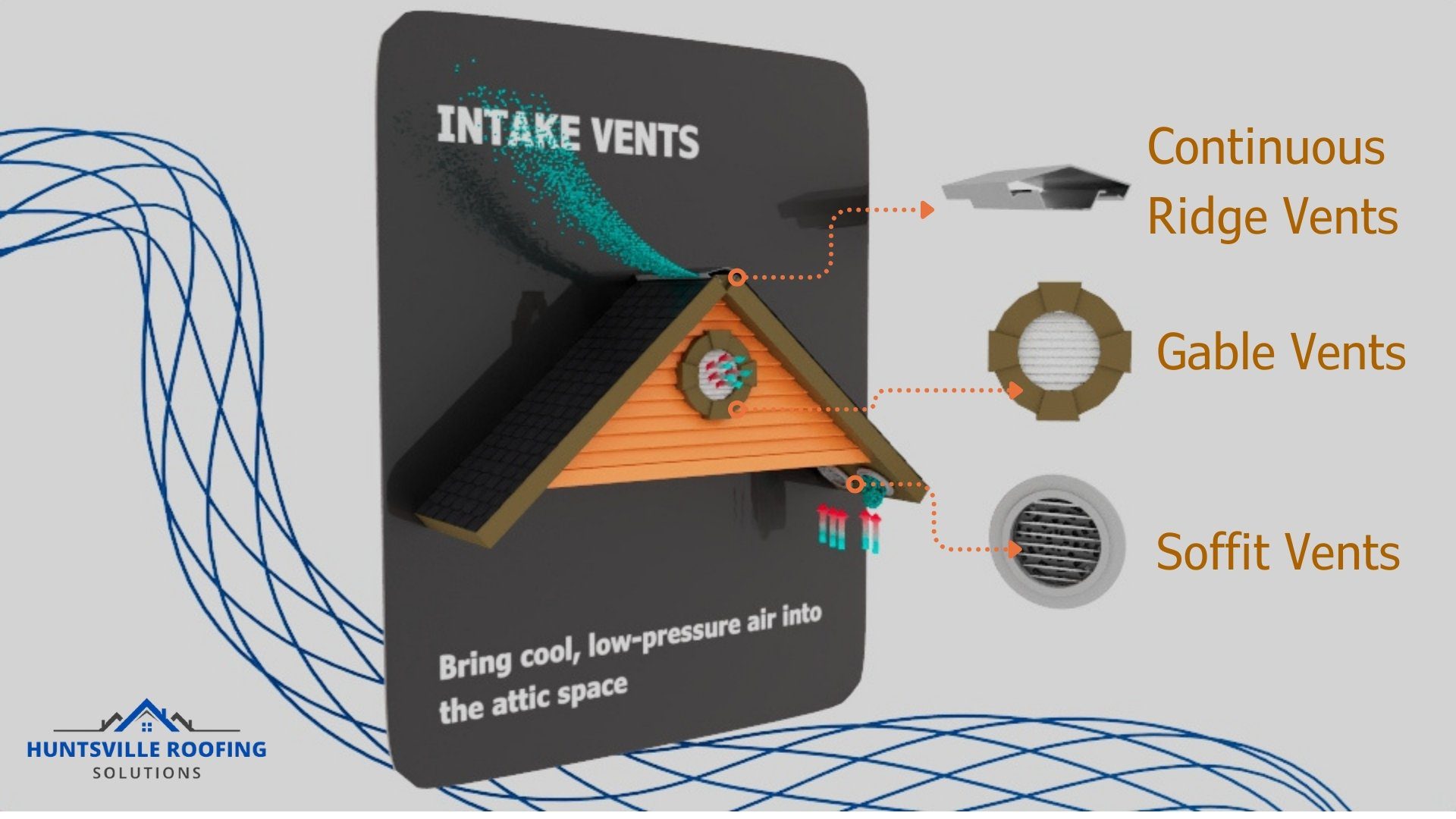
The detailed sizing and balance of that airflow belongs to the site’s guide on attic ventilation and shingle lifespan. The key insulation takeaway here is simpler: do not solve an insulation problem by creating a ventilation problem.
How Much Attic Insulation Makes Sense in North Alabama?
R-value recommendations depend on climate, existing insulation and the location of the thermal boundary.
As a useful benchmark, ENERGY STAR’s retrofit guidance for Climate Zone 3 lists:
- R-49 for an attic that is currently uninsulated.
- R-38 when the attic already has roughly 3 to 4 inches of insulation.
Those figures should be treated as retrofit guidance rather than a universal local code requirement.
The right specification for a particular North Alabama home may differ based on:
- The existing insulation type and depth.
- Whether the attic is vented or intentionally unvented.
- Current building-code requirements for the jurisdiction and project.
- Air sealing.
- Ceiling construction.
- HVAC equipment or ductwork in the attic.
- Moisture conditions.
- The planned renovation or reroofing scope.
The important point for a roofing article is that R-value is only one part of the interface.
An attic with a high nominal R-value can still perform poorly if the insulation is uneven, compressed, wet or displaced by airflow.
Does More Attic Insulation Keep the Roof Cooler?
Not in the simple way this question is often framed.
In a vented attic, attic-floor insulation primarily reduces heat transfer between the hot attic and the conditioned rooms below. It is not installed as a cooling layer directly beneath the shingles.
The temperature of the roof above is still driven heavily by sunlight, roofing color, outdoor conditions and the roof assembly itself.
Ventilation can influence the conditions beneath the roof deck, but that is a separate system function.
So if an upstairs room is uncomfortable, adding attic insulation may help reduce heat flow into the room, but it does not automatically prove the roof is overheating or that more roof vents are needed.
Likewise, a very hot attic on a summer afternoon is not by itself evidence that the roofing system has failed.
The correct diagnosis looks at insulation, air leakage, ductwork, ventilation and roof condition separately before deciding what needs to change.
What Happens When Attic Insulation Gets Wet?
Wet insulation is a symptom that deserves investigation.
Possible causes include:
- A roof leak.
- Condensation beneath the roof deck.
- A leaking plumbing line.
- An HVAC or duct condensation problem.
- A bathroom or kitchen exhaust duct terminating in the attic.
- Wind-driven rain entering through a roofing defect or vent.
Some insulation loses thermal effectiveness when wet or compressed. Persistent moisture can also affect nearby wood, drywall and framing.
The mistake is assuming that wet insulation automatically proves the roof covering is leaking.
A roofer can inspect the roof and roof deck for exterior water entry, but the full moisture path may involve building components beyond the roof itself.
If a roof leak is confirmed, the wet insulation should not simply be ignored after the exterior repair. The affected materials need to be evaluated and dried, restored or replaced as appropriate.
Attic-Floor Insulation vs Spray Foam at the Roof Deck
These two arrangements represent fundamentally different attic strategies.
| Feature | Conventional Vented Attic | Unvented / Conditioned Attic |
|---|---|---|
| Typical insulation location | Attic floor / ceiling plane | Roofline / rafter assembly |
| Attic relationship to conditioned space | Generally outside thermal envelope | Generally inside or closely connected to thermal envelope |
| Outdoor attic ventilation | Designed intake and exhaust | May intentionally have no conventional soffit/ridge ventilation |
| Main insulation concern | Air sealing, uniform coverage and keeping intake paths open | Correct roofline insulation and moisture-control design |
| Can you freely switch strategies? | No. Changing the thermal boundary changes how the assembly manages air, heat and moisture. | |
This is why a roofer should not automatically cut a new ridge vent into every house with spray foam beneath the deck.
Likewise, an insulation contractor should not close the soffit intake of a conventional vented attic without understanding how the roof was designed to ventilate.
The assembly needs to be identified before it is modified.
Can Poor Attic Insulation Shorten Roof Life?
It can contribute to conditions that are unfavorable to the roof, but insulation should not be treated as a single-variable lifespan calculator.
A roof’s actual service life also depends on:
- Shingle quality.
- Installation workmanship.
- Storm exposure.
- Roof orientation.
- UV exposure.
- Flashing.
- Decking condition.
- Ventilation where applicable.
- Moisture control.
- Ongoing maintenance.
Insulation matters most when it affects one of those broader conditions—for example, when it blocks soffit intake, becomes persistently wet or fails to separate the conditioned space effectively from a vented attic.
That is different from promising that upgrading from one R-value to another will add a specific number of years to the shingles.
For broader material-life expectations, see how long roofs last in Alabama.
What Should Be Checked Before a Roof Replacement?
A full reroof is a useful time to evaluate the insulation/roof interface because the project exposes parts of the system that are normally hidden.
Before or during replacement, the contractor should understand:
- Whether the attic is vented or intentionally unvented.
- Where the thermal boundary is located.
- Whether soffit or eave intake is blocked by insulation.
- Whether ventilation baffles are present and intact where needed.
- Whether accessible roof decking shows staining, moisture damage, softness or delamination.
- Whether insulation is wet, compressed or badly displaced.
- Whether bathroom or other exhaust ducts terminate inside the attic.
- Whether spray foam is installed against the roof deck.
- Whether existing roof vents match the intended attic design.
Removing the old shingles also gives direct access to the upper surface of the roof deck.
If plywood or OSB is deteriorated, a new roof should not simply cover it and hope the problem disappears.
At the same time, insulation deficiencies do not mean the roofing contractor should automatically prescribe an insulation package outside the roofer’s expertise. The correct solution may require coordination with an insulation, energy or HVAC professional depending on what is found.
For the roofing side of that project, the residential roof replacement process explains how the deck and complete roof system should be evaluated before new roofing covers them again.
What Are Warning Signs at the Attic Insulation and Roof Interface?
No single symptom proves that attic insulation is harming the roof, but these conditions justify a closer look:
- Insulation packed tightly against soffit vents.
- No visible ventilation baffles where soffit intake should be present.
- Wet, matted or compressed insulation.
- Dark staining on the underside of roof sheathing.
- Condensation on nails or other attic surfaces.
- Bathroom exhaust ducts releasing into the attic.
- Significant gaps around attic penetrations and access openings.
- Soft, swollen or delaminated roof decking.
- An attic that was spray-foamed without a clear understanding of how ventilation was altered.
- A new ridge vent paired with intake vents that remain blocked.
Some of these are insulation problems. Some are roofing problems. Some are ventilation or air-sealing problems.
A useful inspection distinguishes between them instead of attributing every attic symptom to one cause.
The Bottom Line
Attic insulation and your roof interact through heat, air and moisture, but the relationship depends on how the attic was designed.
In a conventional vented attic, insulation normally belongs at the attic floor, air leaks through the ceiling should be controlled, and soffit-to-exhaust airflow should remain unobstructed.
In an intentionally conditioned or unvented attic, the insulation and air-control layers may move to the roofline, creating a different roof assembly that should not be treated like a conventional vented attic.
More insulation is therefore not automatically better if it is installed in the wrong location, blocks ventilation or hides an unresolved moisture problem.
Likewise, insulation alone cannot repair worn shingles, stop a roof leak or restore damaged decking.
For North Alabama homeowners preparing for a reroof, the useful question is not simply, “How much insulation do I have?” It is: Where is the thermal boundary, is the insulation dry and continuous, can the roof assembly manage moisture properly, and will the new roofing system preserve the intended attic design?
Frequently Asked Questions About Attic Insulation and Roofs
Does attic insulation affect the roof?
Yes. Attic insulation changes heat flow between the conditioned rooms and the attic, and its placement can affect ventilation and moisture conditions around the roof deck. It is one component of the complete roof-and-attic assembly rather than a direct substitute for roofing or ventilation.
Should attic insulation touch the roof deck?
In a conventional vented attic, insulation is typically located at the attic floor rather than packed against the roof deck, and intended ventilation paths should remain open. In a properly designed unvented attic, insulation may intentionally be installed at the roofline. The correct arrangement depends on the attic design.
Can attic insulation block soffit vents?
Yes. Loose-fill insulation or batts can obstruct soffit or eave intake if they are installed without maintaining the designed airflow path. Baffles or ventilation chutes are commonly used to keep that pathway open in vented attics.
What R-value should a North Alabama attic have?
ENERGY STAR retrofit guidance for Climate Zone 3 lists R-49 for an uninsulated attic and R-38 where roughly 3 to 4 inches of insulation already exists. Those are retrofit guidance values, not a substitute for checking current local requirements and the design of the individual home.
Does more attic insulation make shingles last longer?
There is no reliable fixed number of extra shingle years created by adding insulation. Correct insulation can improve the overall attic environment, but shingle lifespan also depends on installation, product quality, ventilation, roof orientation, moisture, storms, flashing, decking and maintenance.
Can wet attic insulation mean the roof is leaking?
It can, but a roof leak is only one possibility. Condensation, plumbing, HVAC issues, improperly terminated exhaust ducts and other moisture sources can also wet attic insulation. The moisture source should be identified before assuming the roof covering is responsible.
Does a spray-foam attic need roof vents?
Not automatically. A correctly designed unvented or conditioned attic may intentionally have no conventional soffit and ridge ventilation. Adding roof vents without understanding the insulation and moisture-control design can create problems rather than solve them.
About the author: Jordan Woolf is the founder and owner of Huntsville Roofing Solutions, a locally owned roofing company serving Huntsville and North Alabama with residential and commercial roof replacement, repair, storm-damage and maintenance services.

Jordan is the founder and owner of Huntsville Roofing Solutions, a locally owned, fully licensed and insured roofing company serving Huntsville and North Alabama. He and roofing supervisor Barry Minor have handled residential and commercial roofs across the region — replacements, repairs, storm damage, and insurance claims — earning a 4.9-star Google rating along the way.