
The most common roof mold causes are persistent moisture from roof leaks, attic condensation, high indoor humidity, blocked ventilation, or exhaust fans releasing damp air into the attic. Mold does not automatically mean the entire roof needs replacement. The correct response is to identify and stop the moisture source first, inspect the roof decking and surrounding materials for deterioration, dry the affected area, and then clean, remediate, or replace damaged materials as appropriate. In North Alabama, humidity and heavy rainfall can allow small moisture problems to remain hidden long enough for mold, wet insulation, and wood deterioration to develop before homeowners notice obvious interior damage.

Is It Really Mold on Your Roof?
Before deciding how to fix a roof mold problem, it is important to identify what type of growth or moisture problem you are actually seeing.
Homeowners often use the word “mold” to describe several different conditions.
Attic or roof-deck mold is fungal growth that develops on damp materials inside the roof assembly. It may appear on plywood or OSB decking, rafters, framing, insulation, drywall, or other materials where moisture remains long enough to support growth.
Black streaks on asphalt shingles are often algae rather than mold. In humid climates, dark streaking frequently develops on shaded or north-facing roof slopes that dry more slowly.
Moss is different again. Moss can retain water around shingles and grow around their edges, which can create additional roofing concerns.
All three conditions involve moisture, but they should not automatically receive the same diagnosis or treatment.
For a broader explanation of exterior algae, moss, humidity, and moisture exposure, see our guide to how Tennessee Valley humidity affects roofs.
What Causes Roof Mold?
Mold requires moisture. Spores are common in indoor and outdoor environments, but a persistent mold problem generally develops when building materials stay damp long enough to support growth.
When mold appears around an attic or roofing system, the moisture usually comes from one or more of the following sources.
1. A Slow Roof Leak
A roof leak does not have to create water dripping from the ceiling.
Water may enter around damaged shingles, flashing, valleys, pipe boots, chimneys, skylights, vents, fasteners, or other roof penetrations. From there, it can wet roof decking, insulation, and framing without immediately reaching the finished ceiling below.
A small amount of water entering repeatedly can be more difficult to detect than one major leak because the materials may partially dry between storms.
Over time, however, repeated wetting can create conditions that support mold and eventually damage wood-based roof materials.
If the moisture appears primarily during severe weather, see our guide explaining why a roof may leak only during heavy rain.
2. Attic Condensation
Not every wet roof deck is leaking from outdoors.
Warm, humid air from inside the house can enter an attic through ceiling gaps, attic access openings, recessed fixtures, wiring penetrations, duct penetrations, and other air leaks.
When moisture-laden air contacts a cooler surface, condensation can form.
That surface might be the underside of the roof deck, metal fasteners, air-conditioning ducts, or other attic components.
If condensation happens repeatedly, the surrounding materials may remain damp long enough for mold to develop.
This distinction is important because replacing perfectly functional shingles will not solve mold caused primarily by uncontrolled indoor moisture or condensation.
3. Poor or Blocked Attic Ventilation
In a conventional vented attic, airflow helps remove heat and moisture.
Problems can occur when soffit vents are blocked by insulation, intake ventilation is insufficient, exhaust ventilation is poorly configured, or vents have been added without considering how the complete attic system functions.
Poor airflow can allow moisture to remain inside the attic longer than intended.
Ventilation should not, however, be treated as a universal cure for mold.
If the roof is leaking, the leak still needs repair. If a bathroom fan is exhausting into the attic, the fan still needs to be redirected outdoors. If humid indoor air is entering through significant ceiling leaks, the air-control problem also needs attention.
For a detailed explanation of intake, exhaust, and roof performance, see our article on how attic ventilation affects shingle lifespan.
4. Bathroom or Exhaust Fans Terminating in the Attic
A bathroom exhaust fan that releases air directly into an attic can create a significant moisture problem.
Showers generate large amounts of warm, humid air. If that moisture is intentionally discharged beneath the roof deck instead of outdoors, repeated use can wet nearby insulation, rafters, and decking.
Kitchen exhaust systems and clothes dryers can create similar problems if they are improperly terminated.
When mold is discovered in an attic, checking where exhaust ducts actually terminate should be part of the diagnosis.
Cleaning visible mold without correcting the exhaust problem leaves the moisture source in place.
What Are the Signs of Roof Mold and Moisture Problems?
Some moisture problems are visible from inside the living space, while others are discovered only after entering the attic.
Common warning signs include:
- A persistent musty odor in the attic or upper floor.
- Dark, spotted, fuzzy, or discolored areas on roof decking or framing.
- Recurring brown or yellow stains on ceilings.
- Wet, compressed, or matted attic insulation.
- Water staining beneath roof penetrations.
- Condensation around roofing nails, metal ducts, or other attic surfaces.
- Soft, swollen, deteriorated, or delaminated roof decking.
- Repeated leaks in the same portion of the house.
- Bathroom or kitchen exhaust ducts terminating inside the attic.
- Blocked soffit ventilation or insulation pushed against ventilation openings.
No single symptom proves that the roof covering itself is responsible.
For example, an old water stain may remain visible after a previous leak has already been repaired. Condensation can also wet decking even when the shingles above are functioning correctly.
The purpose of an inspection should therefore be to locate the active moisture source rather than simply identify discoloration.
Can You Identify Mold by Its Color?
Color alone is not a reliable way to determine the species of mold or the seriousness of a building problem.
Mold can appear black, gray, white, green, brown, or in other colors depending on the material, environmental conditions, and organisms present.
The practical roofing question is usually not, “What color is this mold?”
The more useful question is:
Why did this material stay wet long enough for biological growth to develop?
Correcting the moisture source is fundamental to preventing the problem from returning.
Does Mold Mean the Roof Deck Is Rotten?
No.
This is an important distinction because mold growth and structural deterioration are related to moisture but are not the same condition.
Finding mold or dark staining on plywood does not automatically mean the decking has lost its structural integrity.
A roofing inspection should evaluate whether the wood is still firm, properly bonded, and capable of providing a sound fastening surface.
Warning signs of more serious decking deterioration can include softness, rot, severe swelling, delamination, sagging, or material that no longer holds roofing fasteners properly.
Small sections of damaged decking may sometimes be replaced during a localized repair.
Widespread deterioration is different because the roofing material may need to be removed across a larger area to reach and replace the damaged substrate.
Can Roof Mold Develop Before You See a Ceiling Leak?
Yes.
A slow roof leak can affect decking, framing, or insulation well before enough water reaches the finished ceiling to produce an obvious stain.
Water also does not always travel straight down from the entry point.
It may follow roof decking, framing members, nails, pipes, insulation, or other surfaces before becoming visible.
This is why the location of an interior stain does not always identify the exact location where water entered the roof.
If you notice early moisture symptoms but are unsure whether the condition is still localized, our guide to signs a Huntsville roof may need repair explains when isolated roofing defects are still likely to fall within repair territory.
How Should Roof Mold Be Remediated?
Effective roof mold remediation requires more than cleaning what is visible.
The moisture source has to be corrected first, or the conditions that allowed mold to grow can return. The U.S. Environmental Protection Agency’s mold and moisture guidance emphasizes that moisture control is central to mold prevention and recommends drying wet or water-damaged materials within approximately 24 to 48 hours when possible.
A practical process generally follows this sequence:
- Locate the moisture source. Determine whether moisture is coming from a roof leak, condensation, plumbing, ductwork, indoor humidity, blocked ventilation, improperly terminated exhaust, or another source.
- Stop the moisture. Repair the roofing defect, redirect exhaust outdoors, correct the condensation problem, improve the relevant airflow, or resolve the underlying source.
- Determine how much material is affected. The visible mold may not represent the full area that became wet.
- Inspect the condition of the materials. Determine whether decking, insulation, framing, or drywall remains serviceable or has physically deteriorated.
- Clean or remediate appropriate materials. The appropriate method depends on the material and extent of the contamination.
- Remove materials that cannot be adequately restored. Rotten or severely deteriorated decking should not remain simply because surface staining can be cleaned.
- Dry the assembly. Materials need to return to appropriate moisture conditions before the project is considered complete.
- Confirm the original cause has been corrected. A clean attic with an active leak is not a successful remediation.
The EPA also provides specific residential mold cleanup guidance. Its guidance notes that homeowners can sometimes handle relatively small areas themselves, while larger areas, substantial water damage, or more complicated contamination may require professional assistance.
When Should You Avoid Cleaning Mold Yourself?
Mold cleanup is not appropriate for every homeowner or every situation.
The Centers for Disease Control and Prevention’s mold cleanup guidance advises additional caution for people who may be more vulnerable to mold exposure, including those with certain respiratory conditions or weakened immune systems.
Professional assistance is also more appropriate when mold growth is widespread, substantial water damage is present, contaminated water is involved, structural materials appear damaged, the source cannot be identified, or safe access to the attic or roof is difficult.
Attics present additional hazards because insulation can conceal ceiling joists and unsafe walking areas, roofing nails can protrude through decking, electrical wiring may be present, and temperatures can become extreme.
For roofing-related mold, there is another important limitation: cleaning the visible growth does not repair a leaking roof, damaged flashing, deteriorated decking, or a moisture-management problem.
The roofing source still needs to be diagnosed separately.
Should Moldy Roof Decking Be Cleaned or Replaced?
The answer depends on the physical condition of the wood.
Surface mold or staining on structurally sound decking does not automatically require every affected sheet to be removed.
However, cleaning should never be used to disguise structural damage.
Roof decking may need replacement when inspection finds:
- Rot or significant decay.
- Soft or spongy sections.
- Severe OSB or plywood delamination.
- Loss of structural integrity.
- Widespread moisture deterioration.
- Sagging or deformation.
- Material that can no longer securely hold roofing fasteners.
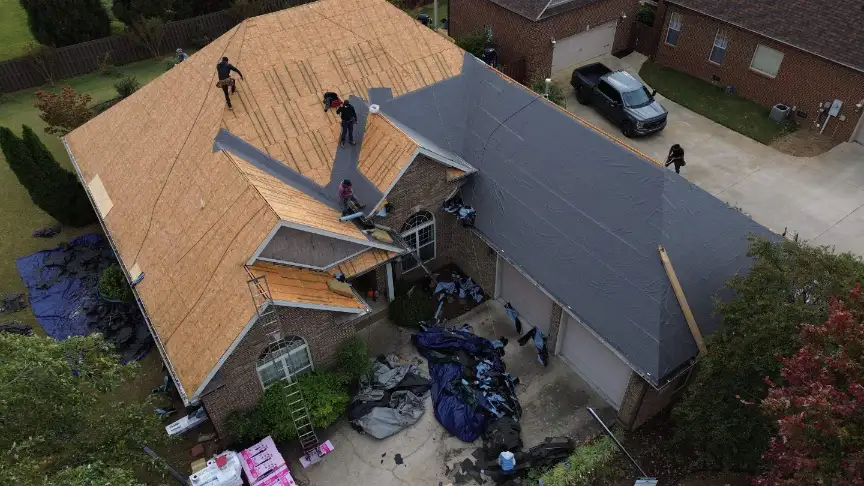
During roof replacement, removal of the old roofing material gives the contractor direct access to the decking.
That makes replacement an important opportunity to inspect the substrate rather than covering questionable material with a new roof.
If moisture damage is widespread across an aging roof, our roof replacement service in Huntsville explains the broader replacement process.
Does Mold Automatically Mean You Need a New Roof?
No.
Mold is evidence that unwanted moisture has been present. It is not automatically evidence that every roofing component has failed.
Consider two very different situations.
A relatively young roof may have one damaged pipe boot. The leak affects a small section of decking, and the surrounding shingles remain in good condition. The correct solution might involve repairing the penetration, addressing the affected material, and restoring the localized area.
Another home may have an aging roof with recurring leaks on multiple slopes, deteriorated decking in several areas, brittle shingles, and repeated unsuccessful repairs.
In the second situation, replacement becomes much more reasonable because the mold is only one symptom of a larger roofing-system problem.
If you are deciding between these two scopes, see our roof repair or replacement decision guide.
Can You Paint Over Roof Mold or Ceiling Stains?
Painting over mold or water staining does not solve the underlying moisture problem.
Interior paint may temporarily hide a ceiling stain, but the evidence can return if water is still entering through the roof or condensation continues above the ceiling.
The correct order is:
- Find the moisture source.
- Stop the water or condensation problem.
- Dry and remediate the affected materials.
- Repair damaged building materials.
- Complete cosmetic restoration last.
Skipping the first steps can hide useful evidence while allowing deterioration to continue out of sight.
Can Roof Mold Come Back After Remediation?
Yes, particularly when the moisture source was never fully corrected.
Cleaning removes existing contamination from appropriate surfaces, but it does not change the environmental condition that caused the growth.
If a flashing defect still allows rainwater into the attic, the material can become wet again.
If a bathroom fan continues exhausting into the attic, it continues adding moisture.
If insulation continues blocking soffit intake or significant humid air is leaking through the ceiling, the attic can return to the same moisture conditions.
A lasting solution therefore depends on moisture control as much as visible cleanup.
What Should a Roof Inspection Check When Mold Is Found?
A useful inspection should do more than confirm that dark discoloration exists.
On the exterior roof, the inspection should consider potential water-entry locations such as:
- Damaged or missing shingles.
- Roof valleys.
- Step flashing.
- Chimney flashing.
- Pipe boots.
- Roof vents.
- Skylights.
- Roof-to-wall transitions.
- Other penetrations.
- Drainage and gutter conditions.
Inside the attic, the inspection should consider:
- Whether mold or staining is localized or widespread.
- Whether insulation is wet or compressed.
- Whether the roof deck remains structurally sound.
- Whether rafters or framing show moisture deterioration.
- Whether bathroom and kitchen exhaust ducts terminate outdoors.
- Whether soffit intake ventilation is obstructed.
- Whether condensation is visible on ducts, fasteners, or decking.
- Whether staining corresponds with a penetration or known leak.
- Whether earlier roof repairs are failing.
The useful outcome should not simply be:
“There is mold.”
The inspection should explain:
Where did the moisture come from? Is it still active? What materials have been affected? Which materials can remain? Which need remediation? Which need replacement?
Why Roof Mold Is Different From Exterior Algae and Moss
Black staining on the outside of a roof is frequently described as “mold,” but that description can be misleading.
Dark streaking on asphalt shingles in humid areas is commonly associated with algae. Moss is another separate biological growth that can hold moisture around shingles.
Those conditions can still deserve attention, but they should not be used as automatic evidence that mold is growing inside the attic or that the roof deck is structurally damaged.
This distinction is especially important in North Alabama, where humidity and shaded roof slopes can make exterior biological growth common.
Diagnosing the correct condition helps prevent homeowners from being sold a structural repair or roof replacement based only on an exterior stain.
Why North Alabama Homes Need Moisture Diagnosis, Not Mold Scare Tactics
Huntsville and the surrounding Tennessee Valley experience high humidity, heavy rainfall, severe thunderstorms, hot summers, and substantial tree cover in many neighborhoods.
Those conditions make roof moisture management important.
They do not mean every dark attic area requires a new roof.
One home may have a localized flashing defect.
Another may have a bathroom fan exhausting into the attic.
A third may have insulation blocking soffit vents.
Another may genuinely have an aging roofing system that has allowed repeated water intrusion across several areas of decking.
The symptoms may initially look similar, but the correct scopes of work are very different.
Homeowners should therefore be cautious of anyone who moves immediately from “we found mold” to “you need a complete roof replacement” without showing where the moisture entered and what condition the roofing materials and decking are actually in.
When Does Roof Mold Point Toward Roof Replacement?
Replacement becomes more appropriate when mold appears alongside broader evidence of roofing-system failure.
Examples include:
- Widespread deteriorated roof decking.
- Soft decking in multiple locations.
- Recurring leaks across several roof planes.
- Repeated repairs that continue to fail.
- Extensive water intrusion beneath an aging roofing system.
- Brittle or severely deteriorated shingles combined with substrate damage.
- Large areas of decking that cannot be addressed without removing substantial sections of the roof.
Conversely, a sound roof with one localized leak and a small affected section may remain a repair-and-remediation project.
The presence of mold should start the investigation. It should not predetermine the answer.
If the roof and decking are deteriorated across a larger area, a complete residential roof replacement in Huntsville may provide access to the substrate and allow the damaged components to be corrected before the new roofing system is installed.
The Bottom Line
Roof mold is usually a moisture symptom before it is a roofing diagnosis.
The most important step is determining why the affected material stayed wet.
Roof leaks, attic condensation, indoor humidity, blocked airflow, improperly terminated exhaust fans, and wet insulation can all contribute to mold around an attic or roof deck.
Cleaning visible mold without stopping the moisture source is unlikely to provide a lasting solution.
At the same time, finding mold does not automatically mean the entire roof must be replaced.
Structurally sound decking may sometimes remain after the underlying water problem is corrected and appropriate remediation is completed. Rotten, soft, delaminated, sagging, or widely deteriorated decking may need to be removed.
For North Alabama homeowners, the correct solution comes from following the moisture path through the entire roof assembly—from shingles and flashing above to the roof decking, ventilation, insulation, framing, and finished ceiling below.
Frequently Asked Questions About Roof Mold
What is the most common cause of roof mold?
Persistent moisture is the underlying cause. Around a roof or attic, that moisture may come from a roof leak, condensation, high indoor humidity, blocked ventilation, or a bathroom or other exhaust fan releasing humid air into the attic.
Is black staining on asphalt shingles mold?
Not necessarily. Dark exterior roof streaks in humid climates are commonly associated with algae, while moss is another separate type of growth. Actual mold is more commonly a concern on damp building materials such as roof decking, rafters, insulation, drywall, and other attic surfaces.
Does mold on roof decking mean the decking must be replaced?
No. Mold or staining does not automatically mean the wood has lost its structural integrity. Decking should be evaluated for rot, softness, swelling, delamination, sagging, deterioration, and its ability to provide a sound fastening surface. Structurally damaged material may need replacement.
Can a roof leak cause mold before I see a ceiling stain?
Yes. A slow leak can repeatedly wet roof decking, framing, or insulation before enough water travels into the living space to create an obvious ceiling stain.
Can poor attic ventilation cause mold?
Poor or blocked airflow can contribute to moisture remaining inside a conventional vented attic. However, the inspection should also look for roof leaks, indoor air leakage, excessive humidity, condensation, and improperly terminated exhaust fans instead of assuming ventilation is the only cause.
Will roof replacement eliminate attic mold?
Not automatically. Roof replacement can stop roofing-related leaks and allow deteriorated decking to be replaced, but mold caused by indoor humidity, condensation, air leakage, exhaust fans, or other moisture problems must also be corrected.
Can roof mold come back after it is cleaned?
Yes. If the roofing leak, condensation problem, humidity source, or ventilation problem remains, the materials can become damp again and mold can return. Successful remediation requires controlling the moisture source as well as addressing existing growth.

Jordan is the founder and owner of Huntsville Roofing Solutions, a locally owned, fully licensed and insured roofing company serving Huntsville and North Alabama. He and roofing supervisor Barry Minor have handled residential and commercial roofs across the region — replacements, repairs, storm damage, and insurance claims — earning a 4.9-star Google rating along the way.