
Attic ventilation can affect asphalt-shingle lifespan in the South because it helps control two conditions that contribute to roof-system aging: trapped heat and excess moisture. In a conventional vented attic, lower intake vents and upper exhaust vents move air beneath the roof deck, reducing heat buildup and giving moisture a path out. Poor airflow can contribute to roof-deck movement, shingle buckling, wood deterioration, wet insulation, and premature roofing-system problems. However, ventilation is not a guaranteed lifespan extender. Shingle quality, roof orientation, color, installation, storm exposure, and maintenance also influence how long a roof lasts.

Does Attic Ventilation Actually Make Shingles Last Longer?
Proper ventilation can help an asphalt-shingle roof reach its expected service life, but homeowners should be cautious of claims that ventilation automatically adds a fixed number of years.
The Asphalt Roofing Manufacturers Association describes ventilation as part of the complete asphalt roofing system. In a conventional vented attic, properly balanced intake and exhaust help lower attic temperatures and remove moisture that might otherwise accumulate beneath the roof deck.
That matters because shingles do not work independently of the structure beneath them. Changes in moisture can cause wood decking to expand, contract, or deteriorate. If the deck moves significantly, the shingles attached to it can buckle or become distorted.
Heat matters too, although the relationship is more nuanced than many roofing articles suggest.
Building-science research has found that asphalt shingles over unvented assemblies may operate only a few degrees warmer on average than shingles over well-ventilated assemblies. This means ventilation can influence roof performance, but shingle color, roof orientation, installation quality, moisture exposure, and other factors also affect service life.
That does not mean a poorly ventilated 25-year roof automatically becomes a 15- or 20-year roof. Real roofs are affected by several variables at the same time.
For broader lifespan expectations by roofing material, see our guide to how long roofs last in Alabama.
Why Attic Ventilation Matters in the South
Southern roofs spend long periods exposed to strong solar radiation, high outdoor temperatures, humidity, heavy rainfall, and rapid weather changes.
North Alabama adds another variable: severe thunderstorms and wind can expose weaknesses that already exist in aging shingles, flashing, fasteners, or decking.
Ventilation cannot stop sunlight from heating shingles or prevent storm damage. What it can do in a conventional vented attic is help control conditions underneath the roof deck.
That distinction matters.
A roof receives solar heat from above. Meanwhile, moisture can enter an attic from everyday household activities, air leakage, bathroom exhaust fans, ductwork, or other sources. When moisture cannot escape effectively, it can contribute to damp insulation, wood deterioration, mold growth, and dimensional movement in the decking.
For a deeper discussion of moisture rather than ventilation specifically, see how Tennessee Valley humidity affects roofs.
Heat Is Only Part of the Attic Ventilation Story
It is tempting to think of attic ventilation as simply a way to “cool the shingles from underneath.”
That explanation is incomplete.
Ventilation does help remove solar-heated attic air, but its other important job is moisture management. Asphalt shingles are installed over a roof deck, so protecting the stability and condition of that deck matters to the entire roofing assembly.
Excessive moisture fluctuations can contribute to swelling and shrinking of wood components. Over time, movement beneath the shingles can contribute to waviness or buckling.
Persistent moisture can also damage decking independently of the shingles themselves.
This is why an inspection should look at the whole roof assembly instead of judging ventilation only by how hot the attic feels on a summer afternoon.
Shingle temperature is also influenced by the surface above the attic. Darker shingles, roof orientation, tree cover, solar exposure, and reflective properties all play a role. We explain that separately in our guide to shingle colors under the Alabama sun.
What Does a Properly Ventilated Attic Look Like?
For a conventional vented attic, the basic principle is simple: air enters low and exits high.
Intake vents are normally positioned along the soffits, eaves, or lower portion of the roof. Exhaust is positioned near the upper portion of the roof, often through a continuous ridge vent or another properly designed exhaust system.
The two sides need to work together.
A house can have a large ridge vent and still be poorly ventilated if insulation is blocking its soffit vents. Likewise, adding more exhaust vents does not necessarily solve the problem if there is not enough intake air.
The goal is an unobstructed airflow path across the underside of the roof deck.
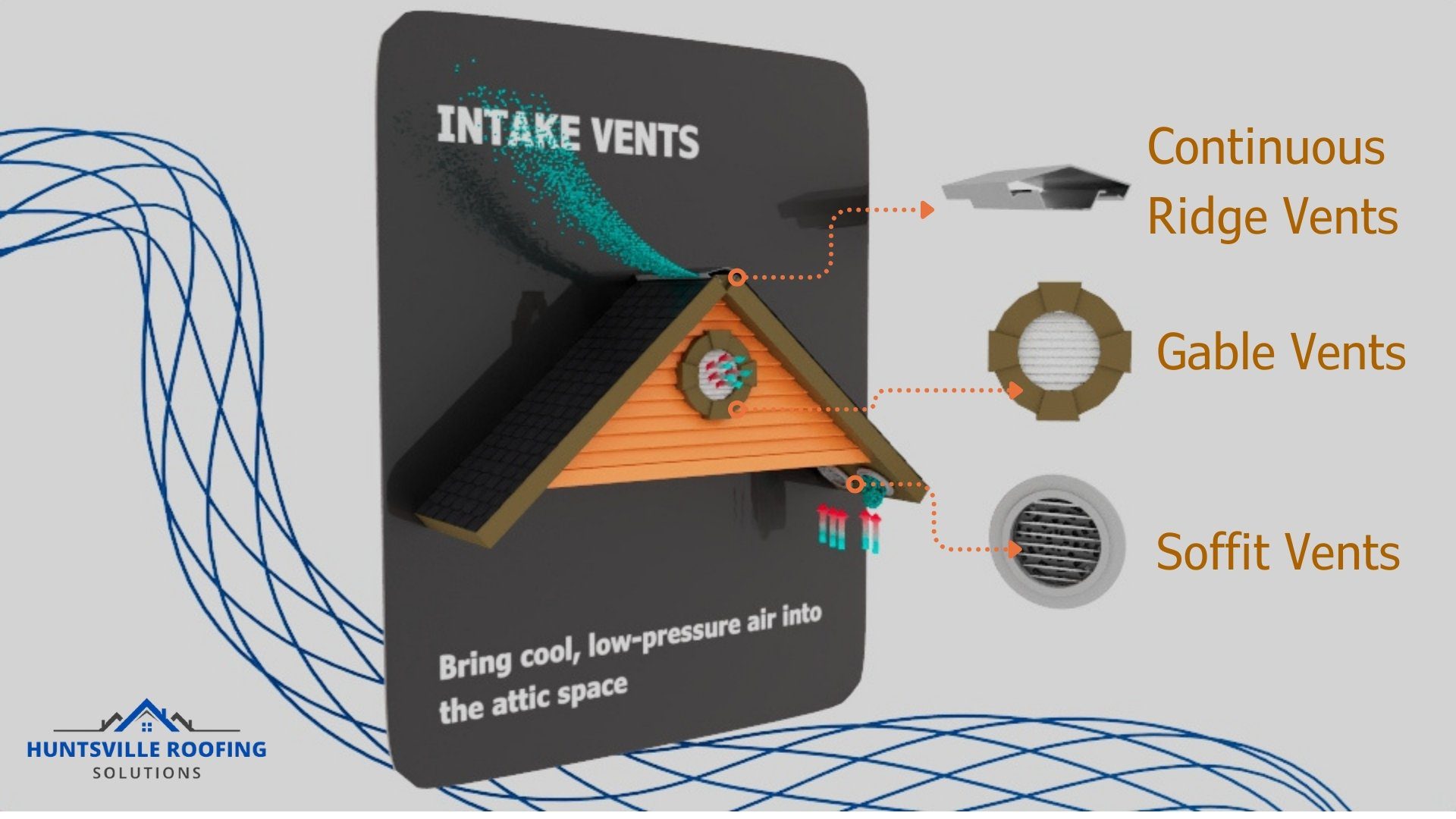
Industry guidance generally recommends a balanced system in which intake represents approximately half of the available vent area and exhaust represents the other half. Intake capacity should not be significantly lower than exhaust capacity.
Mixing several different exhaust systems over the same attic is not automatically better. For example, adding a powered roof fan to an existing ridge-vent system can sometimes interfere with the intended airflow pattern rather than improve it.
How Much Attic Ventilation Does a Roof Need?
Ventilation is measured by net free ventilation area, often shortened to NFA. This is the actual open area through which air can move, not simply the physical dimensions of the vent cover.
A commonly used baseline is approximately 1 square foot of net free ventilation area for every 150 square feet of attic floor area. Building codes may allow approximately 1:300 when specific conditions are satisfied.
For example, a 1,500-square-foot attic using an approved 1:300 design would require about 5 square feet, or 720 square inches, of total net free ventilation area. In a balanced design, that capacity would be divided approximately between lower intake and upper exhaust.
That calculation is only a starting point.
Roof geometry, enclosed rafter bays, cathedral ceilings, insulation placement, vent manufacturer requirements, local code, and whether the attic is intentionally conditioned can change the correct design.
This is why simply counting the number of roof vents from the driveway is not a reliable ventilation assessment.
What Are the Signs of Poor Attic Ventilation?
No single symptom proves that ventilation is the cause, but several conditions together justify a closer inspection:
- Soffit vents are covered by insulation, paint, debris, or stored materials.
- The attic has exhaust vents but little or no visible lower intake.
- Roof decking shows persistent staining, moisture damage, delamination, or unusual movement.
- Insulation is damp or there are repeated signs of condensation inside the attic.
- Bathroom exhaust fans discharge into the attic instead of outdoors.
- Shingles appear wavy or buckled and movement in the deck is suspected.
- Several different exhaust systems have been added without a documented ventilation plan.
A hot upstairs room or high cooling bill by itself is not proof of bad roof ventilation. Insulation, duct leakage, air sealing, HVAC sizing, glazing, and solar exposure can produce similar symptoms.
The same rule applies to shingles. Curling, granule loss, or brittleness should not automatically be blamed on the attic. Age, manufacturing, installation, UV exposure, color, orientation, storms, and previous repairs all need to be considered.
Is More Attic Ventilation Always Better?
No.
The objective is correct and balanced ventilation, not the largest possible number of vents.
Excess exhaust without adequate intake can change pressure relationships inside the attic. Instead of drawing outdoor air through the soffits, an exhaust vent may begin pulling air from another exhaust opening or from leaks between the home and attic.
The location of the vents also matters. Air should move through the attic rather than taking a short path between two nearby openings and leaving large areas poorly ventilated.
This is one reason a roof replacement is a good opportunity to evaluate ventilation as a system rather than automatically reinstalling whatever vents happened to be on the old roof.
What About Spray-Foamed or Conditioned Attics?
Not every Southern attic should be vented to the outdoors.
Modern homes can use intentionally unvented or conditioned attic assemblies. In these systems, insulation and the air-control layer are commonly moved to the roofline, and temperature and moisture are managed differently from a traditional vented attic.
A properly designed unvented attic is not the same thing as a conventional attic with blocked vents.
Adding soffit vents or cutting a ridge vent into a conditioned assembly without understanding how it was designed can create new moisture or energy problems.
If spray foam is installed against the roof deck, or HVAC equipment is located within a conditioned attic, the assembly should be evaluated before anyone recommends adding ventilation simply because the house is in Alabama.
What Should Be Checked When You Replace an Asphalt-Shingle Roof?
A roof replacement should evaluate more than the shingles that are being removed.
The contractor should determine whether the attic is intended to be vented or unvented and inspect the roof system for:
- Existing soffit or eave intake.
- Insulation blocking ventilation pathways.
- The type and location of existing exhaust vents.
- Available net free ventilation area where applicable.
- Moisture-related deterioration in accessible decking.
- Bathroom or other exhaust fans terminating inside the attic.
- Existing ridge, box, turbine, gable, or powered vent combinations.
If ridge ventilation is being installed, the available intake needs to be checked at the same time. A new ridge vent cannot compensate for soffits that are completely blocked.
Ventilation products installed within the roof field are also best evaluated while the old roofing is removed because the contractor can see the deck, vent openings, underlayment, and surrounding roofing components directly.
If your shingles are already near the end of their useful life, our roof replacement service in Huntsville explains what should be evaluated when replacing the full roofing system.
Can Fixing Attic Ventilation Restore Worn-Out Shingles?
No.
Improving ventilation can correct an underlying roof-system problem and help create better conditions going forward, but it cannot reverse physical deterioration that has already occurred.
Ventilation will not replace lost granules, make brittle asphalt flexible again, reseal cracked shingles, repair hail damage, or restore deteriorated roof decking.
This distinction is important because homeowners should not be sold a ventilation upgrade as a substitute for legitimate roof repair or replacement.
Likewise, an older roof should not automatically be replaced merely because its ventilation system could be improved. The shingles, decking, flashing, installation, storm history, and remaining service life should all be evaluated together.
How Important Is Ventilation Compared With Shingle Quality?
Think of attic ventilation as one component of a complete roofing system.
A properly ventilated attic cannot compensate for poorly installed shingles. Premium shingles cannot compensate for rotten decking. A strong roof deck cannot prevent premature problems if flashing is installed incorrectly.
Long roof life depends on the components working together.
For Southern asphalt roofs, major variables include:
- Shingle product and quality.
- Installation workmanship.
- Roof orientation and solar exposure.
- Attic design.
- Moisture control.
- Storm exposure.
- Roof maintenance.
- Flashing installation.
- Roof decking condition.
That is more useful than claiming one component determines exactly how many years the roof will last.
The Bottom Line
Attic ventilation can support longer asphalt-shingle service life in the South, particularly by controlling heat and moisture in a conventional vented attic and helping protect the roof deck beneath the shingles.
But ventilation should be treated as part of the roof system rather than a cure-all.
Balanced intake and exhaust matter more than simply adding vents. Blocked soffits can make a ridge vent ineffective. Excess exhaust can create its own airflow problems. And intentionally unvented or conditioned attics require a different approach entirely.
For North Alabama homeowners, the best time to evaluate the ventilation system is during a roof inspection and especially before a complete roof replacement in Huntsville. That allows the new shingles, decking, ventilation, flashing, and insulation interface to be considered together rather than as separate projects.
Frequently Asked Questions
Does attic ventilation really make asphalt shingles last longer?
It can help an asphalt roof reach its intended service life by reducing heat and moisture buildup and helping protect the roof deck. However, no fixed number of extra years can be promised because shingle quality, color, roof orientation, installation, storms, and maintenance also affect longevity.
Is a ridge vent enough without soffit vents?
Usually not in a conventional vented attic. A ridge vent is an exhaust component, so it needs adequate lower intake—commonly through soffit or eave vents—and a clear airflow path between the intake and exhaust.
Can an attic have too much exhaust ventilation?
Yes. More exhaust is not automatically better. If exhaust capacity substantially exceeds intake, the system can pull air from unintended openings or another exhaust vent. A balanced system with sufficient intake is the goal.
Does a spray-foamed attic need ridge vents?
Not automatically. A properly designed conditioned or unvented attic may intentionally have no outside attic ventilation. Before adding ridge or soffit vents, the insulation, air barrier, HVAC configuration, moisture-control strategy, and applicable code should be evaluated.

Jordan is the founder and owner of Huntsville Roofing Solutions, a locally owned, fully licensed and insured roofing company serving Huntsville and North Alabama. He and roofing supervisor Barry Minor have handled residential and commercial roofs across the region — replacements, repairs, storm damage, and insurance claims — earning a 4.9-star Google rating along the way.