
“`html
TPO vs. EPDM vs. PVC: Choosing a Flat Roof Membrane
When comparing TPO vs EPDM vs PVC, the best flat-roof membrane depends on the building rather than on one material being universally superior. TPO is a thermoplastic membrane commonly selected for reflective commercial roofs and uses heat-welded seams. EPDM is a thermoset synthetic rubber with a long performance history, high flexibility and taped or bonded seams. PVC is another heat-welded thermoplastic and can be especially useful when chemical exposure is an important design consideration. Building use, roof geometry, insulation, membrane thickness, drainage, rooftop traffic and installation quality should all influence the final choice.
For a typical commercial property in North Alabama, the decision should start with a question broader than “Which membrane costs less?”
What does this particular building require from its roof?
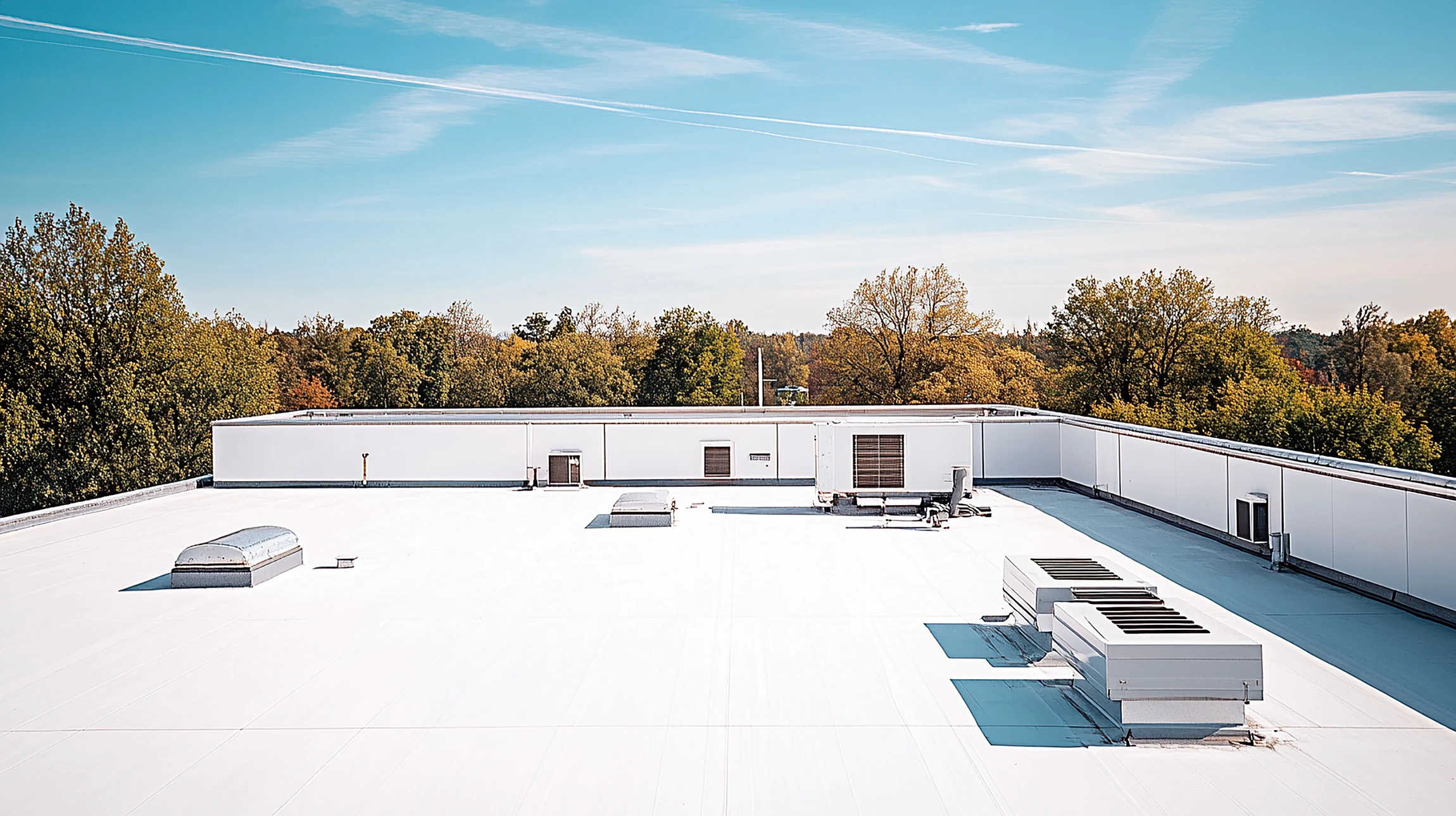
TPO vs EPDM vs PVC: Quick Comparison
| Feature | TPO | EPDM | PVC |
|---|---|---|---|
| Material type | Thermoplastic | Thermoset synthetic rubber | Thermoplastic |
| Field seams | Heat-welded | Typically taped or bonded | Heat-welded |
| Common roof color | White is common; other colors available | Traditionally black; white products also exist | White is common; other colors available |
| Reflective roof applications | Strong option with white membrane | Depends heavily on membrane color | Strong option with white membrane |
| Chemical exposure | Project-specific | Requires compatibility review | Often considered where greater chemical resistance is needed |
| Flexibility | Flexible thermoplastic | Highly flexible rubber membrane | Highly flexible thermoplastic |
| Common project fit | General commercial low-slope roofing | Projects valuing flexibility and proven rubber technology | General commercial plus selected chemical/grease-exposure environments |
This table is a starting point. The exact product, membrane thickness and roof assembly can change the comparison substantially.
What Is a Single-Ply Roof Membrane?
TPO, EPDM and PVC are all commonly grouped under single-ply roofing.
Single-ply systems use manufactured flexible sheets installed over a low-slope roof assembly. The membrane provides the primary waterproofing layer, but it is only one part of the roof.
A commercial roof may also include:
- Structural roof deck.
- Vapor or air-control layers where required.
- Thermal insulation.
- Tapered insulation for drainage.
- Cover board.
- Fasteners or adhesive.
- Membrane.
- Flashing and penetration details.
- Drains, scuppers and edge systems.
That matters because a premium membrane installed over wet insulation, inadequate drainage or a poorly designed substrate is still a poor roof system.

The Biggest Technical Difference: Thermoplastic vs Thermoset
The most important material distinction in a TPO vs EPDM comparison is how the membranes respond to heat.
TPO and PVC are thermoplastics.
The National Roofing Contractors Association’s roofing technical library explains that thermoplastic membrane material can be reactivated with heat, allowing adjacent sheets to be fused together.
That is why TPO and PVC field seams are normally joined with hot-air welding.
EPDM is different.
EPDM is a thermoset synthetic rubber. Once cured, it does not soften and re-form in the same way as a thermoplastic membrane.
Its field seams therefore typically use compatible primers, tapes or bonding products rather than hot-air welding.
What Is TPO Roofing?
TPO stands for thermoplastic polyolefin.
It is one of the most widely used single-ply membranes on commercial low-slope roofs.
TPO sheets contain reinforcement and are joined with heat-welded seams. Depending on the specified system, the membrane may be mechanically attached, fully adhered, induction-welded or installed using another manufacturer-approved assembly.
White is a common TPO color because the surface can provide high solar reflectance and emittance.
Where TPO Can Make Sense
TPO is worth considering when:
- The building has a conventional commercial low-slope roof.
- A reflective roof surface is desirable.
- Heat-welded seams are preferred.
- The owner wants a widely available commercial membrane system.
- The building does not have an unusual chemical exposure requiring a more specialized membrane.
- Available contractors have strong experience installing the proposed TPO system.
The existing Huntsville Roofing Solutions TPO roofing page covers the system itself in more detail. This comparison is intended to help decide whether TPO should be specified in the first place.
What TPO Does Not Solve
A TPO specification does not compensate for poor roof design.
Performance still depends on:
- Correct seam welding.
- Proper flashing details.
- Compatible accessories.
- Suitable membrane thickness.
- Correct attachment.
- Appropriate cover board where required.
- Drainage.
- Maintenance.
There are also different TPO formulations and products. Comparing “TPO” as if every sheet from every manufacturer were identical oversimplifies the decision.
What Is EPDM Roofing?
EPDM stands for ethylene propylene diene monomer.
It is a cured synthetic rubber membrane that has been used on low-slope roofing projects for decades.
Carlisle SynTec notes that EPDM has been used on low-slope roofing projects for more than 50 years.
Traditional EPDM is black, although white EPDM products are also manufactured.
Because EPDM is a thermoset rather than a thermoplastic, its seams are normally joined using compatible tapes and primers instead of hot-air welds.
Where EPDM Can Make Sense
EPDM may be worth evaluating when:
- A highly flexible rubber membrane suits the project.
- The roof design can take advantage of large membrane sheets and fewer field seams.
- The contractor has strong EPDM installation experience.
- A proven thermoset system is preferred.
- The proposed assembly and building use are compatible with the membrane.
Does Black EPDM Make Sense in Alabama?
It can.
It would be too simplistic to say that black EPDM should never be installed in Alabama merely because the climate has hot summers.
Black membrane absorbs more solar energy than a highly reflective white membrane, so roof-surface temperature and cooling demand deserve consideration.
But the roof’s thermal performance also depends heavily on:
- Insulation R-value.
- Building use.
- HVAC design.
- Air leakage.
- Roof assembly.
- Membrane color.
White EPDM products also exist.
The membrane decision should therefore be made from a building-level energy and roof-system perspective rather than using color alone.

What Is PVC Roofing?
PVC stands for polyvinyl chloride.
Like TPO, PVC is thermoplastic. Sheets can therefore be joined with heat-welded seams.
PVC membranes are commonly available in reflective light colors and are known for flexibility and weather resistance.
One of the most important reasons PVC enters a specification discussion is chemical exposure.
GAF describes its PVC membranes as providing increased chemical protection compared with other single-ply membrane technologies.
That does not mean every PVC product is immune to every chemical.
Exact compatibility still depends on:
- The chemical involved.
- Concentration.
- Frequency of exposure.
- Temperature.
- The particular PVC formulation.
- Manufacturer requirements.
- Warranty exclusions.
Where PVC Can Make Sense
PVC may deserve closer consideration for buildings where the roof can be exposed to grease, oils or other chemicals, including some:
- Restaurants.
- Food-processing buildings.
- Industrial facilities.
- Manufacturing operations.
- Buildings with specialized exhaust systems.
In more demanding environments, specialized PVC/KEE products may also be considered.
The correct step is to provide the roofing manufacturer with the actual expected exposure rather than simply specifying “PVC” and assuming compatibility.

TPO vs EPDM: Which Is Better?
Neither is automatically better.
The practical differences are more useful than a universal ranking.
| Consideration | TPO | EPDM |
|---|---|---|
| Membrane chemistry | Thermoplastic | Thermoset rubber |
| Seaming | Heat-welded | Taped / bonded |
| Typical color | White commonly specified | Traditionally black |
| Reflective roof option | Common | White EPDM exists, but black is traditional |
| Flexibility | Flexible | Highly elastic and flexible |
| History | Newer than EPDM but extensively used | Used commercially for more than five decades |
| Seam equipment | Hot-air welding equipment | Primers / seam tapes or approved bonding system |
For many conventional commercial buildings in Huntsville, TPO may be attractive because of its white reflective surface, welded seams and broad market availability.
EPDM remains a legitimate option when its flexibility, sheet configuration and proven thermoset performance better fit the project.
TPO vs PVC: What’s the Difference?
TPO and PVC can look similar from a distance.
Both may be white, both are single-ply membranes and both use heat-welded seams.
The important difference is their chemistry.
That chemistry affects characteristics such as flexibility, formulation and resistance to specific exposures.
A straightforward warehouse or office building may not need the same chemical resistance consideration as a restaurant with grease-laden exhaust or an industrial facility with process emissions.
This is why PVC should not simply be treated as “more expensive TPO,” and TPO should not be treated as “cheaper PVC.”
They are different membrane technologies.
EPDM vs PVC: Which One Fits the Building?
The difference becomes even clearer when comparing EPDM with PVC.
EPDM is rubber and uses bonded or taped seams.
PVC is thermoplastic and uses welded seams.
Traditional EPDM is dark. PVC is commonly specified in reflective white.
EPDM has strong flexibility and a long track record. PVC offers a different chemistry that can be advantageous where certain chemical exposures need to be addressed.
The building’s use may therefore be more important than deciding which material has the longest list of generic benefits.
What About Energy Efficiency in Alabama?
North Alabama experiences significant summer heat, so roof reflectivity can be relevant for many commercial properties.
White TPO and white PVC membranes can reflect a larger portion of incoming solar energy than a traditional black roof membrane.
This can reduce roof-surface temperature and may reduce cooling demand in some buildings.
However, energy savings are not guaranteed simply because the membrane is white.
The actual effect depends on factors including:
- Climate.
- Insulation.
- Building occupancy.
- HVAC efficiency.
- Utility rates.
- Air leakage.
- Roof area.
- Existing roof color.
A highly insulated warehouse and a poorly insulated retail building may respond differently to the same membrane.
Which Membrane Is Better Around Grease or Chemical Exhaust?
This is one area where building use can materially change the answer.
Restaurants and some industrial properties can discharge grease, oils or process chemicals through rooftop exhaust equipment.
PVC and specialized PVC/KEE membranes are often evaluated for these applications because selected products offer increased resistance to certain chemical exposures.
EPDM generally requires more caution around oils, petroleum products and grease.
TPO compatibility also needs to be checked against the specific exposure.
But even with PVC, do not assume blanket protection.
The roofing manufacturer should review the actual chemical or exhaust conditions and confirm:
- Whether the membrane is compatible.
- Whether special details are required.
- Whether a particular formulation should be used.
- Whether exposure affects the warranty.
Which Membrane Handles Roof Traffic Best?
The membrane alone should not carry the entire burden of rooftop traffic.
Commercial roofs frequently contain HVAC equipment, exhaust fans, electrical equipment and other systems that require service technicians to walk across the roof.
Repeated traffic can create:
- Abrasion.
- Punctures.
- Damage around fasteners or seams.
- Compression of underlying insulation.
For traffic-heavy roofs, specification decisions may include:
- Thicker membrane.
- Fleece-backed membrane.
- High-density cover board.
- Designated walkway pads.
- Improved protection around service zones.
A lighter-duty membrane over soft insulation should not be expected to perform like a more robust assembly with a protective cover board simply because both roofs use the same membrane chemistry.
Membrane Thickness Matters
Comparisons often stop at TPO, EPDM or PVC, but membrane thickness is another important specification variable.
Manufacturers offer several thicknesses within each product category.
A thicker membrane generally provides more material between the weather and the reinforcement or underlying roof assembly.
That can matter for:
- Long-term weathering.
- Roof traffic.
- Puncture exposure.
- Warranty eligibility.
- Building ownership horizon.
A fair comparison should therefore be:
specific TPO assembly vs specific EPDM assembly vs specific PVC assembly
rather than comparing only three material names.
Attachment Method Matters Too
Single-ply membranes can be installed using different attachment strategies depending on the product and roof design.
Common approaches include:
- Mechanically attached systems.
- Fully adhered systems.
- Induction-welded systems for compatible thermoplastic assemblies.
- Ballasted EPDM assemblies where appropriate.
The attachment design influences wind-uplift resistance, labor, deck requirements and system cost.
This is especially relevant when specifying commercial roofs in storm-prone areas.
A material cannot be evaluated separately from how the assembly is secured to the building.
Don’t Ignore the Cover Board
Owners sometimes spend most of their decision-making time comparing membranes while barely discussing the substrate immediately beneath them.
That can be a mistake.
A suitable cover board can help create a more durable working surface over insulation and improve resistance to some forms of impact and traffic damage.
Whether one is required or advisable depends on the assembly and manufacturer specification.
If rooftop equipment generates frequent technician traffic, a stronger substrate beneath the membrane may be particularly valuable.
Drainage Matters More Than the Membrane Logo
TPO, EPDM and PVC are waterproofing membranes. None should be used as an excuse to ignore poor drainage.
A low-slope commercial roof should move water toward drains, scuppers or other designed drainage points.
If large areas hold water because of:
- Deck deflection.
- Insufficient slope.
- Blocked drains.
- Poor tapered-insulation design.
- Settlement.
simply installing a different membrane does not correct the underlying geometry.
If the current roof already has recurring ponding, open seams, wet insulation or multiple leaks, diagnose those conditions before selecting the replacement membrane. Our separate guide covers signs a commercial flat roof is failing.
Which Flat Roof Membrane Is Usually Best for Different Buildings?
| Building / Priority | Membrane Worth Evaluating | Reason |
|---|---|---|
| Typical office or retail building | TPO, EPDM or PVC | All may work when properly designed; compare assembly, budget and energy priorities |
| Warehouse seeking reflective white roof | TPO or PVC | Reflective white thermoplastic systems are widely available |
| Building owner prioritizing proven rubber technology | EPDM | Long commercial history and high flexibility |
| Restaurant with grease-laden exhaust | PVC / specialized PVC system worth evaluating | Certain PVC systems offer greater resistance to chemical and grease exposure |
| Industrial building with process chemicals | Project-specific PVC/KEE or other compatible system | Exact chemical resistance needs manufacturer review |
| Roof with extensive service traffic | Any suitable membrane with upgraded assembly | Cover board, thickness and walkway protection may matter as much as chemistry |
| Roof with many complicated penetrations | Project-specific | Detailing, flexibility and installer experience become especially important |
These are specification starting points, not universal rules.
Is TPO Always the Cheapest?
No universal price ranking should be assumed.
TPO is often positioned as a cost-effective commercial membrane, but the installed roof price includes far more than the membrane roll.
Project cost can change with:
- Membrane thickness.
- Roof area.
- Tear-off requirements.
- Wet insulation replacement.
- Cover board.
- Tapered insulation.
- Attachment method.
- Number of penetrations.
- Perimeter and corner requirements.
- Crane and material handling.
- Drainage corrections.
- Warranty specification.
A low membrane price does not automatically produce the lowest installed roof price.
Which One Lasts Longer: TPO, EPDM or PVC?
There is no responsible single-number answer that applies to every roof.
All three technologies are capable of long-term commercial use when the correct product is installed as part of a suitable assembly and maintained properly.
Service life depends heavily on:
- Specific product formulation.
- Membrane thickness.
- Installation quality.
- Seam quality.
- UV and heat exposure.
- Roof traffic.
- Hail and storm exposure.
- Drainage.
- Insulation condition.
- Maintenance.
- Repairs over time.
For this reason, a generic online statement that “EPDM lasts X years while TPO lasts Y” is less useful than comparing the exact systems proposed for your building.
What Should Be Compared in a Commercial Roofing Proposal?
When receiving bids, ask each contractor to identify more than the membrane acronym.
- What exact manufacturer and membrane product are proposed?
- What membrane thickness is specified?
- Is the system reinforced or fleece-backed?
- What insulation type and thickness are included?
- Is a cover board included?
- How will the membrane be attached?
- How are perimeter and corner wind-uplift requirements handled?
- How are HVAC curbs, pipes and other penetrations detailed?
- Does drainage need to be corrected?
- What existing wet material will be removed?
- What manufacturer warranty is actually included?
- Are any building-specific chemicals or exhausts compatible with the membrane?
Those answers make bids comparable.
“60-mil TPO” and “PVC roof” are not complete commercial roof specifications by themselves.
What If the Existing Flat Roof Is Still Repairable?
Choosing between TPO, EPDM and PVC only becomes necessary when a new membrane system is actually justified.
An existing commercial roof with localized defects may still be repairable.
Another roof may qualify for a restoration coating instead of full replacement.
That decision should come first.
If you are deciding whether the existing membrane can be restored rather than removed, see our guide to roof coating vs full replacement.
How to Choose Between TPO, EPDM and PVC in Huntsville
For a North Alabama commercial building, use a project-specific sequence:
- Identify building use. Office, warehouse, restaurant and industrial buildings can create different roof exposures.
- Inspect the existing roof. Determine whether insulation, decking or drainage need correction.
- Identify chemical exposure. Review exhaust, grease, oils and process chemicals.
- Evaluate energy goals. Decide whether roof reflectivity is important to the building’s energy strategy.
- Assess rooftop traffic. Determine whether additional membrane, cover-board or walkway protection is justified.
- Review wind design. The attachment system must suit the building and applicable design requirements.
- Compare complete assemblies. Do not compare membrane-sheet prices alone.
- Verify contractor experience. Seam quality and detailing depend heavily on proper installation.
Huntsville Roofing Solutions’ commercial roofing services in Huntsville cover the broader evaluation, repair and replacement process for low-slope commercial buildings.
Frequently Asked Questions About TPO, EPDM and PVC
Which Is Better, TPO or EPDM?
Neither is universally better. TPO offers heat-welded seams and commonly comes in reflective white membranes, while EPDM is a flexible thermoset rubber with a long service history and taped or bonded seams. Building use, roof design, climate, assembly and budget determine which is more appropriate.
What Is the Main Difference Between TPO and PVC?
Both are thermoplastic single-ply membranes with heat-welded seams. PVC generally offers increased chemical resistance compared with many other single-ply membranes, while TPO is widely used for general commercial applications where reflectivity and cost-effective thermoplastic roofing are priorities.
Is EPDM Good for Hot Alabama Weather?
EPDM can be used in hot climates and has strong heat and UV resistance. Traditional black EPDM absorbs more solar heat than reflective white membranes, so roof color, insulation, HVAC loads and the complete assembly should be considered rather than rejecting EPDM solely because the building is in Alabama.
Is PVC the Best Roof Membrane for a Restaurant?
PVC may be worth evaluating where grease, oils or chemical exposure are important concerns because certain PVC systems provide increased chemical resistance. The exact membrane formulation, exposure and manufacturer warranty requirements must still be checked for the project.
Are TPO and PVC Seams Welded?
Yes. TPO and PVC are thermoplastic membranes, so properly prepared adjoining sheets can be joined with hot-air welding. EPDM is a thermoset membrane and typically uses tapes or bonding products at field seams.
Which Commercial Roof Membrane Lasts the Longest?
There is no dependable universal winner based on membrane name alone. Thickness, formulation, roof design, installation quality, attachment, insulation, drainage, traffic, maintenance and exposure can all materially affect service life.
The Bottom Line
The TPO vs EPDM vs PVC decision should be made around the building, not around which three-letter acronym sounds best.
TPO offers a widely used thermoplastic system with heat-welded seams and commonly specified reflective surfaces.
EPDM provides highly flexible synthetic-rubber roofing with decades of commercial use and bonded or taped seams.
PVC combines heat-welded thermoplastic construction with increased chemical-resistance options that can make it especially worth evaluating for certain restaurants and industrial facilities.
But the membrane is only the top layer of the decision.
The best-performing system also needs appropriate insulation, attachment, drainage, cover-board protection, flashing details, wind design and installation quality.
For that reason, compare complete roof assemblies rather than selecting a membrane solely from price per square foot or a generic lifespan claim.
For commercial roof inspections, repairs, restoration and replacement planning in North Alabama, continue to Huntsville Roofing Solutions’ commercial roofing services in Huntsville, AL.
“`

Jordan is the founder and owner of Huntsville Roofing Solutions, a locally owned, fully licensed and insured roofing company serving Huntsville and North Alabama. He and roofing supervisor Barry Minor have handled residential and commercial roofs across the region — replacements, repairs, storm damage, and insurance claims — earning a 4.9-star Google rating along the way.