
Roof Coating vs. Full Replacement for Flat Roofs
The choice between roof coating and replacement mainly depends on what is happening underneath the roof surface. If a commercial flat roof is structurally sound, most of the insulation remains dry, the membrane is stable, and problem areas can be properly repaired, a coating may extend the life of the roof without tearing everything off. However, if moisture is widespread, insulation or decking has deteriorated, leaks keep appearing in different areas, or the existing system no longer provides a dependable base, replacement is likely the better option. A coating can restore a suitable roof. It cannot fix a roof assembly that has already failed.
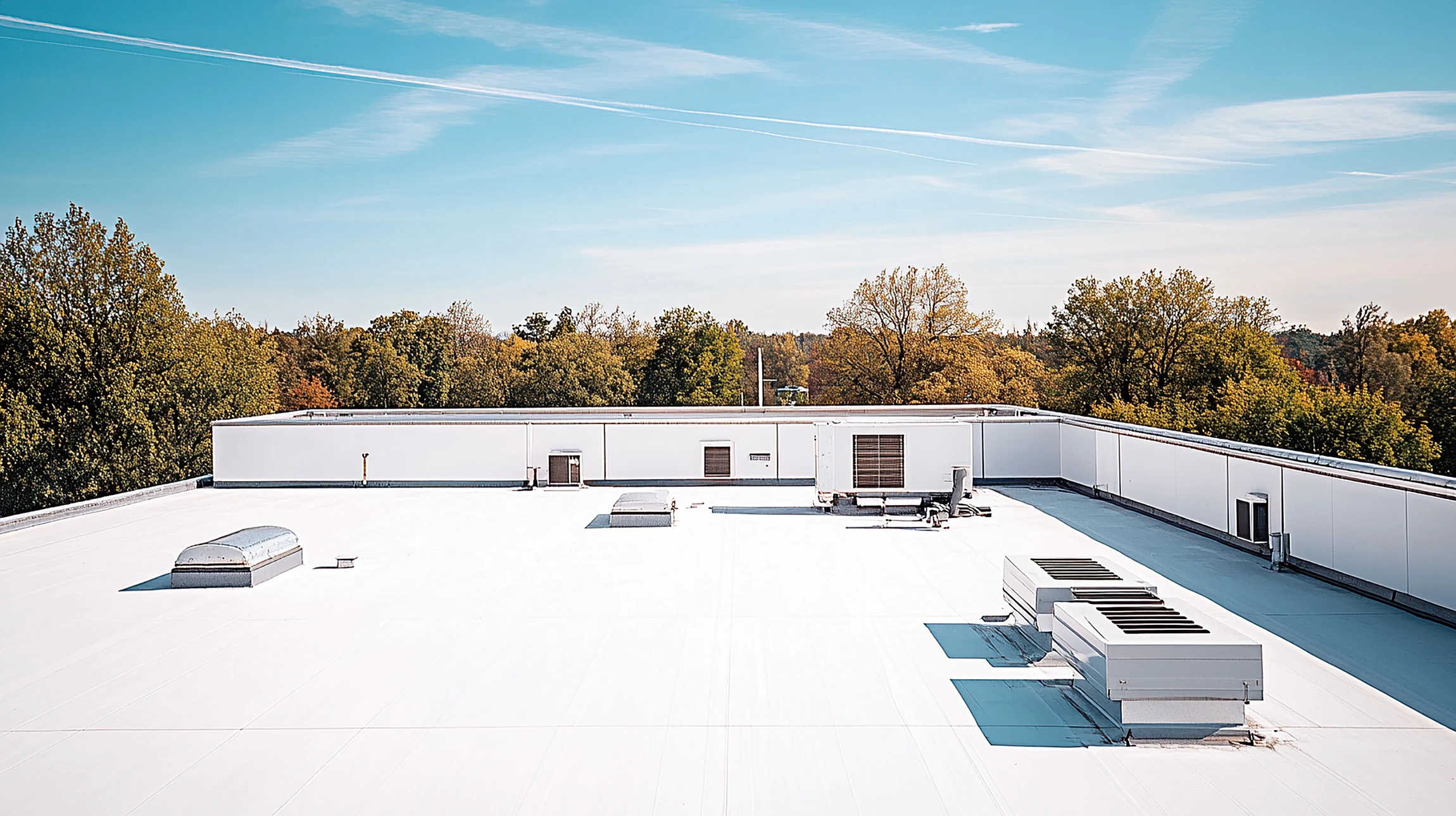
What Is the Difference Between Roof Coating and Roof Replacement?
The main difference is how much of the existing roof remains.
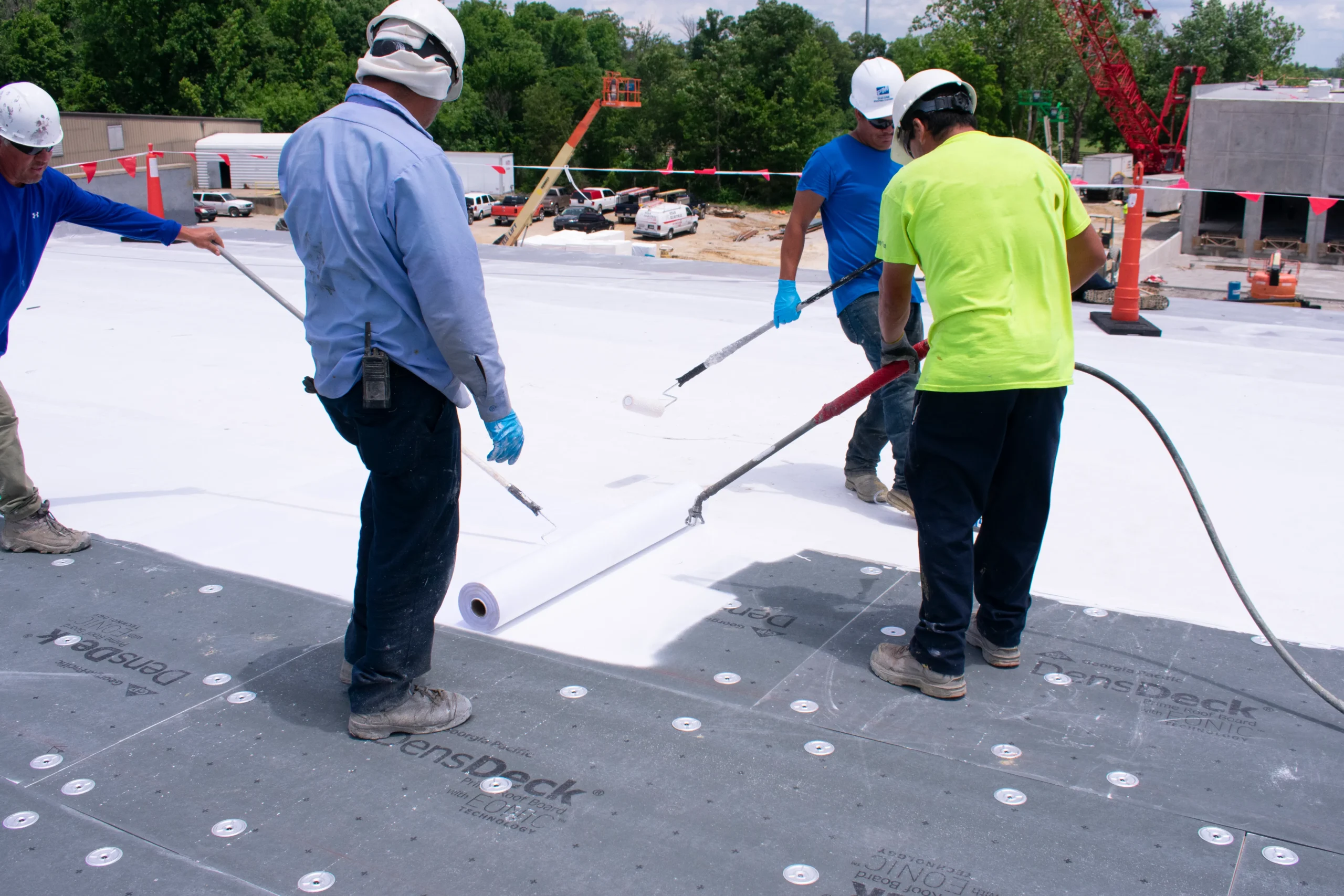
Roof coating is a restoration process. The existing roof stays in place, problem areas are repaired and prepared, and a compatible liquid coating system is installed over the roof surface.
Roof replacement is a more extensive process. Depending on the project, the existing membrane, insulation, and other roofing materials may be torn off so damaged components can be repaired or replaced before the new roofing system is installed.
This difference affects several things, including cost, construction time, waste, business disruption, and how much hidden roof damage can actually be addressed.
| Factor | Roof Coating | Full Roof Replacement |
|---|---|---|
| Existing roof | Most of the existing roof remains | Existing materials may be torn off and rebuilt |
| Appropriate for | Structurally sound and restorable roofs | Roofs with widespread damage or moisture |
| Business disruption | Usually lower | Usually greater |
| Waste | Less tear-off material | More material may need to be removed |
| Access to damaged areas | Limited to areas opened and repaired | Allows extensive damaged areas to be exposed and corrected |
| Initial investment | Usually lower when the roof qualifies | Usually higher |
Neither process is automatically better. The better option depends on the current condition of the roof.
When Is It a Good Idea to Coat a Roof?
A coating can be a practical option if the roof has aged but has not yet reached widespread failure.
That distinction is important. A roof coating should not be viewed as paint that can simply be applied over any old roof surface.
There are several common characteristics of a good roof-coating candidate.
The Roof Is Still Structurally Sound
The roof deck and the assembly beneath the membrane need to provide a structurally sound foundation.
If large areas of the deck have deteriorated, a surface coating cannot repair the problem underneath.
This is why the condition beneath the visible membrane is just as important as the condition of the surface itself.
Moisture Is Limited
A small wet area does not automatically mean the entire roof needs to be torn off.
Depending on the roof system and the restoration specification, isolated wet insulation may sometimes be identified, removed, and replaced before the coating is applied.
Widespread moisture is different.
Once wet areas are spread across large portions of the roof, a coating may simply conceal an existing problem instead of solving it.
As one manufacturer-specific example, GAF guidance says that when a moisture survey identifies moisture in 25% or more of the roof area, complete tear-off may be considered.
The 25% figure should not be treated as a universal rule for every roof or manufacturer. It is a useful example of why moisture testing needs to happen before the restoration decision is made.
The Main Problems Are at the Roof Surface
Liquid coating systems are especially useful when the existing membrane remains serviceable but the exposed surface has aged from sunlight, weathering, and normal environmental exposure.
After the necessary preparation and repairs have been completed, a compatible coating can provide a continuous protective surface over the existing roof.
Huntsville Roofing Solutions offers commercial roof coating and restoration systems for aging roofs that remain suitable for restoration.

Leaks Can Be Addressed Before Coating
A coating is not an alternative to identifying where a roof leak is coming from.
Failed flashing, damaged seams, membrane punctures, deteriorated penetrations, and other defects should be repaired before the coating system is applied.
If the contractor cannot determine the source of the leak, simply covering the roof may address the symptom without solving the actual problem.
You Want to Minimize Tear-Off and Operational Disruption
For an occupied warehouse, office, retail building, manufacturing facility, school, or multifamily property, disruption is part of the financial decision.
A restoration project generally involves less tear-off than replacement. That can mean fewer dumpsters, less material movement, and less disruption around the property.
It does not mean coating will always be cheaper over the entire life of the roof.
It only makes financial sense when the existing roof is actually a good candidate for restoration.
When Would Replacement Make More Sense?
If the problems are no longer limited to the surface, replacement becomes a more realistic option.
If several warning signs are already present, it is worth reviewing the warning signs of commercial flat roof failure before assuming a coating will solve the problem.
Moisture Has Spread Across Large Areas of the Roof
Wet insulation is one of the most important reasons to reconsider whether restoration still makes sense.
Moisture can reduce the effectiveness of insulation and may indicate that water has been entering the roofing system for some time.
If testing shows that large areas are wet rather than a few isolated spots, removing and rebuilding damaged sections can provide a more dependable result than preserving as much of the existing roof as possible.
The Roof Deck Has Deteriorated
Coating is a surface treatment. It cannot repair decayed wood decking, a corroded metal deck, or other deterioration hidden beneath the membrane.
Once the roof deck itself is no longer dependable, replacement gives the contractor access to those damaged components so they can be removed and corrected.
Leaks Continue to Appear in Different Areas
One isolated leak can usually be repaired.
Leaks appearing across several different areas of the roof tell a different story.
If every repair is followed by another leak somewhere else, the problem may no longer be one defective seam or penetration.
The roof itself may be reaching the point where additional repairs or restoration bring less and less value.
Large Areas of the Membrane Have Failed
Cracking, severe deterioration, failed seams, widespread blistering, loss of adhesion, and other membrane problems can make it difficult to create a dependable surface for coating.
A coating can only perform as well as the surface it adheres to.
If the surface itself is unstable, covering it does not remove the underlying weakness.
The Drainage System Needs Major Correction
Coatings can protect the roof surface, but they do not automatically fix poor roof geometry.
If water continually pools because of low areas, damaged insulation, badly positioned drains, or slope problems, correcting the drainage may require considerably more work.
Some coating products tolerate certain ponding-water conditions better than others, but coating should never be used as an excuse to ignore a drainage problem.
Will a Roof Coating Fix Leaks?
It can help create a watertight restored roof surface, but only after the causes of the existing leaks have been addressed.
This is an important point for building owners to understand.
A properly designed coating system is completely different from pouring a bucket of coating material over a leaking membrane.
Preparation may include:
- Cleaning the roof surface.
- Identifying active leaks.
- Removing wet or damaged materials when necessary.
- Repairing membrane defects.
- Repairing seams.
- Fixing flashing and penetrations.
- Correcting manageable drainage problems.
- Checking coating compatibility and surface adhesion.
The coating is the final layer of the restoration. It should not be the first response to an unexplained leak.
How Do Contractors Determine Whether a Commercial Roof Can Be Coated?
A visual inspection is useful, but the decision should not be based only on what the top of the membrane looks like.
A commercial roof evaluation can involve several stages.
1. Analyze the Repair and Leak History
A roof that was punctured once during HVAC installation is very different from a roof that has been repaired repeatedly in ten different places.
The repair history helps determine whether the problem is isolated or systemic.
2. Check the Membrane, Seams, Flashing and Penetrations
The contractor should look for problems across the entire roof, not only in the center.
Roof edges, drains, HVAC curbs, vents, pipes, seams, parapet transitions, and other details are common places for problems to develop.
3. Test for Moisture Beneath the Surface
A roof can appear relatively normal from above while the insulation underneath has already absorbed water.
Depending on the building and the proposed restoration system, moisture testing, core cuts, or other diagnostic methods may be used to understand what is happening below the roof surface.
4. Evaluate the Roof Deck and Substrate
The contractor also needs to determine whether the existing roof structure is capable of supporting a restoration system.
Soft areas, deterioration, corrosion, or other substrate problems can change the recommendation.
5. Check Whether the Existing Roof Is Suitable for the Proposed Coating
Not every coating can be applied to every roof membrane without preparation.
The existing roofing material, surface condition, previous coatings, adhesion requirements, primer requirements, and manufacturer specifications all need to be considered.
Comparing the Cost of Roof Coating and Roof Replacement
A coating generally requires a lower initial investment than tearing off and rebuilding a commercial flat roof, as long as the roof is a suitable candidate.
But comparing only the first invoice can be misleading.
Consider two simple examples.
Illustrative Example A: The roof has a dry and structurally sound assembly with an aging membrane and several repairable defects. Paying for complete tear-off could mean removing large amounts of roofing material that are still functioning. In this situation, restoration may provide better value.
Illustrative Example B: The roof has wet insulation, a deteriorated deck, recurring leaks, and drainage problems. Applying a lower-cost coating first may simply delay replacement and add another expense.
These examples are illustrative only. They are not project estimates.
The important question is not only:
“Which one costs less?”
A more useful question is:
“What will each option realistically give this building for the money being spent?”
How Long Can a Roof Coating Extend the Life of a Flat Roof?
There is no single lifespan that applies to every coating project.
The result depends on the existing roof, coating system, preparation, applied thickness, drainage, installation quality, maintenance, and manufacturer requirements.
Huntsville Roofing Solutions states that qualifying coating systems may add approximately 10 to 20 years of roof life and may carry manufacturer warranties of up to 20 years.
This should not be interpreted as a guarantee that any old roof can simply be coated and gain another 20 years.
The existing roof has to qualify for the system, and the specific warranty proposed for that project should be reviewed.
Will Replacement Be Better for a Long-Term Building Owner?
Not necessarily.
It can be tempting to think that an owner who plans to keep a property for decades should automatically replace the roof, while a short-term owner should simply coat it.
But the condition of the roof comes first.
If a structurally sound roof can be responsibly restored, removing it early may not provide enough additional value to justify the extra cost.
If restoration would only delay an unavoidable replacement for a short period, replacement becomes the more sensible option.
The owner’s time horizon can influence the financial analysis, but it should not override the actual condition of the roof.
What About Replacing the Roof With TPO?
If replacement is necessary, the building owner may then need to compare different roofing systems instead of simply deciding whether the old roof should come off.
One common option for low-slope commercial buildings is a TPO roofing system.
TPO uses large single-ply membrane sheets with heat-welded seams and is commonly installed on commercial flat and low-slope roofs.
However, this article is not intended to decide between TPO, modified bitumen, EPDM, metal, or every other commercial roofing material.
That is a separate decision to make after determining whether the existing roof can reasonably be restored.
How Does Huntsville Weather Affect the Decision?
Commercial roofs in Huntsville and North Alabama have to deal with intense sunlight, high temperatures, humidity, thunderstorms, heavy rain, wind, and seasonal temperature changes.
Those conditions do not mean every aging roof needs to be replaced.
They do mean smaller problems can become more important when they are left untreated.
A deteriorated seam becomes more serious during wind-driven rain. A partially blocked drain becomes more important during a heavy storm. A dark, aging roof surface continues to absorb Alabama’s summer sun and heat.
Reflective coatings can help reduce solar heat absorbed at the roof surface on suitable commercial buildings.
But reflectivity cannot compensate for wet insulation, a deteriorated substrate, or unresolved drainage problems.
What Are the Risks of Coating a Roof That Needs Replacement?
The biggest risk is paying for work on the wrong layer of the building.
If the real problem is underneath the membrane, a new coating can make the roof look better while damaged insulation or decking remains below it.
Potential consequences include:
- Leaks returning after restoration.
- Wet insulation remaining in the roof assembly.
- Continued deterioration of the substrate.
- Poor coating adhesion.
- Warranty complications.
- Paying for both coating and replacement within a relatively short period.
This is why recommending replacement does not automatically mean a contractor is trying to sell the most expensive option.
At the same time, recommending restoration does not necessarily mean the contractor is taking a shortcut.
Either recommendation can be correct when it is supported by the actual condition of the roof.
What Are the Risks of Replacing a Roof That Could Have Been Coated?
There is also a cost to removing a roof earlier than necessary.
Premature replacement can mean:
- Removing materials that still have useful service life.
- Higher labor and material costs.
- More waste.
- More disruption around an occupied building.
- Paying for replacement before it was technically necessary.
This is why the goal should not be to push one option before the inspection.
The goal is to preserve the existing roof when that is technically responsible and replace it when restoration can no longer provide dependable value.
Simple Roof Coating vs Replacement Guide
| Condition | Coating Can Be Appropriate | Replacement May Be More Suitable |
|---|---|---|
| Roof deck | Structurally sound and stable | Structural deterioration or widespread problems |
| Insulation | Mostly dry with limited repairable wet areas | Extensive wet or damaged insulation |
| Leaks | Localized and traceable | Leaks across multiple roof areas |
| Membrane | Aged but capable of preparation and restoration | Widespread failure or instability |
| Drainage | Working with manageable corrections | Extensive correction or reconstruction required |
| Business disruption | Lower disruption is important | Roof condition outweighs disruption concerns |
| Initial cost | Usually lower | Usually higher |
| Access to underlying materials | Limited opening needed | Extensive access to damaged areas required |
What Questions Should You Ask Before Making a Choice?
Instead of asking the contractor only, “How much will it cost?”, ask why the recommendation is being made.
- How much of the roof is actually wet?
- Is the roof deck structurally sound?
- Where are the leaks coming from?
- Are the defects localized or widespread?
- What needs to be repaired before coating?
- Is the existing membrane compatible with the proposed coating?
- What warranty applies to this specific system?
- What realistic service life does each option provide?
- What happens if hidden wet material is discovered?
A strong recommendation should be based on observable roof conditions instead of simply saying that the roof is “old.”
The Bottom Line
When comparing roof coating vs replacement for a flat roof, coating makes sense when the existing roof is structurally sound, moisture is limited, defects can be repaired, and the remaining assembly provides a dependable base for restoration. When moisture, membrane deterioration, wet insulation, damaged decking, recurring leaks, or drainage problems are widespread, replacement becomes the stronger option.
The cheapest solution today is not necessarily the most cost-effective solution over the life of the building.
Coating a roof that should have been replaced can delay an unavoidable replacement. Replacing a roof too early can throw away useful service life that was still available.
For owners and facility managers in North Alabama, the decision should start with evaluating the entire roof assembly rather than only looking at the surface.
Huntsville Roofing Solutions provides commercial roofing services in Huntsville covering repair, restoration, coating, maintenance, and replacement of flat and low-slope roof systems.
After either option is completed, regular inspection and drainage checks can help protect the investment. The company’s commercial roof protection program is one option for scheduled inspection and preventive maintenance.
Frequently Asked Questions About Roof Coating vs Replacement
Is coating a flat roof cheaper than replacing it?
Generally, yes, if the roof is a suitable candidate for restoration. Coating avoids much of the expense associated with full replacement, including tear-off, disposal, new materials, and additional labor. However, coating a roof with extensive moisture or membrane deterioration can become expensive if replacement is still required soon afterward.
Can a leaking flat roof be coated?
It may be possible if the source of the leak is properly diagnosed and repaired before the final coating is applied. A coating should be used as part of a restoration process, not as a way to cover a leak that was never properly identified.
Can wet roof insulation be coated?
Wet insulation generally needs to be identified and addressed rather than simply covered with coating. Isolated wet areas may sometimes be removed and replaced during restoration, while widespread moisture can make replacement more appropriate.
How long can a commercial roof coating last?
There is no single lifespan for every project. Performance depends on the existing roof, preparation, coating system, applied thickness, drainage, maintenance, installation quality, and manufacturer requirements. Huntsville Roofing Solutions states that qualifying systems may extend roof life by approximately 10 to 20 years.
Is roof coating considered a new roof?
A roof coating is generally considered a restoration of the existing roof rather than the same thing as removing and installing a completely new roofing assembly. The exact treatment for code, insurance, warranty, accounting, or tax purposes should be confirmed for the individual building and jurisdiction.
How do I know if my flat roof needs replacement rather than coating?
Replacement becomes more likely when an inspection finds widespread wet insulation, deteriorated decking, recurring leaks in multiple areas, extensive membrane failure, major drainage problems, or an existing roof that can no longer provide a stable substrate for restoration.

Jordan is the founder and owner of Huntsville Roofing Solutions, a locally owned, fully licensed and insured roofing company serving Huntsville and North Alabama. He and roofing supervisor Barry Minor have handled residential and commercial roofs across the region — replacements, repairs, storm damage, and insurance claims — earning a 4.9-star Google rating along the way.