
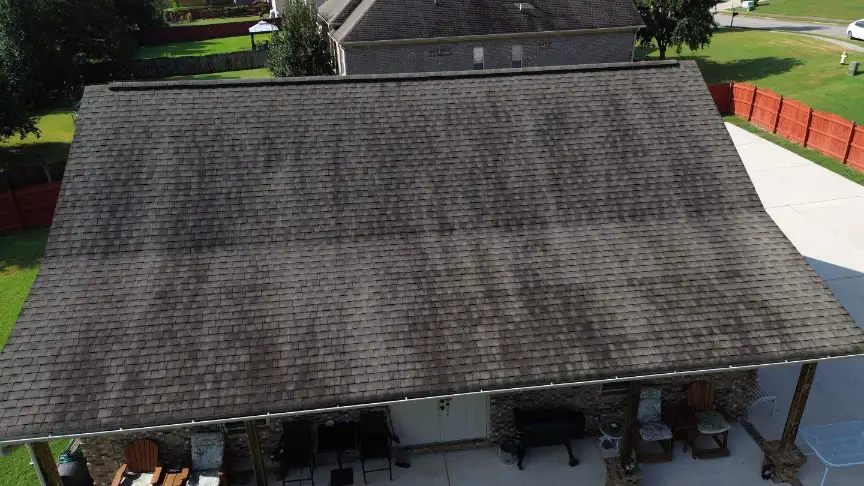
What Causes Black Streaks on a Roof?
Black streaks on asphalt-shingle roofs are commonly caused by a microorganism known as Gloeocapsa magma. It is a cyanobacterium often referred to in the roofing industry as blue-green algae.
The organism can travel through the air and establish itself on roofing surfaces when moisture and temperature conditions are favorable. As colonies develop, they produce dark pigmentation that makes a roof appear dirty, stained or prematurely aged.
The discoloration may begin as small dark areas and eventually form longer streaks across a roof plane. Because algae favors moisture, the pattern is often more obvious where shingles remain damp longer due to shade, tree cover or limited sun exposure.
This is particularly relevant in Huntsville and the surrounding Tennessee Valley, where warm temperatures and humidity create favorable conditions for biological roof staining. For the broader effect of local moisture conditions on roofing systems, see our guide to how Tennessee Valley humidity affects roofing.
Do Black Streaks Mean Your Roof Is Damaged?
No—not when the streaking is simply blue-green algae. Algae discoloration by itself is primarily an appearance issue and does not automatically mean the asphalt shingles have stopped protecting the home.
That distinction matters because a stained roof can look much older than it actually is. A homeowner may see dark streaking from the driveway and assume the roof needs replacing when the shingles themselves may still be serviceable.
At the same time, not every dark area on a roof should automatically be labelled algae. What matters is the pattern and the condition of the roofing material around it.
| What You See | What It May Indicate | Typical Next Step |
|---|---|---|
| Broad brown or black streaking across otherwise intact shingles | Algae discoloration | Cleaning may be considered for appearance |
| Green, thick or raised growth | Moss or other biological growth | Professional assessment and appropriate removal |
| Cracked, curled, lifted or missing shingles | Physical roof deterioration or storm damage | Roof inspection and possible repair |
| Dark staining concentrated around a vent, chimney or flashing detail | Possible moisture or drainage problem | Inspect the roof detail rather than assuming algae |
| Large amounts of loose granules in gutters with visibly worn shingles | Shingle aging or deterioration | Evaluate remaining roof condition |
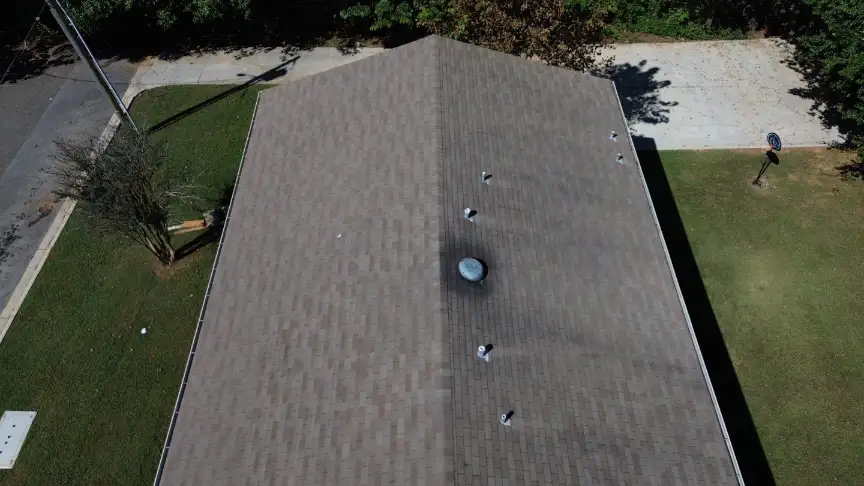
Roof Algae vs Mold, Moss and Actual Shingle Damage
Algae
Algae usually appears as dark brown or black discoloration spread across the shingle surface. It can form streaks or more uniform staining and is primarily a cosmetic condition.
Mold
Homeowners often call any dark roof growth “mold,” but visible black streaks on the outside of asphalt shingles are frequently algae instead. Mold is more commonly a concern where persistent moisture affects organic materials such as roof decking, framing, insulation or interior surfaces.
Moss
Moss is easier to distinguish because it develops visible, raised plant growth rather than flat dark streaking. Moss can retain water around shingles and may interfere with shingle edges, so it should not be treated as equivalent to cosmetic algae staining.
Physical shingle damage
Cracking, curling, exposed areas, lifted tabs, missing shingles, punctures and significant deterioration are physical roofing conditions. Those problems should be assessed independently of whether algae is also present.
Likewise, gradual color change caused by sunlight and weathering is different from biological streaking. Our guide to shingle color and visible aging in Alabama explains that distinction in more detail.
Why Are Black Roof Streaks Common in Huntsville and North Alabama?
Algae can occur almost anywhere, but warm and humid climates provide particularly favorable conditions for growth.
That makes North Alabama a logical place to see it. Huntsville homes may experience long humid periods, heavy summer moisture, rainfall, tree cover and shaded sections of roof that take longer to dry.
Two homes on the same street can also look very different. One roof may receive direct sunlight for most of the day while another sits under mature trees. One slope may dry quickly after morning dew while another stays damp for hours.
That does not automatically mean the shaded roof has a structural problem. It simply creates a more favorable surface for algae discoloration.
Algae can also spread through a neighborhood because the organisms are transported through the air. Seeing similar streaks on nearby homes therefore does not necessarily mean several roofs are failing at the same time.
Do You Need to Clean Black Streaks Off the Roof?
Not necessarily. If an inspection confirms that the discoloration is algae and the shingles are otherwise performing properly, cleaning is mainly an appearance decision.
A homeowner who is satisfied with the appearance may decide not to treat the streaking immediately. That is an important distinction: a stained roof is not automatically an emergency roof.
If you do want the discoloration removed, cleaning should follow the instructions for the specific shingle manufacturer and roofing product.
The Asphalt Roofing Manufacturers Association notes that algae discoloration can be treated with an appropriate low-pressure cleaning approach, but also warns that roof surfaces become extremely slippery during treatment and encourages professional cleaning. Cleaning may also be temporary because algae can return when environmental conditions remain favorable.
Can You Pressure Wash Black Streaks Off Asphalt Shingles?
No. A high-pressure washer should not be used to clean asphalt shingles.
Pressure washing can loosen or remove the mineral granules that form the protective exterior surface of an asphalt shingle. Scrubbing with stiff brushes or brooms can create the same problem.
ARMA specifically advises against power washing asphalt roofing when removing algae or other stains.
There is also a safety issue. Wet roofing, cleaning solution and sloped surfaces are a dangerous combination. Even when the staining itself is harmless, trying to remove it incorrectly can create actual roofing damage—or a serious fall hazard.
When Do Black Streaks Need Roof Repair?
Algae alone usually does not require a roof repair. Repair becomes relevant when the inspection reveals a separate roofing defect.
Examples include leaking flashing, damaged pipe boots, missing or wind-lifted shingles, punctures, cracked shingles, deteriorated seal areas or localized decking problems.
You should pay particular attention when a dark area is concentrated around one roof penetration rather than spread naturally across the roof plane, especially if there is also water staining inside the attic or home.
If you have black streaking plus an active leak, damaged shingles or another physical defect, the underlying problem—not the algae—is what may require roof repair in Huntsville.
Do Black Streaks Mean You Need a Roof Replacement?
No. A roof should not be replaced solely because normal algae staining makes it look old.
Replacement decisions should be based on the actual condition of the roofing system: age, widespread shingle deterioration, recurring leaks, storm damage, compromised decking, repeated repair history and the remaining useful life of the roof.
This is where an honest inspection matters. Sometimes the answer is simply that the roof is stained and otherwise serviceable.
On the other hand, if the roof is already near the end of its service life and has widespread deterioration independent of the algae, cleaning an old roof purely for appearance may make little financial sense. In that situation, it is more useful to evaluate the complete roof and compare the cost of continued work with roof replacement options.
Can Algae-Resistant Shingles Help Prevent Black Streaks?
They can help reduce the likelihood of visible algae staining.
Many modern asphalt-shingle lines use algae-resistant technology that incorporates copper-containing granules or similar systems designed to inhibit blue-green algae growth.
That does not mean every algae-resistant roof will remain completely stain-free forever. Product design, warranty terms, climate, shade and exposure differ by manufacturer and shingle line.
If you are replacing a roof in North Alabama anyway, algae resistance is worth including in the product comparison—particularly on a property with heavy tree cover or a history of visible streaking.
What Should a Huntsville Homeowner Do After Noticing Black Streaks?
Start by looking at the roof from the ground rather than climbing onto it.
If the shingles appear flat and intact and the discoloration consists mainly of long dark streaks across the roof surface, algae is a reasonable possibility.
If there are also missing shingles, curled edges, obvious impact marks, damaged flashing, a ceiling leak, soft decking, sagging or concentrated staining around a penetration, the roof deserves a closer inspection because another issue may be present.
The practical question is not simply, “How do I make the black color disappear?”
It is:
“Is this only discoloration, or is there an actual roofing problem underneath it?”
That is the question worth answering before anyone sells you cleaning, repair or replacement.
Frequently Asked Questions About Black Streaks on Roofs
What causes black streaks on roof shingles?
Black or dark-brown streaks on asphalt shingles are commonly caused by blue-green algae, particularly Gloeocapsa magma. The organism produces dark pigmentation that becomes visible as colonies spread across the roof.
Are black streaks on a roof a sign of damage?
Usually not when the streaks are algae. Algae discoloration is primarily cosmetic and does not by itself mean the shingles have failed. Cracking, curling, missing shingles, leaks, soft decking or other physical deterioration are separate signs that deserve inspection.
Are black roof streaks mold?
Often they are not. Homeowners commonly describe exterior roof discoloration as mold, but flat black streaking on asphalt shingles is frequently algae. Mold is more commonly associated with persistently damp building materials such as roof decking, framing or interior surfaces.
Can I pressure wash algae off my roof?
No. High-pressure washing can remove protective granules from asphalt shingles. Roofing-industry guidance recommends manufacturer-approved low-pressure treatment methods and cautions that roof cleaning is hazardous because the surface becomes slippery.
Should I replace a roof because it has black streaks?
No. Algae staining by itself is not a reason to replace an otherwise serviceable roof. Replacement should be based on the roof’s age, condition, leaks, widespread deterioration, storm damage and remaining service life.
Do algae-resistant shingles prevent black streaks?
They can significantly reduce algae discoloration. Many manufacturers use copper-containing granules or other algae-resistant technology, although protection periods and warranty terms vary by product.
The Bottom Line
Black streaks on a roof usually tell you more about algae and local moisture conditions than they do about whether the roof needs replacing.
For Huntsville and North Alabama homeowners, the sensible first step is diagnosis. Confirm whether the streaking is algae, distinguish it from moss or localized moisture staining, and look separately for actual signs of shingle or roof-system deterioration.
If it is only algae, cleaning may be optional and largely cosmetic. If the inspection finds damaged shingles, flashing problems or leaks, repair the roofing problem. If the entire roofing system is genuinely worn out, then replacement becomes the conversation.
Huntsville Roofing Solutions serves homeowners throughout our North Alabama service area and can help determine which of those situations you actually have.
Industry Guidance Reviewed
This article was prepared using current guidance from the Asphalt Roofing Manufacturers Association and major asphalt-shingle manufacturers regarding algae discoloration, algae-resistant shingles and safe cleaning practices.
Jordan is the founder and owner of Huntsville Roofing Solutions, a locally owned, fully licensed and insured roofing company serving Huntsville and North Alabama. He and roofing supervisor Barry Minor have handled residential and commercial roofs across the region — replacements, repairs, storm damage, and insurance claims — earning a 4.9-star Google rating along the way.