
The decision should therefore answer one practical question:
Is temporary covering reasonably necessary to prevent additional damage before the roof can be permanently repaired?

When Is Emergency Roof Tarping Necessary?
A roof generally needs temporary protection when the existing roofing system can no longer reliably keep weather out and permanent repairs cannot be completed before the next exposure to rain.
Common situations include:
- A large section of shingles has blown off.
- Roof underlayment is exposed.
- Plywood or other roof decking is exposed.
- A tree limb or debris has punctured the roof.
- Part of the roof has been removed during emergency work.
- Water is actively entering the home after storm damage.
- An opening cannot be permanently repaired before more rain arrives.
- Fire, wind or impact damage has left part of the roof open to weather.
The existence of roof damage alone does not automatically mean tarping is required.
A damaged shingle that remains watertight is different from an exposed section of decking with thunderstorms forecast overnight.
The purpose of the tarp is not to make the roof “look repaired.” It is to reduce the chance that the original damage turns into additional damage to decking, insulation, ceilings, walls, flooring and personal property.
When Is a Roof Tarp Probably Not Necessary?
Tarping is usually unnecessary when there is no meaningful pathway for water to enter and the roof can remain weather-resistant until it is repaired.
Examples may include:
- Minor cosmetic marks with no exposed roofing layers.
- Hail marks that have not created an opening or active leak.
- A small repair that can be permanently corrected immediately.
- Damage to a gutter or another component that does not compromise the roof covering.
- A condition that should not be walked on because the roof structure may be unstable.
That last situation deserves emphasis.
If a roof is structurally unsafe, the answer is not for the homeowner to climb onto it with a tarp. An unstable roof may require professional emergency evaluation and a different method of securing the property.
Likewise, hail does not automatically require tarping. Hail can damage shingles without producing an immediate opening. If you are trying to establish whether surface marks are actually hail-related, use the separate guide explaining what hail damage on a roof can look like.
How Much Does Emergency Roof Tarping Cost in 2026?
Current 2026 national pricing data places professional roof tarping at approximately $0.70 to $2.80 per square foot.
Standard scheduled professional tarping commonly falls around $0.70 to $2.00 per square foot, while rush or emergency service commonly runs around $1.00 to $2.80 per square foot.
Those are planning figures rather than a guaranteed Huntsville or North Alabama rate.
| Area Needing Protection | Illustrative Emergency Range at $1-$2.80/Sq. Ft. |
|---|---|
| 100 sq. ft. | $100-$280* |
| 300 sq. ft. | $300-$840 |
| 600 sq. ft. | $600-$1,680 |
| 1,000 sq. ft. | $1,000-$2,800 |
| 1,500 sq. ft. | $1,500-$4,200 |
*Small jobs may still be subject to contractor minimum charges, mobilization costs or emergency service fees, so a tiny tarp job does not necessarily price as a simple square-foot calculation.
Likewise, a 1,000-square-foot tarp area does not mean that exactly 1,000 square feet of tarp material will be required. The covering often needs to extend beyond the visibly damaged section so it can shed water rather than directing water beneath the tarp.
What Makes Roof Tarping More Expensive?
The size of the damaged area is only one part of the price.
Emergency or After-Hours Response
A planned tarp installed during normal working hours is different from a crew mobilizing after a major thunderstorm at night or during a weekend.
Emergency work can carry additional labor or mobilization costs.
Demand also matters. After a widespread North Alabama storm, dozens or hundreds of properties may require temporary protection at the same time.
Roof Pitch
A steep roof usually requires more time, fall protection and careful movement than a low-slope roof.
The same tarp area can therefore cost more on a steep two-story house than on a simple low-slope structure.
Building Height and Access
A single-story roof with straightforward ladder access is generally easier to reach than a high roof surrounded by landscaping, fences, power lines or limited staging space.
Amount of Damage
Tarping over several missing shingles is different from covering a section damaged by a fallen tree.
Debris may need to be safely addressed before the temporary covering can perform properly.
Tarp Size and Material
Larger and heavier-duty tarps cost more than small lightweight covers.
A professional also needs enough material to extend beyond the damaged area and create a drainage path rather than simply laying plastic directly over the hole.
Attachment Requirements
The tarp has to remain secure enough to resist wind until permanent work occurs.
How it can be safely secured depends on roof type, roof geometry and the damaged area. The method should avoid creating unnecessary additional damage while still preventing the tarp from becoming loose during the next storm.
Can You Tarp a Roof Before the Insurance Adjuster Arrives?
Yes. You generally do not need to leave an exposed roof open to additional rain simply because an insurance adjuster has not arrived.
The Alabama Department of Insurance advises homeowners to document damage and take reasonable steps to prevent further destruction. Its post-storm guidance specifically includes temporary repairs such as covering a hole in a roof.
The National Association of Insurance Commissioners gives similar guidance: document the loss first, then make reasonable temporary repairs intended to prevent additional damage.
Whenever it is safely practical:
- Take photographs or video before the tarp is installed.
- Photograph the surrounding roof, not only one close-up.
- Document interior leakage or water stains.
- Record the date the damage was discovered.
- Photograph the tarp after installation.
- Keep the contractor’s invoice and proof of payment.
The tarp does not prove that the insurance company accepted the claim.
It documents a temporary mitigation measure while the cause, coverage and permanent scope are still being evaluated.
For the broader claims process—including documentation, adjusters and how the roofing contractor fits into the process—continue to Huntsville Roofing Solutions’ roof insurance claim assistance guide.
Will Homeowners Insurance Pay for Roof Tarping?
It may, when the tarp is a reasonable temporary expense associated with a covered loss, but reimbursement is not automatic.
The Alabama Department of Insurance states that insurance will typically reimburse reasonable temporary-repair costs when the underlying loss is covered.
That qualification matters.
A tarp installed after covered storm damage may be treated differently from a tarp placed over a roof that has been leaking for months because of normal deterioration.
Coverage can depend on:
- The cause of the roof damage.
- The terms of the individual policy.
- Whether the work was reasonably necessary.
- The cost of the temporary work.
- Documentation.
- Receipts and invoices.
Do not treat a contractor’s statement that “insurance will pay for it” as a coverage determination.
The insurance carrier applies the policy and determines reimbursement.
Why Should You Photograph the Roof Before Tarping?
Tarping necessarily covers the condition that existed underneath it.
That is the entire point physically—but it can create a documentation problem if nobody records what was covered first.
A useful pre-tarp record can show:
- Where roofing material was missing.
- Whether underlayment or decking was exposed.
- The size of the affected area.
- Nearby undamaged roofing.
- Tree or debris impact.
- Interior water intrusion.
Take what photographs you safely can from the ground or accessible areas.
You do not need to climb onto a damaged roof simply to create insurance photos.
Should You Tarp the Roof Yourself?
Sometimes a homeowner can safely cover a small, accessible low-risk area. But many emergency tarping situations involve exactly the conditions that make roof access dangerous: wet roofing, wind, loose shingles, exposed decking and uncertain structural damage.
Do not climb onto a roof when the surface is wet, steep, unstable or visibly damaged.
The money saved on professional tarping is not worth a fall.
Professional help becomes especially appropriate when:
- The roof is steep.
- The building is two stories or higher.
- The roof deck may be damaged.
- A tree has hit the structure.
- Large areas need covering.
- Wind is still strong.
- Electrical lines or other hazards are nearby.
- You cannot identify a safe access route.
If you hire someone after a widespread storm, verify who you are dealing with. The site’s guide to checking an Alabama roofing contractor’s license and insurance explains how to verify credentials separately.
Is a Roof Tarp the Same as a Roof Repair?
No. A tarp is temporary mitigation.
A permanent roof repair addresses the damaged roofing system itself.
Depending on what happened, that could involve replacing:
- Individual shingles.
- Underlayment.
- Flashing.
- Pipe boots.
- Roof vents.
- Damaged decking.
- A larger roofing section.
A tarp simply buys time and limits weather exposure while that permanent scope is determined.
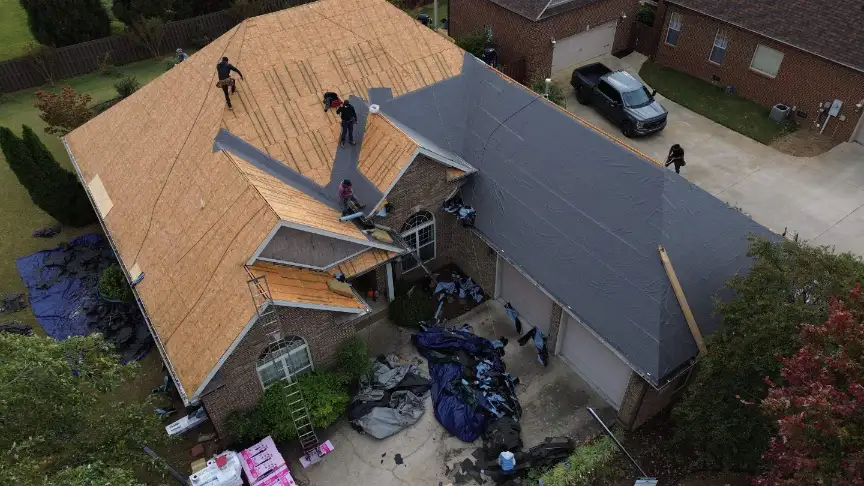
Once the roof has been inspected and the required scope is understood, a permanent roof repair should replace temporary protection when repair is the appropriate solution.
How Long Can a Roof Tarp Stay On?
A roof tarp should be treated as a short-term solution rather than a substitute for functioning roofing.
There is no responsible universal number of days because durability depends on the tarp, fastening method, roof slope, sunlight, wind, rain and whether the covering is repeatedly disturbed.
Even a tarp that still looks intact can loosen around edges or allow water beneath it.
If permanent repairs are delayed, the tarp should be checked after significant wind or rain when that can be done safely by a qualified person.
The goal should be to move from temporary protection to a properly diagnosed permanent solution—not to keep extending the life of the tarp indefinitely.
Can a Roof Tarp Cause Damage?
It can if it is installed poorly.
Potential problems include:
- Fasteners placed where they create unnecessary holes.
- A tarp that directs water underneath roofing materials.
- Loose material flapping in the wind.
- Water collecting in low areas of the tarp.
- Fastening into roofing that is already unstable.
- Covering conditions before they have been documented.
This is another reason not to tarp every roof automatically.
Temporary protection should solve a real weather-exposure problem rather than become an automatic response to any storm-related mark.
What Should You Do Immediately After Storm Damage?
If tarping is only one part of a larger storm event, use the site’s separate first 48 hours after storm damage checklist.
That guide covers safety, interior water, documentation, insurer notification, inspections and the sequence of the first two days.
This page stays focused specifically on deciding whether the roof needs temporary covering and what that protection may cost.
What Should a Professional Roof-Tarp Invoice Include?
If insurance may be involved, ask for a written invoice rather than paying for undocumented emergency work.
A useful invoice may identify:
- Property address.
- Date of service.
- Area protected.
- Approximate tarp size.
- Emergency or after-hours service, if applicable.
- Labor.
- Materials.
- Any debris-related work.
- Total cost.
- Contractor’s business information.
Retain that document with photographs, the claim number and related correspondence.
Frequently Asked Questions About Emergency Roof Tarping
How much does emergency roof tarping cost?
Current 2026 national data puts professional roof tarping around $0.70-$2.80 per square foot, with emergency or rush service commonly around $1-$2.80 per square foot. Roof pitch, height, access, damage, tarp size, storm demand and contractor minimum charges can change the final price.
When does a damaged roof need a tarp?
A tarp is usually appropriate when roof damage has created an opening or vulnerable area that could allow additional rainwater into the home before permanent repair is possible. Exposed decking, exposed underlayment, a roof puncture and substantial missing roofing are common examples.
Does every roof with missing shingles need a tarp?
No. The need depends on how much roofing is missing, what layers remain exposed, whether the area is still weather-resistant and how quickly permanent repairs can be completed. A few damaged shingles do not automatically justify covering an entire roof slope.
Can my roof be tarped before the insurance adjuster sees it?
Yes. Alabama and national insurance guidance recommends reasonable temporary measures to prevent additional damage after a loss. Document the original condition first when safely possible and keep receipts for the temporary work.
Will insurance reimburse emergency roof tarping?
It may when the tarp is a reasonable temporary repair associated with a covered loss. The underlying cause, policy terms, documentation and cost all matter. The insurer—not the roofing contractor—determines coverage and reimbursement.
Is a tarp a permanent roof repair?
No. A tarp is temporary weather protection. The damaged roofing, flashing, decking or other components still need to be properly inspected and permanently repaired or replaced as appropriate.
Should I tarp a roof myself?
Do not attempt DIY tarping when the roof is wet, steep, storm damaged, structurally questionable or difficult to access. Emergency roof conditions can make falls and structural hazards more likely, so professional tarping is often the safer option.
The Bottom Line
Emergency roof tarping makes sense when a damaged roof can no longer reliably keep rain out and permanent repairs cannot happen immediately.
It is not something every storm-damaged roof automatically needs.
For 2026 budgeting, professional roof tarping generally falls around $0.70-$2.80 per square foot, with emergency or rush work commonly around $1-$2.80 per square foot. Small jobs may also have minimum charges that make their effective per-square-foot price higher.
If insurance may be involved, photograph the damage before covering it whenever safely practical, keep photographs after installation, retain the invoice and notify the insurer promptly.
The Alabama Department of Insurance specifically recommends mitigating additional loss after documenting the original damage, including temporary measures such as tarps when they can be used safely.
For broader help with roof-damage documentation, adjuster coordination and the insurance process in Huntsville and North Alabama, continue to Huntsville Roofing Solutions’ insurance and storm-claim assistance page.
Sources and Consumer Guidance

Jordan is the founder and owner of Huntsville Roofing Solutions, a locally owned, fully licensed and insured roofing company serving Huntsville and North Alabama. He and roofing supervisor Barry Minor have handled residential and commercial roofs across the region — replacements, repairs, storm damage, and insurance claims — earning a 4.9-star Google rating along the way.