
Hail damage on a roof often looks like localized bruising or dents in asphalt shingles, disturbed or missing granules around impact areas, and dents in softer metal components such as gutters, vents or flashing. It can be subtle enough that the roof still looks normal from the ground and may not leak immediately. Just as important, ordinary granule shedding, heat blisters, age-related curling, foot-traffic wear and wind-lifted shingles are not automatically hail damage. One symptom by itself does not prove the cause. A hail assessment should look for a consistent pattern and document the condition before repairs are made.

Hail is one of the easier types of roof damage to either miss completely or blame for something it did not cause.
A homeowner may look up after a storm, see no missing shingles and assume nothing happened. Another homeowner may find granules in a gutter and assume the roof was destroyed by hail.
Neither conclusion is reliable on its own.
Your site’s existing storm guidance makes the important point: hail can bruise shingles and loosen granules without producing an immediate leak or an obvious driveway-level symptom.
The goal of an inspection is therefore not to “find hail damage.” It is to determine whether the roof shows damage that is actually consistent with hail.
What Does Hail Damage on an Asphalt-Shingle Roof Look Like?
On an asphalt-shingle roof, the most important clues are usually impact-related changes to the shingle surface rather than a dramatic hole through the roof.
Your existing site content identifies three especially useful clues: shingle bruising, displaced granules and corresponding dents in softer metal components.
1. Bruised or Dented Shingles
Hail can leave small dents or bruised areas in asphalt shingles.
Your storm-inspection content notes that these marks may be difficult or impossible to see clearly from the ground. The affected area may be more apparent during a close professional inspection than from a driveway photograph.
Another section of your site describes hail bruises as soft, dark impact areas that can sometimes be felt more readily than seen.
The important word is impact. A hailstone strikes the roof rather than creating the gradual, edge-to-edge deterioration associated with normal aging.
A bruise also does not have to create an immediate hole or active leak to matter. The shingle can continue shedding water while the damaged area becomes a weaker point in the roofing material.
2. Localized Granule Loss Around Impact Areas
Asphalt shingles are covered with mineral granules that protect the asphalt beneath them from sunlight and weathering.
Hail impact can dislodge some of those granules.
That may leave an affected area looking darker or different from the surrounding shingle surface, and a significant storm can also produce an increase in loose granules in gutters and at downspout outlets.
But this is where hail identification gets more complicated:
Granule loss by itself is not proof of hail.
Your existing roofing content correctly notes that shingles also lose granules through ordinary aging. Foot traffic can dislodge them. Branch abrasion can wear them away. Other forms of roof deterioration can produce bare or darker areas as well.
The question is whether the granule displacement is consistent with impact damage and with the rest of the evidence from the storm.
3. Dents in Gutters, Vents, Flashing or Other Soft Metal
One of the most useful supporting clues may not be on the shingles at all.
Your yearly maintenance guidance recommends checking softer metal components after hail, including gutters, roof vents and flashing. It notes that metal can show visible dents even when shingle bruising is hard to see.
Those dents do not prove that every shingle on the roof was damaged.
They do establish useful storm context: something struck exposed surfaces around the roof with enough force to leave an impact mark.
A roofer can then compare those collateral marks with conditions on the shingles themselves.
4. A Roof Can Have Hail Damage Without Leaking Right Away
This is one of the most important things for homeowners to understand.
Your site’s repair content explicitly states that hail damage often does not leak immediately.
Hail can knock granules loose and bruise the shingle material beneath them while the roof continues functioning for some time.
That means “my ceiling is dry” is not the same as “the roof has no hail damage.”
It also means the opposite is true: a ceiling leak after a hailstorm is not automatically proof that hail created the opening. Wind, flashing failure and pre-existing roofing problems can occur during the same weather event.
What Hail Damage Is Not
The phrase “hail damage” should describe a cause, not simply any roof that looks imperfect after a storm.
Several common roof conditions can resemble part of the hail-damage picture while having a completely different cause.
Normal Granule Loss Is Not Automatically Hail Damage
Some shingle granule loss occurs naturally over time.
Your existing storm article says a small amount of granule loss can be normal with aging, while your roof-lifespan content also describes granules loosening as asphalt shingles grow older.
A gutter containing granules after rain is therefore a clue that needs context—not a diagnosis by itself.
A sudden increase after a significant storm deserves attention. Long-term, widespread shedding on an aging roof may be deterioration rather than a new hail event.
Heat Blisters Are Not Automatically Hail Bruises
Your existing content identifies attic heat and inadequate ventilation as a cause of shingle blistering.
That matters because a raised, blistered or damaged-looking shingle surface can be blamed on hail simply because a storm occurred recently.
But if heat or ventilation created the condition gradually, calling it hail damage changes the cause without evidence.
This is one reason a roof should be evaluated as a system rather than by pointing at one mark.
Curling and Buckling Are Usually an Aging Clue, Not a Hail Signature
Your roof-replacement guidance describes curling and buckling as deterioration associated with age, heat cycling and moisture absorption.
Those conditions can certainly exist on a roof that later experiences a hailstorm. But the storm does not automatically become the cause of deterioration that was already developing.
This distinction becomes particularly important when an older roof is being documented for an insurance claim.
Lifted or Missing Shingles May Be Wind Damage
Hail and high wind frequently arrive in the same storm, but they do not damage a roof in exactly the same way.
Your site’s repair guidance identifies lifted, creased and missing shingles as common wind-related problems.
So if shingles are missing after a severe thunderstorm, that is evidence of storm damage—but it should not automatically be labeled hail damage.
Separating wind damage from hail impact produces a more accurate inspection and better documentation.
Foot-Traffic Damage Is Not Hail Damage
Your maintenance checklist specifically warns that walking on shingles can dislodge granules and, under some conditions, crack the roofing material.
That creates another reason not to diagnose hail from granule loss alone.
It also supports a simple safety rule: homeowners should not climb onto their roofs searching for impact marks.
Hail Damage vs. Common Lookalikes
| Condition | What It May Indicate | Does It Prove Hail? |
|---|---|---|
| Localized bruise or dent in a shingle | Possible impact damage | No, but consistent impact patterns deserve inspection |
| Localized granule disruption around impact areas | Possible hail impact | Not by itself |
| Dents in gutters, vents or flashing after the same storm | Useful collateral evidence of impact | Supports the hail assessment |
| Small amount of granules in gutters | Can occur through normal aging | No |
| Blistered shingles | Can be related to heat or ventilation | No |
| Curling or buckling across an older roof | Age, heat cycling or moisture-related deterioration | No |
| Lifted, creased or missing shingles | Often associated with wind | No |
| Granule loss where people have walked | Possible foot-traffic wear | No |
Why a Pattern Matters More Than One Mark
One suspicious spot does not tell the whole story.
A credible hail assessment considers multiple pieces of evidence together: the shingles, the distribution of impact-like marks, nearby metal components, the roof’s age and existing condition, and the timing of the storm.
This is especially important on an older roof.
If a roof already has widespread granule loss, brittle shingles or age-related curling, a recent hailstorm does not erase that pre-existing deterioration. At the same time, an older roof can still sustain legitimate new storm damage.
The job is to distinguish the two rather than choosing whichever answer is more convenient.
What Can a Homeowner Safely Check After Hail?
You can gather useful information without walking on the roof.
After the storm, check the ground and downspout outlets for an unusual accumulation of shingle granules. Look at accessible gutters and other metal surfaces for fresh-looking dents. From the ground, scan for obviously displaced roofing materials.
If you can safely access the attic, look for new moisture after the next rain.
Photograph anything unusual and record the date.
Do not climb onto a wet, steep or potentially damaged roof to press on shingles looking for bruises. Your existing maintenance guidance recommends ground-level observations and professional roof access instead.
Does Every Hailstorm Damage Every Roof?
No.
A hailstorm occurring in the neighborhood does not automatically mean every nearby roof has covered damage.
Likewise, seeing dents on one metal component does not automatically establish the scope of damage to the shingles.
Roof condition, the roofing material and the actual impact pattern all have to be evaluated.
This is why the useful question after a hailstorm is not “Did it hail?” but “What condition is this specific roof in after the event?”
Does Hail Damage Mean the Roof Has to Be Replaced?
Not automatically.
The scope matters.
A roof can have a localized repair need after an impact, while a broader pattern of compromised roofing may require a different solution. Age and pre-existing condition also remain relevant.
For the broader distinction between a contained problem and a roof that is becoming systemically compromised, see the site’s repair-stage roof warning signs.
If the inspection identifies a repairable condition rather than replacement-level damage, the site’s residential roof repair service covers that scope.
What Should Be Documented After Suspected Hail?
Documentation matters because storm damage and gradual deterioration are different categories.
Your existing content recommends dated photographs and inspection records because they help establish what the roof looked like before and after a storm.
A useful professional report should clearly identify what was observed and where, rather than relying on a general statement such as “hail damage everywhere.”
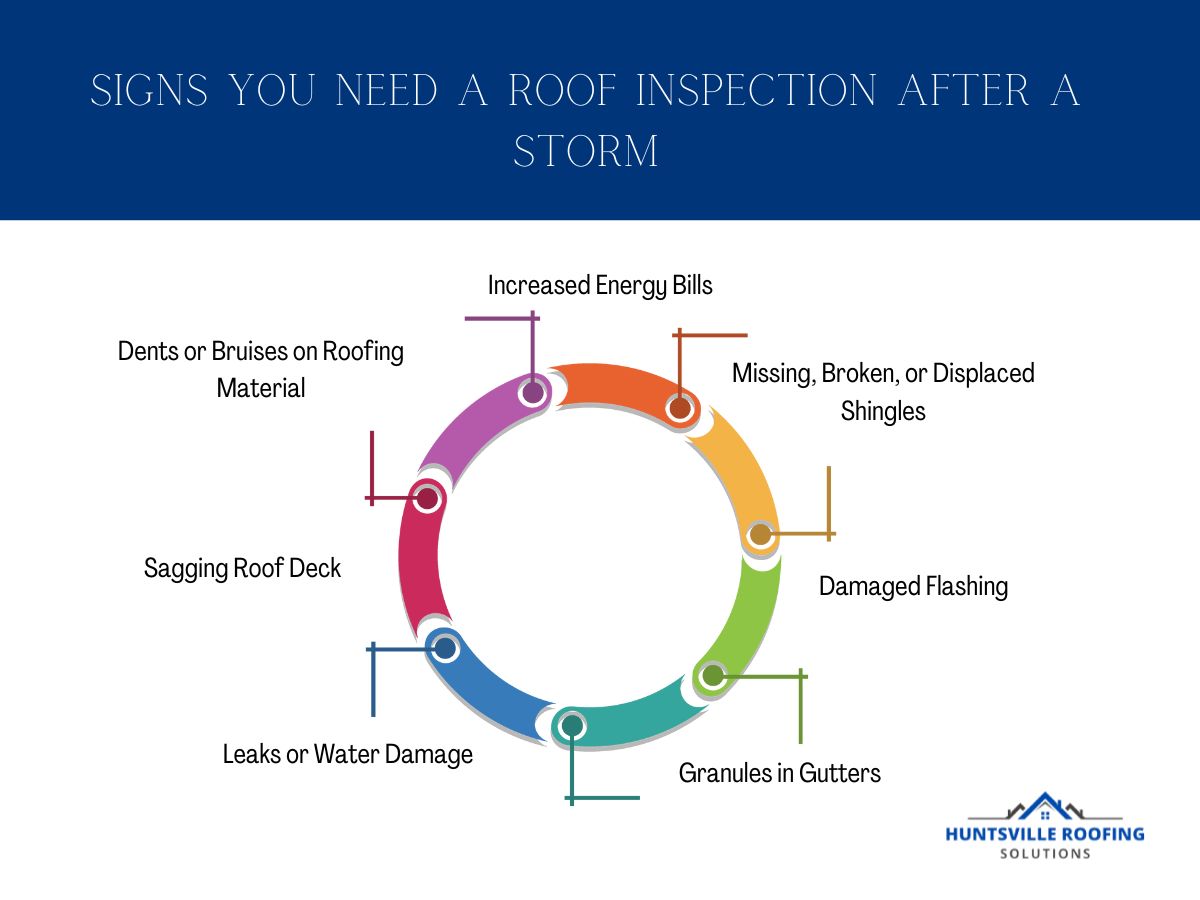
If you already keep roof records, retain previous inspection photographs and repair receipts as well. They can provide useful context when the condition of the roof before the storm matters.
Should You File an Insurance Claim as Soon as You See a Suspicious Spot?
Finding one mark does not tell you whether you have an insurance claim.
First establish what damage is actually present and document it accurately.
Coverage decisions belong to your insurance carrier and depend on the terms of your policy. Normal wear and gradual deterioration should not be represented as storm damage simply because a hail event happened recently.
If an inspection finds legitimate storm-related damage and you need to understand the next steps, Huntsville Roofing Solutions’ roof insurance claim assistance page explains the claim process separately.
Why Hail Identification Matters in North Alabama
North Alabama experiences severe thunderstorms that can combine hail, high winds and heavy rain.
That combination makes cause especially important.
A single storm may leave hail impact in one area, wind-lifted shingles in another and no damage at all on another part of the property.
Your existing site guidance repeatedly makes the same practical point: hail damage can be real without being obvious from the ground.
But subtle does not mean imaginary. It means the inspection has to be careful enough to distinguish legitimate impact damage from ordinary roof wear.
Frequently Asked Questions About Hail Damage on a Roof
What does hail damage look like on asphalt shingles?
Hail damage can appear as localized bruises or dents, disturbed granules around impact areas and darker damaged spots in the shingle surface. It may be difficult to see from the ground, so supporting evidence such as dents in gutters, vents or flashing can also matter.
Are granules in my gutters proof of hail damage?
No. Hail can dislodge shingle granules, but normal aging, foot traffic, abrasion and other forms of deterioration can also cause granule loss. A sudden increase after a storm is worth investigating, but granules alone do not establish the cause.
Can a roof have hail damage without leaking?
Yes. Hail can bruise shingles or disturb their protective granules without creating an immediate leak. Your roof may continue shedding water while damaged areas become weaker and age prematurely.
Are missing shingles a sign of hail damage?
Missing shingles after a severe storm indicate roof damage, but they are commonly associated with wind rather than hail impact itself. Hail and high winds can occur during the same storm, which is why the causes should be documented separately.
Are shingle blisters the same as hail damage?
Not necessarily. Your site’s existing roofing guidance identifies excessive attic heat and inadequate ventilation as causes of shingle blistering. A blistered surface therefore should not automatically be labeled hail damage simply because a storm occurred recently.
Should I climb onto my roof to check for hail bruises?
No. Hail damage can be subtle, and walking the roof creates a fall risk while also potentially dislodging granules or damaging shingles. Check accessible surfaces and the property from the ground, document what you see and use a professional roof inspection when close access is needed.
Does hail damage automatically mean insurance will replace my roof?
No. The existence and scope of roof damage must first be established, and coverage is determined by your insurer under the terms of your policy. A roofing inspection can document physical conditions, but it does not guarantee coverage or a particular claim outcome.
The Bottom Line
Good hail-damage identification is as much about ruling things out as finding damage.
Bruised shingles, localized granule disruption and dents in soft metal can be consistent with hail. But normal granule shedding, heat blisters, age-related curling, foot-traffic wear and wind-lifted shingles have other explanations.
Do not assume a roof is fine because it does not leak, and do not assume every imperfection after a storm is hail damage.
Document the condition, determine the actual cause and scope, and then decide what action is justified.
If the inspection establishes legitimate storm damage and an insurance claim is appropriate, continue with the site’s insurance and storm-damage claim guidance.

Jordan is the founder and owner of Huntsville Roofing Solutions, a locally owned, fully licensed and insured roofing company serving Huntsville and North Alabama. He and roofing supervisor Barry Minor have handled residential and commercial roofs across the region — replacements, repairs, storm damage, and insurance claims — earning a 4.9-star Google rating along the way.