The most important questions to ask a roofing contractor before signing are about who is legally responsible for the work, what the roof actually needs, exactly what the written price includes, which materials will be installed, how unexpected damage will be priced, who performs and supervises the installation, what warranties apply, when payments are due and who returns if something goes wrong. In Alabama, homeowners should also independently verify the contractor’s state credentials and insurance rather than relying on a logo, truck, website or verbal assurance. A good contractor should be able to answer these questions clearly before asking you to commit.
A roof is one of the more expensive systems on a home, but homeowners often spend less time reviewing a roofing agreement than they would comparing a new vehicle.
That is partly because roofing proposals can look deceptively simple.
You may see a product name, a total price and a warranty term.
What you cannot immediately see is whether the price includes the same roof system another contractor quoted, how concealed damage will be handled, whether old flashing will be reused, who is actually installing the roof or what happens if the roof leaks six months later.
The questions below are designed to expose those differences before the contract is signed.
1. What Is the Exact Legal Name of the Company I Am Hiring?
Start with identity before price.
The name on the contract should make sense alongside the company’s license information, insurance documents and payment instructions.
Ask:
- What is the full legal business name?
- Is that the same entity that will sign the contract?
- Who will receive my payments?
- Where is the company’s physical business address?
- Who is responsible for the project after the salesperson leaves?
A trade name or different payment name is not automatically a problem. Businesses can operate under legitimate trade names.
But the contractor should be able to explain the relationship clearly.
2. Are You Properly Licensed for This Roofing Work?
For residential roofing work in Alabama exceeding $2,500, homeowners should verify the appropriate state license.
Do not stop at asking, “Are you licensed?”
Ask for the legal name and license number, then verify the information independently through the Alabama Home Builders Licensure Board.
A printed number on an estimate does not prove that the license is active, belongs to the contracting company or covers the work being proposed.
Our dedicated guide explains how to verify an Alabama roofing contractor’s license and insurance step by step.
Licensing is a minimum credential check. It does not by itself prove that a contractor produces excellent roofing work.
3. Can You Show Me Current Proof of Insurance?
Ask for current documentation rather than simply accepting the phrase “licensed and insured.”
Depending on the contractor and work arrangement, relevant coverage may include:
- Commercial general liability insurance.
- Workers’ compensation coverage where applicable.
- Other coverage appropriate to the business and work being performed.
Check that the insured business name is consistent with the company you are hiring and that the policy dates are current.
Insurance and licensing are separate checks. An active contractor license does not automatically prove that every insurance policy claimed by the salesperson is current.
4. What Did You Actually Find Wrong With My Roof?
A replacement recommendation should begin with a roof condition, not a sales package.
Ask the contractor to show what they observed.
That may include photographs of:
- Missing or damaged shingles.
- Flashing problems.
- Pipe boots and penetrations.
- Granule deterioration.
- Roof valleys.
- Storm-related damage.
- Interior or attic moisture.
- Visible decking concerns.
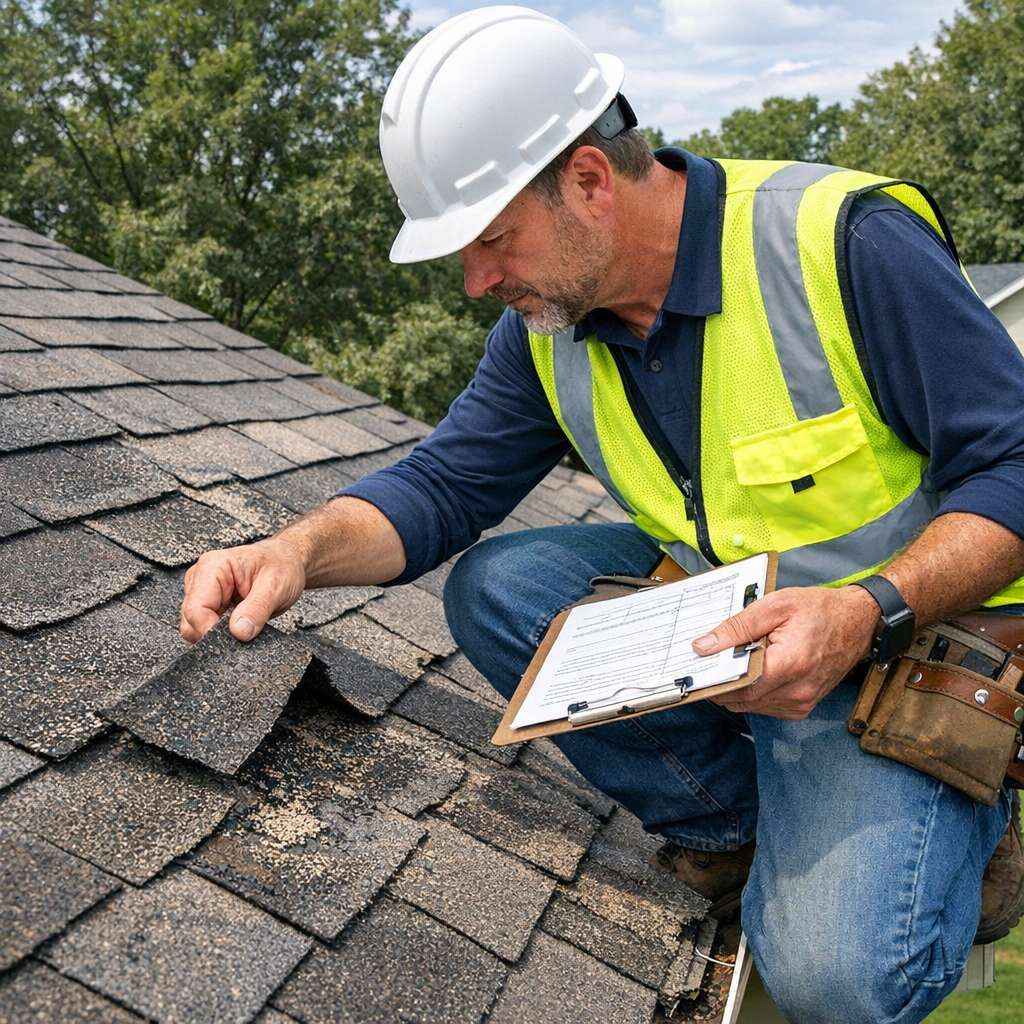
If one contractor recommends a small repair while another recommends complete replacement, ask both to explain the physical evidence behind their recommendation.
A trustworthy answer can sometimes be, “You do not need a new roof yet.”
5. Why Are You Recommending Replacement Instead of Repair?
Not every roof problem requires complete replacement.
Ask whether the problem is:
- Localized or widespread.
- Related to one penetration or flashing detail.
- Caused by storm damage.
- Part of broader age-related deterioration.
- Repairable without creating an unreasonable mismatch in remaining service life.
A contractor recommending replacement should be able to explain why repairing the affected area would not be the better use of your money.
The opposite matters too. A contractor offering a cheap repair on a roof with widespread deterioration should be able to explain what that repair can—and cannot—reasonably accomplish.
6. Exactly What Is Included in the Written Scope?
This is one of the most important questions on the list.
Two proposals can both say “roof replacement” while describing substantially different work.
Ask whether the scope identifies:
- Existing roof tear-off.
- Number of layers being removed.
- Debris disposal.
- Roof deck inspection.
- Underlayment.
- Drip edge.
- Valley protection.
- Starter shingles.
- Field shingles.
- Ridge or hip caps.
- Wall and chimney flashing.
- Pipe boots and penetrations.
- Ventilation components.
- Cleanup.
- Permits where required.
- Workmanship warranty.
For a deeper comparison of what changes the number on an estimate, see our guide to what changes a roof replacement quote.
The lowest total is not automatically the lowest price for the same work.
Sometimes it is simply less work.
7. Which Exact Roofing Products Are You Installing?
“Architectural shingles” is not a complete product specification.
Ask for:
- Manufacturer.
- Exact product line.
- Color.
- Underlayment product.
- Starter product.
- Hip and ridge product.
- Ice-and-water or self-adhered membrane where specified.
- Ventilation products.
This matters because manufacturers often sell several product tiers that can look similar from the ground but have different specifications and warranty terms.
A written product name is easier to compare than “premium shingle.”
8. What Happens If You Find Damaged Decking After Tear-Off?
Roof decking is one of the most common places for an otherwise clear estimate to develop additional cost.
Some decking conditions cannot be fully confirmed until the old roofing is removed.
Before signing, ask:
- Is any decking replacement included in the base quote?
- How much?
- What is the price for additional plywood or OSB?
- Who decides whether a sheet needs replacement?
- Will I receive photographs?
- Do you obtain approval before substantially increasing the scope?
The goal is not to demand that the contractor predict every concealed condition.
The goal is to agree in advance on how surprises will be documented and priced.
9. How Are Change Orders Handled?
A change order is not inherently suspicious.
Roofing work sometimes reveals conditions that were genuinely impossible to see beforehand.
The important issue is process.
Ask whether additional work will be:
- Documented.
- Explained.
- Priced before proceeding where practical.
- Approved in writing.
A vague clause allowing unlimited additional charges is very different from a clear unit price for unexpected decking replacement.
10. Who Will Actually Install My Roof?
The person giving the estimate may never drive a nail.
Ask:
- Do you use employees, subcontractors or both?
- Who supervises the crew?
- Who is my project contact during installation?
- Who checks the completed work?
- Who is responsible if a subcontractor damages something?
Using subcontractors is not automatically a negative. Roofing companies can use subcontracted crews responsibly.
The useful question is whether the contractor maintains clear supervision and remains accountable for the final installation.
11. How Will You Handle Flashing and Ventilation?
Homeowners naturally focus on shingles because shingles cover most of the visible roof.
Leaks often occur at the details.
Ask specifically what will happen at:
- Chimneys.
- Sidewalls.
- Roof-to-wall transitions.
- Plumbing penetrations.
- Skylights.
- Roof vents.
- Valleys.
Also ask whether the contractor has evaluated the existing attic ventilation rather than simply replacing whatever vents happen to be on the old roof.
A new shingle surface does not correct a poorly designed flashing detail or an existing ventilation problem automatically.
12. Who Is Responsible for Permits and Required Inspections?
Permit requirements depend on the property location and project.
Before signing, ask:
- Does this project require a permit?
- Who obtains it?
- Is the permit fee included in the proposal?
- Are inspections required?
- Who schedules them?
Do not assume a county mailing address tells you which permitting jurisdiction controls the property.
The contractor should know how the permitting responsibility will be handled before the project begins.
13. When Will the Project Start, and What Can Change the Schedule?
A responsible contractor can give you an expected window without pretending that roofing schedules are immune to weather.
Ask about:
- Estimated start date.
- Expected project duration.
- Material delivery.
- Rain delays.
- How an open roof will be protected if weather changes.
- What happens if work extends into another day.
Be cautious of confusing an estimated construction schedule with a guaranteed hour-by-hour promise.
Weather, concealed decking damage and material availability can legitimately change timing.
14. What Is the Payment Schedule?
Get payment terms in writing.
Ask:
- Is a deposit required?
- When are progress payments due?
- When is the final balance due?
- Who should the payment be made to?
- What forms of payment are accepted?
- How are approved change orders added to the balance?
Alabama consumer authorities advise homeowners not to pay the full amount—or a substantial portion of it—up front for home-repair work.
A payment request should also make sense in relation to the legal company named on your contract.
15. What Does the Warranty Actually Cover?
There are usually at least two different warranty concepts involved in a new roof.
Manufacturer warranty
This relates primarily to the roofing products and the manufacturer’s terms.
Workmanship warranty
This concerns the contractor’s installation.
Ask:
- How long is the workmanship warranty?
- What does it cover?
- What does it exclude?
- Who handles a workmanship claim?
- What documentation will I receive?
- Does the manufacturer warranty require registration?
- Who completes that registration?
A long manufacturer’s product warranty does not automatically mean labor or installation errors are covered for the same period.
Ask the contractor to separate those two promises clearly.
16. How Will You Protect My Property and Clean Up?
Roof replacement creates substantial debris.
Ask how the crew protects:
- Landscaping.
- Windows and siding.
- Driveways.
- HVAC equipment.
- Decks and patios.
- Vehicles.
Also ask about:
- Daily debris cleanup.
- Final ground cleanup.
- Magnetic nail sweeps.
- Dumpster placement.
- Who is responsible if property is damaged.
Cleanup should be part of the project scope, not an assumption left until the final afternoon.
17. Can I Speak With Customers Whose Projects Are Already Finished?
Online reviews are useful, but references allow more specific questions.
Ask previous customers:
- Did the final price match the written scope?
- Were unexpected costs explained?
- Did the crew protect the property?
- Was cleanup thorough?
- Did the company communicate when the schedule changed?
- Has the company responded to any issue since completion?
The most revealing question may not be, “Did the roof look good on installation day?”
It may be:
“Did they answer the phone when you needed them afterward?”
18. Who Do I Contact If the Roof Leaks After the Job Is Complete?
Ask this before signing, not after the first heavy rain.
You should know:
- Which company remains responsible.
- Who handles service calls.
- How warranty issues are reported.
- What response process applies.
- What documentation should be retained.
Longevity matters because a roof may not reveal an installation issue immediately.
If you are evaluating a company itself rather than only the proposal, you can learn who is behind Huntsville Roofing Solutions and compare that information with the legal entity and credentials on your contract.
19. If Insurance Is Involved, What Will the Contractor Do—and Not Do?
A roofing contractor can inspect physical damage, photograph roof conditions, prepare a construction estimate and answer technical roofing questions.
The insurance company determines coverage under the policy.
For Alabama residential roofing, contractors should not be representing or negotiating the homeowner’s insurance claim as though they were the policyholder’s claims representative.
Ask:
- Will you document the physical roof damage?
- Will you provide a written roofing estimate?
- Who determines whether the loss is covered?
- What communication, if any, will you have with the insurer?
If someone guarantees that an insurer “has to buy the roof,” treat that as a reason to slow the conversation down.
20. What Changes If the Roofer Contacted Me After a Storm?
Nothing about severe weather removes the need for due diligence.
You can still ask for:
- Legal company name.
- License details.
- Insurance evidence.
- Written inspection findings.
- Written scope.
- References.
- Warranty information.
- Payment terms.
An out-of-town contractor is not automatically dishonest, and a local contractor is not automatically excellent.
What matters is whether the business, credentials, work and future accountability can be verified.
Our comparison of storm chasers and established local roofers covers those post-storm checks in more detail.
What Should Be in the Contract Before You Sign?
The answers to the questions above should eventually turn into written terms.
A roofing contract should be sufficiently detailed that another person could read it and understand:
- Who the contracting parties are.
- Which property is involved.
- What work will be performed.
- Which major materials will be used.
- What the project costs.
- How payments work.
- How additional work is approved.
- Expected timing.
- Warranty terms.
- Cleanup responsibility.
Alabama consumer guidance recommends written contracts and specifically advises homeowners to make sure contractor identity, contact information, description of work, estimated project dates and total project cost are documented.
Do not sign a blank or materially incomplete agreement because someone promises that the details will be filled in later.
Is the Cheapest Roofing Contractor Automatically the Wrong Choice?
No.
A lower-priced contractor can legitimately have lower overhead, better material purchasing arrangements or a simpler business structure.
A higher price also does not guarantee better workmanship.
The useful question is whether you are comparing equivalent work.
A $14,000 proposal including new flashing, ventilation corrections, a defined decking allowance and complete accessory system is not directly comparable with a $12,000 proposal that simply says “tear off and install architectural shingles.”
Compare scope against scope first. Compare totals second.
What Answers Should Make You Slow Down Before Signing?
No single awkward answer automatically proves that a contractor is dishonest.
But several patterns justify additional checking:
- “You don’t need to verify our license.”
- “Insurance isn’t important.”
- “We don’t put all that in the contract.”
- “We’ll figure out the decking price later.”
- “The warranty covers everything,” without written terms.
- “You have to sign today.”
- “Pay the whole job now and we’ll schedule you.”
- “Your insurance company has to approve this roof.”
- No clear answer about who returns for warranty work.
The purpose of asking questions is not to trap the contractor.
It is to make the project understandable before money changes hands.
Frequently Asked Questions About Hiring a Roofing Contractor
What is the most important question to ask a roofing contractor?
Start by asking what the contractor found during the inspection and exactly what work they recommend. Then verify who the legal contractor is, their credentials and whether the written scope matches the recommendation.
Should I ask a roofer for their license number?
Yes. For qualifying residential roofing projects in Alabama, ask for the contractor’s legal name and license information and independently verify the record through the Alabama Home Builders Licensure Board.
Should a roofing contractor provide proof of insurance?
Yes. Ask for current proof of applicable coverage and make sure the named insured is consistent with the company you are hiring. Licensing and insurance should be verified separately.
How many roofing estimates should I get?
There is no mandatory number. Multiple written estimates can be useful when the scope is large or recommendations differ, but three poorly documented quotes are not automatically better than two complete ones. Compare inspection findings and scope rather than collecting totals alone.
Should I pay a roofer in full before work starts?
Alabama consumer authorities advise against paying the full amount or a substantial down payment up front. Review the written payment schedule before signing and understand what is due at each stage.
What is the difference between a manufacturer warranty and a workmanship warranty?
A manufacturer warranty generally relates to the roofing product under the manufacturer’s terms. A workmanship warranty relates to installation performed by the contractor. The coverage periods, exclusions and claim processes may be different.
Should I sign a roofing contract immediately after a storm?
Not unless urgent conditions genuinely require immediate action. Temporary protection may be necessary when the home is open to weather, but you can still verify the contractor and distinguish emergency work from a permanent repair or replacement agreement.
The Bottom Line
The best questions to ask a roofing contractor before signing are the ones that turn promises into details you can verify.
You should understand who is responsible for the project, why the roof needs the proposed work, exactly what is included, which products are being installed, how concealed damage is handled, who supervises the installation, what payments are required, what the warranties cover and who comes back if there is a problem.
A good roofing conversation should make the project clearer as it progresses—not more confusing.
If you want to compare those questions against a real inspection and written proposal, you can request a roof inspection and written estimate from Huntsville Roofing Solutions.
Jordan is the founder and owner of Huntsville Roofing Solutions, a locally owned, fully licensed and insured roofing company serving Huntsville and North Alabama. He and roofing supervisor Barry Minor have handled residential and commercial roofs across the region — replacements, repairs, storm damage, and insurance claims — earning a 4.9-star Google rating along the way.