
Quick answer: Paying cash costs less in absolute dollars, but only if writing that check still leaves you with a cash cushion. Borrowing over ten years at a standard rate can add roughly half again to what a roof cost you; borrowing on a promotional plan and clearing it on time adds nothing. So the real decision isn’t about the interest rate — it’s about liquidity. If paying outright would drop your reserves below three to six months of expenses, finance. If it wouldn’t, pay. Most homeowners land somewhere in between: a partial payment down, the remainder financed.

The Question Behind the Question
Most homeowners frame this as “what’s cheaper.” That framing has a clear winner — cash, every time, since borrowing money is never free unless a promotion makes it so.
But cheapest and smartest aren’t the same thing here. A roof is one of the few expenses that arrives on its own schedule rather than yours, and it usually arrives alongside other things. The household that pays cash and then faces a transmission failure or a medical bill six weeks later ends up borrowing anyway, often at a worse rate on a credit card.
So the useful question is narrower: what does each choice cost you, and what does each choice protect? The rest of this page puts numbers on both sides.
What Borrowing Actually Costs
Interest is easy to underestimate because it’s quoted as a monthly payment. Here’s the same $15,000 project seen three ways on a fixed-rate plan around 9.99%:
| Approach | Monthly | Total interest | Total paid |
|---|---|---|---|
| Cash | — | $0 | $15,000 |
| Promotional plan, paid off in time | ~$834 | $0 | $15,000 |
| Fixed rate, 5 years | ~$319 | ~$4,100 | ~$19,100 |
| Fixed rate, 10 years | ~$198 | ~$8,800 | ~$23,800 |
Illustrative figures at 9.99% fixed. Your approved rate and terms will differ.
Two things stand out. First, the ten-year plan has the friendliest monthly number and by far the largest total — that’s the trade the low payment buys. Second, the gap between five and ten years is roughly $4,700, which means term length is a bigger lever than most people realise. If you can carry $319 instead of $198, you keep most of that difference.
It’s also worth noting the middle row. A promotional structure costs nothing if it’s cleared inside its window — but it behaves very differently if it isn’t, and that’s worth understanding before you choose it. We walk through that mechanism in how an 18-month deferred-interest plan works.
What Paying Cash Costs You

Paying outright has a price tag too; it just doesn’t appear on a statement.
You lose the cushion. This is the big one. Money sitting in savings is doing a job — absorbing the next surprise. Spending it means the next surprise gets handled by a credit card at a much higher rate than any roofing plan. A common guideline is to keep three to six months of essential expenses accessible after the project is paid for, not before.
You give up whatever the money was earning. With a competitive savings account paying somewhere in the low-to-mid single digits, $15,000 sitting still for eighteen months earns a meaningful amount. Against a 0% promotional plan, that earning continues while the roof gets replaced — which is precisely why some homeowners who could pay cash choose not to.
You lose optionality. Cash can be redirected. Once it’s in a roof, it isn’t coming back out until you sell the house.
None of this makes paying cash wrong. It makes it a decision with two sides rather than the obvious default it’s often treated as.
When Paying Cash Is Clearly the Right Call
- The reserve survives it. If you can write the check and still have several months of expenses untouched, take the free option. There’s no clever argument for borrowing at a real rate when you don’t need to.
- You hate carrying debt. This is a legitimate reason, not a financial mistake. Sleeping well is worth something, and the arithmetic is close enough that peace of mind can decide it.
- Your credit profile would mean a high rate. If the rate you’d be offered is steep, the math turns against borrowing quickly.
- The job is small. A targeted repair rather than a full replacement often isn’t worth opening an account for. And if a repair would genuinely buy you a few more years, price that before you price anything else.
When Financing Is Clearly the Right Call
- Paying cash would empty the account. If the check leaves you at or near zero, you’ve traded a manageable monthly payment for genuine exposure. Finance it.
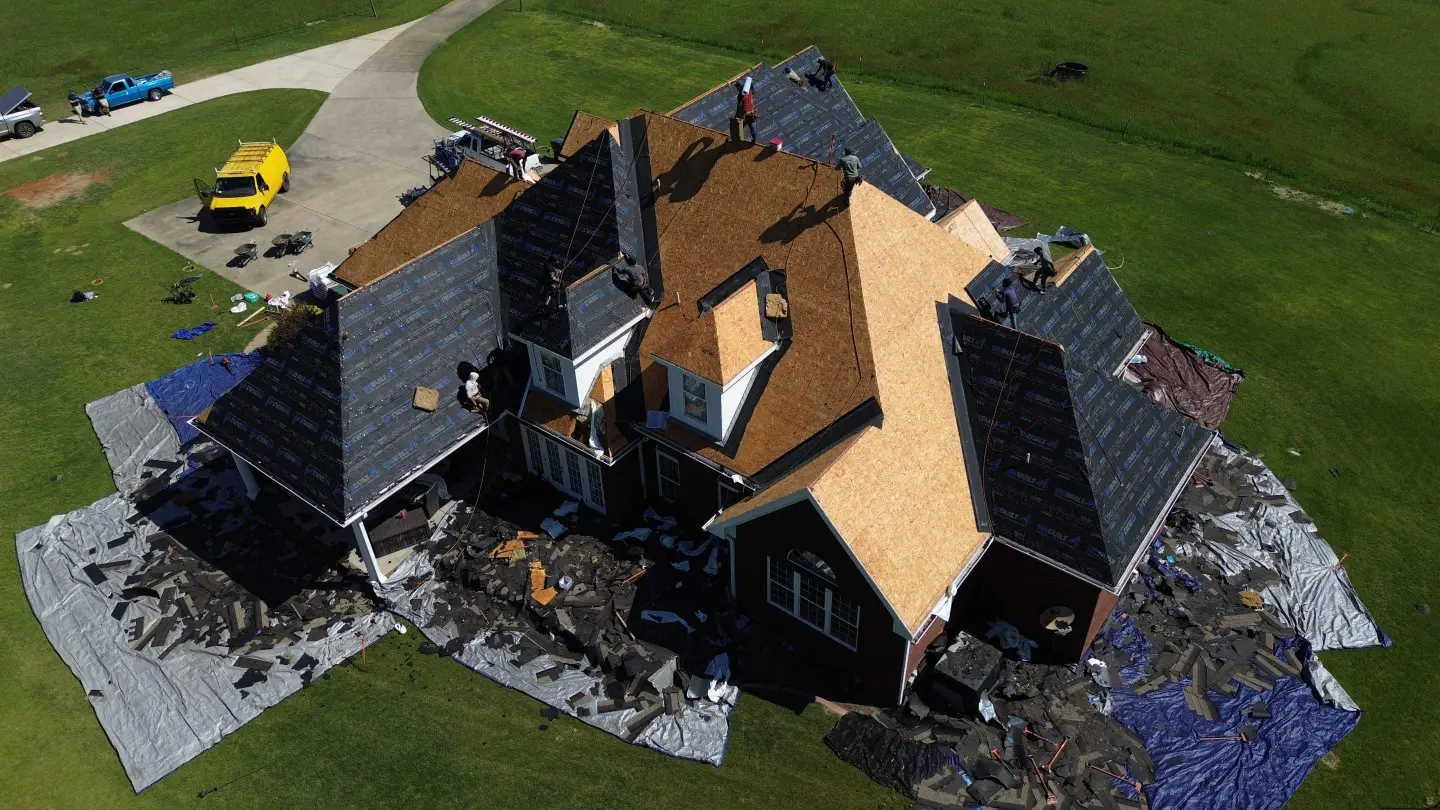
- The roof is actively leaking. Water damage compounds. Decking, insulation, drywall, and framing all cost more to fix than shingles do, so delaying a needed replacement to save up frequently costs more than the interest would have.
- You’d qualify for a promotional plan and can hit the payoff. Free money is free. Keep your cash liquid and pay the plan down on schedule.
- A claim is in progress. Financing bridges the gap so the work happens now, and the settlement — including depreciation released after completion — retires the balance later. Our insurance claim assistance covers how that sequencing works.
The Hybrid Most Homeowners Actually Choose
In practice the decision is rarely all-or-nothing. The common pattern looks like this: put down whatever you can comfortably spare, finance the remainder, then attack the balance with extra principal payments whenever cash flow allows.
This works because it borrows the strengths of both. A partial payment shrinks the amount financed and the monthly figure. Keeping the rest of your savings preserves the cushion. And because these plans carry no prepayment penalty, every additional dollar you send shortens the term and cuts total interest — you’re not locked into the ten-year outcome just because you signed a ten-year plan.
It also stacks cleanly with insurance. A settlement that covers most but not all of a job leaves a remainder that’s easy to finance, which is a far better position than an approved claim you can’t act on.
You can see the specific structures available and what each one requires on our payment plan page, or read the wider overview of every way to pay for a roof if you’re still mapping the landscape.
Five Questions That Settle It
Answer these honestly and the choice usually makes itself.
- After paying cash, how many months of expenses would I have left? Under three, don’t pay cash.
- Do I have a lump sum arriving within eighteen months? A refund, bonus, settlement, or asset sale points toward a promotional plan rather than either extreme.
- Can I carry the shorter-term payment instead of the longest one? If yes, take the shorter term — that’s where most of the savings sit.
- Is the roof leaking right now? If yes, timing outranks optimisation. Move.
- Would carrying a balance genuinely bother me? If it would, weight that heavily. The dollar difference is smaller than the stress difference.
Frequently Asked Questions
Is it better to finance or pay cash for a new roof?
Cash is cheaper in raw dollars if it doesn’t exhaust your reserve. Financing is better when paying outright would leave you without a cushion, or when a promotional plan means you pay no interest at all.
How much interest would I pay on a roof loan?
On a fixed plan near 9.99% over ten years, a $15,000 roof runs roughly $8,800 in interest. Over five years it’s closer to $4,100. On a promotional plan cleared in time, nothing.
Should I drain my savings to avoid financing?
Usually not. Aim to keep three to six months of expenses accessible after the project is paid for.
Can I pay part cash and finance the rest?
Yes, and it’s the most common approach. It lowers both the borrowed amount and the payment while keeping a reserve intact.
Is there a penalty for paying a roof plan off early?
These plans typically have none, so extra payments reduce principal and total interest. Confirm it in your agreement before signing.
Does a new roof add enough value to justify borrowing?
A replacement reliably improves saleability and prevents costlier structural damage, though it rarely returns its full cost as resale value. Treat it as protection first and an upgrade second.
See Both Numbers Before You Decide
This decision is much easier when you’re looking at your actual project rather than a hypothetical $15,000. Once we’ve scoped your roof, we’ll show you the cash figure and the monthly figure across each term side by side — including the total interest, not just the payment — so you can see the trade rather than guess at it.
No obligation, and no pressure toward the plan that happens to look best in an ad.
Get My Free Quote
See Payment Plans
Serving Huntsville, Madison, Athens, Decatur, Harvest, Meridianville, and the greater Tennessee Valley. Figures on this page are illustrative, not a financing offer, and not personalised financial advice. Rates, terms, and approval are set by the lender.

Jordan is the founder and owner of Huntsville Roofing Solutions, a locally owned, fully licensed and insured roofing company serving Huntsville and North Alabama. He and roofing supervisor Barry Minor have handled residential and commercial roofs across the region — replacements, repairs, storm damage, and insurance claims — earning a 4.9-star Google rating along the way.