
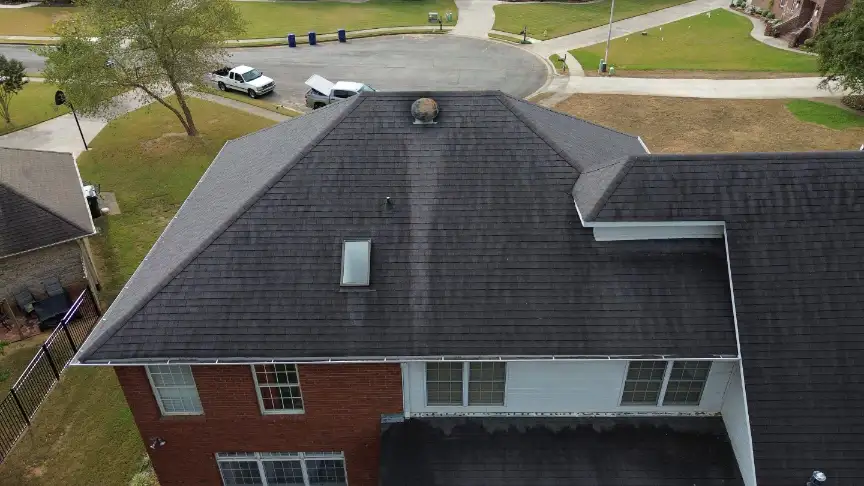
That is the reason for paying extra attention to these details during the roof inspection in Huntsville.
Your shingles may look perfect while a small flashing joint on the sides of the chimney or skylight lets the water into the roof structure.
Why Do Chimneys and Skylights Leak So Often?
The regular asphalt roof functions based on overlapping materials that make the water run down towards the eaves.
Chimneys and skylights are interrupting this process.
Instead of water moving down one continuous shingle field, the roof now has to channel water around the vertical object, then redirect it around the several corners and finally move it back onto the roof surface.
All this process largely depends on flashing.
Roof flashing is a water-resisting material installed at junctions and penetrations of the roofing system that cannot be sealed using shingles alone. As GAF roof-leak guidance points out, damaged or deteriorating flashing around chimneys, skylights, vents and other penetrations is a common source of moisture intrusion.
As you can see from the above, roof flashing is not just one strip of metal around the object. Properly built chimneys or skylights usually employ several pieces that are working as a team in order to channel water properly.
What Usually Causes a Chimney Flashing Leak?
A masonry chimney creates four different roof-to-wall transitions: the downslope face, both sides and the upslope face. The management of water differs in each of these areas.
1. Step Flashing Has Shifted, Corroded or Was Installed Improperly
On both sides of the chimney, individual pieces of step flashing are usually inserted into the shingle courses. The water is supposed to move down the roof as each of the pieces overlaps the one below.
If the pieces of flashing are missing, too short, incorrectly positioned, rusted or disturbed during the previous repairs, water can penetrate behind the roofing.
As the flashing is partly covered by shingles and counter flashing, this defect may not be seen from the ground.
2. Counter Flashing Has Pulled Away From the Chimney
Counter flashing covers the top edge of the step flashing where the roof meets masonry.
This type of flashing is supposed to prevent water running down the chimney wall from penetrating into the lower flashing system.
Gap formation can occur as a result of metal flashing loosening, mortar deteriorating, repair material failing or movement caused by temperature change of the chimney and roofing surfaces.
This is one of the reasons why applying new sealant on the outside of the joint may stop a drip temporarily without solving the flashing detail underneath.
3. The Front Apron Flashing Is Not Properly Directing the Water Onto the Roof
Downslope face of the chimney employs apron flashing in order to channel water from the masonry back onto the roof surface.
If the apron is damaged, punctured, poorly lapped or pulled away from other materials, water can move behind the shingles.
4. Water Is Getting Behind the Chimney on the Upslope Side
Upslope side of the chimney is its most loaded part since the runoff water moving down the roof hits the uphill side of the masonry and has to split around it.
In addition to that, this area may use back-pan flashing and, depending on the configuration of the chimney and roof, cricket or diverter in order to redirect the water.
The water accumulation and debris around the chimney can make this problem even worse.
If water sits or backs up in this area, even a small flashing defect can become evident during a stormy weather.
What If the Chimney Flashing Looks Fine?
Not every chimney flashing leak originates at the roof flashing.
There are other possible points of entry into the masonry chimney.
- The cracked or deteriorated mortar joints can absorb or let water in.
- The damaged chimney crown can let water inside the masonry.
- The absent or damaged cap can expose the flue system to the rain.
- The porous or deteriorated masonry can absorb the water during prolonged rainfall.
- The water can get into the roof further upslope and travel down the roof deck before reaching the chimney.
This differentiation is important since rebuilding a perfect flashing will not solve the problem of water leaking from the top or face of the masonry chimney.
The proper diagnosis of the problem should be done to check whether the water gets into the roof, into the chimney or into both of these structures.
What Usually Causes a Skylight to Leak?
Another interruption of the roofing surface is the skylight. While the water management system of a skylight is different from a masonry chimney one, the flashing system can be similar.
Depending on the configuration of the skylight and the type of roofing material, the skylight flashing assembly can include sill flashing at the bottom, side or step flashing, head flashing at the top, underlayment around the opening, the skylight frame or curb, gaskets and glazing components.
According to the installation guidance of VELUX, their skylight flashing systems are supposed to cooperate with roofing material and provide water drain from around the unit rather than let it enter the roof opening. VELUX’s installation guidance also stresses that the slope of the roof matters as the system requires sufficient slope for water movement. Refer to the manufacturer’s guidance on skylight flashing.
1. The Skylight Flashing Was Disturbed
Reroofing or repair of the roof can disturb the flashing even if the skylight was not intentionally removed.
After the flashing pieces are bent, punctured or incorrectly reinstalled, the original sequence of water management may be broken.
This is especially true in case a skylight started leaking right after the roofing work in the vicinity of the skylight.
2. The Underlayment Around the Opening Was Not Properly Installed
The flashing is only a part of the water-management system.
Underlayment around the skylight is the second line of protection under the roof and flashing.
According to the VELUX replacement installation guidance, removal and replacement of the flashing and underlayment around the existing skylight is included into reroofing and skylight replacement work.
The surface bead of sealant cannot serve as a replacement for the missing or improperly integrated material.
3. The Water Is Entering Around the Frame or Glazing
Sometimes the roof flashing can be working properly, but the problem can be with the skylight itself.
The aged gaskets, frame components, glazing seals or any damage to the unit can lead to water entry above the flashing system.
This problem is more likely to happen when the skylight is old or moisture appears despite the roof around it being in good condition.
4. The Leakage Is Caused by Condensation
The water inside the skylight does not necessarily come from rain.
Warm, humid interior air can condense on a cold skylight surface and run downward, leaving a stain or dripping that looks exactly the same as a roof leak.
The timing of the appearance can give an important clue about the problem.
If moisture appears during the rain, the flashing or the skylight assembly has to be inspected. If moisture appears during cold morning or high indoor humidity, the condensation has to be taken into consideration.
Chimney Leak vs. Skylight Leak: What Does the Pattern Tell You?
| What you see | Possible area to inspect | Important note |
|---|---|---|
| The stain next to the chimney after the wind-driven rain | Step flashing, counter flashing, upslope flashing | The water could enter through the masonry |
| The leak appears behind the chimney | Back pan, cricket/diverter area, debris buildup | The entrance point may be further upslope |
| The water appears at the lower edge of the skylight | Sill flashing and roofing around it | The water entrance may be at the top of the skylight |
| The water appears near the upper part of the skylight frame | Head flashing, underlayment or frame | Condensation or glazing issues can imitate a roof leak |
| The leak happens only during severe rain | Flashing laps, lifted materials or wind-driven entry | Appearance of the rain does not reveal the defective component |
If the problem occurs during the severe storms, our separate article explains why roofs leak only during heavy rain without making this chimney-and-skylight article a general storm-leak page.
Why the Ceiling Stain Is Often Not Directly Below the Leak
The biggest mistake people tend to make while diagnosing roof leaks is the location of the interior stain.
The water can get into the roof beside the chimney or skylight, move down the roof deck, travel along the sheathing, rafters, nails or underlayment and finally drip onto the insulation or drywall several feet away.
This means that cutting the ceiling directly under the stain or sealing the roof directly above it may not solve the problem.
The proper inspection of the problem should be made in both directions: starting from the roof flashing and from the attic or interior evidence underneath it.
Is Caulking the Chimney or Skylight a Proper Repair?
Sometimes sealant can be an appropriate part of a repair. It should never be seen as a whole repair.
If a small sealant joint has reached the end of its service life and the underlying flashing is still in place and in good shape, the cleaning and resealing of the joint can be a reasonable solution.
This is different from the situation when you apply a thick layer of roofing cement or caulk on the damaged flashing.
If the flashing is loose, incorrectly lapped, punctured, corroded or missing, the proper repair may require removing the adjacent shingles, exposing the flashing and rebuilding the water-shedding system underneath.
The same thing is true for the skylights. Covering the perimeter with the sealant will not solve the problem of a failed flashing or underlayment joint.
Can a Chimney or Skylight Leak Usually Be Repaired Without Replacing the Roof?
Often, yes.
Chimney and skylight leaks are often localized as the failure occurs in the area of one roof penetration while the surrounding shingle field remains intact.
Such repair can consist of replacing the damaged shingles around the opening, rebuilding flashing, correcting the underlayment detail, repairing the small damaged decking or fixing the penetration itself.
This is exactly what we explain in our guide on localizing roof repair.
However, the localization of water entrance does not mean the localization of the damage.
The active leak can lead to deterioration of the large section of the decking or insulation. Several leaks or deterioration of shingles can indicate that the roof requires the bigger evaluation.
If you notice any other warning signs away from the chimney or skylight, compare them to our early signs a Huntsville roof requires repair.
Why Huntsville Weather Makes These Details Worth Watching
North Alabama roofs experience heavy rainfall, wind-driven storms, strong summer heat and frequent temperature changes.
This is important in case of chimneys and skylights since both of these features represent a joint between different materials.
Metal flashing, shingles, masonry, sealants, wood framing and skylight components do not react to the changes the same way.
The detail that performed well when it was newly installed can eventually develop a gap as the sealant ages, fasteners loosen, the mortar deteriorates or the roofing materials are repaired around it.
The practical approach to such a situation is not assuming these areas will leak. It is inspecting them before the small weakness will have enough time to wet the roof decking underneath.
What Should Be Checked During a Chimney or Skylight Leak Inspection?
A useful inspection should not be limited to the first visible bead of sealant.
For a chimney, the inspection should include:
- Step flashing on both sidewalls.
- Counter flashing on the masonry.
- Front apron flashing.
- Back-pan or upslope flashing.
- Cricket or diverter in case it is present.
- Condition of the shingles around the chimney.
- Condition of the mortar joints and masonry.
- Chimney crown and cap if it is related to the problem.
- Decking or attic evidence below the area.
For a skylight, the inspection should include:
- Head, side and sill flashing.
- The shingles around the unit.
- Underlayment integration in case it is accessible.
- The frame or curb.
- Glazing and gasket condition.
- Water or debris accumulation upslope of the skylight.
- Interior condensation patterns.
- Roof decking and insulation below the opening.
The purpose of this inspection is to determine where the water enters the roof, why it can enter there and how far the water has moved inside the roof structure.
When Should You Have These Areas Inspected?
You do not need to wait until the water will get to the ceiling.
These roof areas are worth inspecting during the routine roof inspections, after the work is done around them, after the severe weather, when the sealant or flashing is visibly deteriorating or when any unexplained ceiling stain appears in the vicinity.
This is when the preventative maintenance is most beneficial: finding the problem with the flashing while it is still a flashing problem rather than waiting for rotten decking, wet insulation and damaged drywall to appear.
For the ongoing inspection and preventive roof care, refer to our roof maintenance program.
Frequently Asked Questions About Chimney and Skylight Leaks
How Do I Know If I Have a Chimney Flashing Leak?
The stain or drip near the chimney that appears during the rain can be a sign of flashing leakage, especially if the surrounding roof is in a good condition. However, there are many other possible reasons: masonry, mortar, the chimney crown, the cap or the water entering farther upslope. The flashing and chimney have to be inspected together.
Can You Fix a Chimney Flashing Leak Without Replacing the Roof?
Usually, yes. If the surrounding roof still has the useful service life and the damage is localized, a roofer can remove shingles around the chimney, build the proper flashing detail, replace the small damaged decking area and reinstall the surrounding roofing.
Why Does My Skylight Leak Only During Heavy Rain?
Heavy or wind-driven rain can expose a marginal flashing lap, underlayment problem or a small opening that ordinary rainfall cannot reach. This pattern is helpful for diagnostics, but it cannot be used as a proof of what skylight component has failed.
Does a Leaking Skylight Require to Be Replaced?
No. If the skylight itself is still in good condition and the problem is limited to the flashing or roofing around the skylight, it is possible to make a localized repair. However, if the frame, glazing system or other parts of the skylight are deteriorated or roof replacement is required, the skylight replacement is a better choice.
Can Condensation Be Mistaken for a Skylight Leak?
Yes. The indoor humidity can condense on a cold skylight surface and run down the frame, leaving moisture that resembles the rain intrusion. If the moisture appears even when it is not raining, condensation should be considered as part of the problem diagnosis.
Will Caulk Solve the Problem With Chimney Flashing Leak?
It depends on the defect. Sealer can be an appropriate component of the repair if it is applied to a specifically designed joint. However, it cannot be applied to incorrectly installed, loose, corroded or missing flashing. A proper repair should fix the water-shedding detail.
The Bottom Line
The chimney and skylight are among the most common sources of roof leaks because of the interruption of the roof’s natural water-shedding process. At chimneys, step flashing, counter flashing, apron flashing and upslope details are the primary candidates for inspection. At skylights, flashing, underlayment, framing and the skylight itself are all important.
But location is not necessarily diagnosis.
Masonry can leak at chimneys. Condensation can form in skylights. And water may get into the roof at other places and travel to its destination inside the home.
The proper solution is to find the entry point, inspect the underlying material and repair the failure rather than just keep addressing the symptom.

Jordan is the founder and owner of Huntsville Roofing Solutions, a locally owned, fully licensed and insured roofing company serving Huntsville and North Alabama. He and roofing supervisor Barry Minor have handled residential and commercial roofs across the region — replacements, repairs, storm damage, and insurance claims — earning a 4.9-star Google rating along the way.