
Wind Damage vs. Wear and Tear: How Adjusters Decide
Wind damage can be difficult to separate from normal roof wear because the adjuster has to determine what existed before the storm and what physically changed during it. Evidence of wind damage can include missing, torn, displaced, or creased shingles, damage patterns that make sense for wind exposure, fresh exposed surfaces, and storm timing. Wear and tear is more likely to show as gradual aging, granule loss, curling, brittle shingles, old repairs, corrosion, or repeated leakage. Roof age matters, but age by itself does not prove the cause. Coverage ultimately depends on the evidence, the reported event, and the specific insurance policy.
What Is the Adjuster Trying to Decide?
At first, the question seems simple:
Is the roof damaged?
But there is a more important question:
What caused the damage, and is that cause covered by the policy?
A roof can contain several different conditions at the same time. One area may have shingles removed during a recent windstorm, while another area may have been deteriorating, leaking, repaired, or installed incorrectly for years.
This distinction matters because homeowners insurance is not intended to function as routine roof maintenance.
The Alabama Department of Insurance explains that when only part of a roof is damaged by a covered peril, the insurer is generally responsible for the covered damaged portion. If the remaining roof needs replacement because of normal wear and tear, that additional work may remain the homeowner’s responsibility.
That is why the age of the roof and the cause of the damage are separate questions.
What Does Wind Damage Look Like?
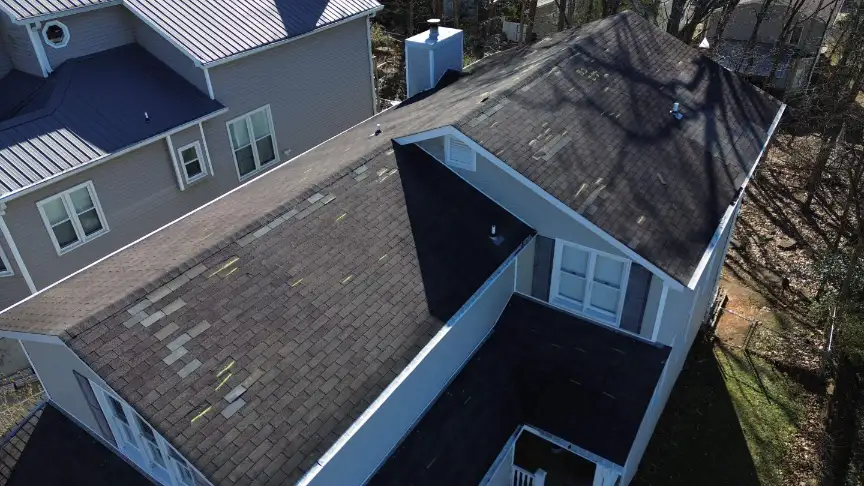
Actual wind damage usually involves a physical change to the roofing material.
Depending on wind speed, roof geometry, installation quality, shingle condition, and where wind pressure was strongest, an inspector may find:
- Missing shingles or shingle tabs.
- Shingles displaced from their original position.
- Torn roofing materials.
- Creases caused by lifting and bending.
- Fastener pull-through or detachment.
- Damage near roof edges, ridges, rakes, or other high-pressure areas.
- Damage caused by wind-blown objects.
- Newly exposed roofing surfaces beneath missing shingles.
Wind creates pressure and suction across a roof surface. Asphalt shingles rely partly on their adhesive seal to resist that force.
Once a shingle tab lifts, the wind can place additional stress on it. That can lead to creasing, tearing, displacement, or complete removal.
However, none of these observations should end the analysis by themselves.
An inspector looks at the roof as a whole rather than treating one damaged shingle as automatic proof of a covered wind event.
What Does Normal Roof Wear and Tear Look Like?
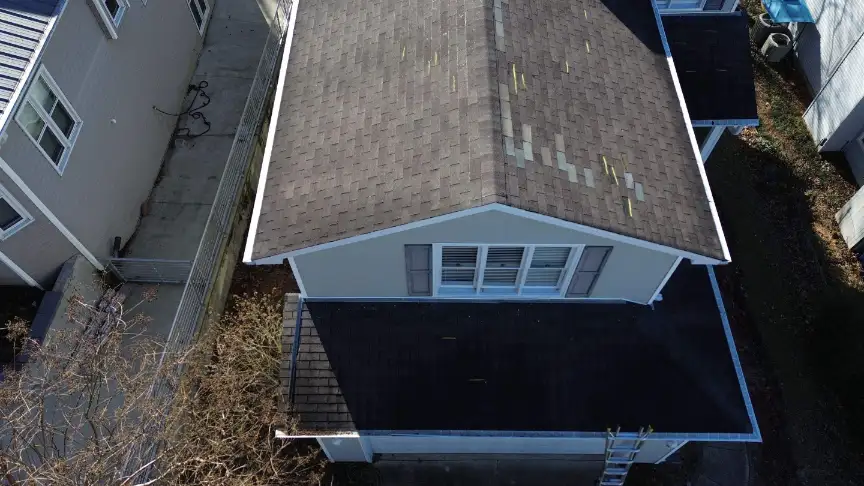
Normal wear and tear usually develops slowly.
Age-related deterioration of asphalt shingles can include:
- Gradual granule loss across large areas.
- Fading and discoloration.
- Curling or distortion across multiple shingles.
- Brittleness caused by weather exposure.
- Sealant deterioration.
- Long-term cracking.
- Old repairs or patches.
- Repeated leaks around flashing or roof penetrations.
- Corrosion of fasteners or other components.
- Similar deterioration across several roof slopes.
The difference is often the timeline.
Wind is an event. Aging is a process.
That does not mean an older roof cannot suffer wind damage. It can.
In fact, aging can make a roof more vulnerable to wind.
Does an Old Roof Prove the Damage Is Wear and Tear?
No.
Roof age can be relevant, but it does not automatically prove what caused the damage.
An older asphalt roof can still lose shingles during a windstorm.
However, older shingles may have less resistance to wind than they did when they were new. That can make the causation question more complicated.
Research from the Insurance Institute for Business & Home Safety shows that asphalt-shingle wind performance can change as a roof ages. Climate, roofing product, orientation, installation, and seal condition can all influence that performance.
IBHS has also reported that shingle seal resistance can deteriorate significantly over time, with vulnerability increasing substantially in some roofs after roughly 7 to 10 years.
That is not an insurance cutoff.
There is no magic seven- or ten-year point when legitimate storm damage suddenly becomes wear and tear.
It simply means an older roof may not perform against wind the same way it did when it was new.
Can Wind Damage and Wear and Tear Happen at the Same Time?
Yes.
This is one of the most important ideas for homeowners to understand when dealing with a wind damage roof claim.
A roof can be old and still suffer new storm damage.
For example, imagine a 17-year-old asphalt roof with normal granule loss and some sealant deterioration.
A severe storm then removes eight shingles from the west-facing slope.
The aging process did not necessarily remove those eight shingles. But the roof’s age may have reduced the shingles’ ability to resist the wind.
The adjuster may therefore need to separate:
- Conditions that were already present before the storm.
- Physical changes that happened during the storm.
- Repairs required because of those new changes.
- Repairs or replacement that would eventually have been necessary because of normal aging.
This is also why a roofing contractor should document what is actually found instead of simply labeling the entire roof as “wind damaged.”
What Evidence Does an Insurance Adjuster Consider?
There is no single physical sign that decides every wind claim.
An adjuster usually looks at several pieces of evidence together.
1. The Date and Reported Storm
The reported date of loss provides context.
An adjuster may compare that event with available weather information and the condition found at the property.
A strong storm in the area does not automatically prove that every roof condition happened during that storm.
At the same time, a lack of obvious neighborhood-wide damage does not prove an individual roof was unaffected.
The roof still needs to be inspected.
2. The Pattern of Damage
Wind pressure is not distributed evenly across a roof.
Roof shape, wind direction, ridges, edges, valleys, nearby buildings, and surrounding terrain all affect how wind moves over the structure.
That is why technical investigations look at whether the location and distribution of the damage make sense for wind exposure.
Damage scattered randomly across an old roof can tell a different story from concentrated, fresh damage following a storm.
3. Whether Shingles Are Torn, Creased or Displaced
A shingle that has physically torn, folded, creased, moved, or blown away is different from a shingle that simply no longer has an effective seal.
This distinction matters because an unsealed shingle is not automatically a wind-damaged shingle.
Shingles can lose their seal because of aging, thermal movement, installation conditions, contamination of the sealant strip, or other causes unrelated to one recent storm.
4. The Appearance of Exposed Surfaces
The condition of material exposed beneath a missing shingle can sometimes give clues about whether the damage is recent.
Freshly exposed asphalt may look different from material that has been exposed to sunlight and weather for months or years.
Corrosion on previously exposed fasteners can also provide context.
But this type of evidence is not a stopwatch. Weathering rates vary.
5. The General Condition of the Roof
An adjuster may also look at:
- Overall granule condition.
- Shingle flexibility.
- Previous repairs.
- Cracking or curling.
- Flashing condition.
- Installation quality.
- Visible decking condition.
This does not mean an old roof has no coverage.
It means the overall condition helps establish what may have existed before the reported storm.
6. Damage Elsewhere on the Property
Adjusters may also look at other exterior components for evidence supporting the reported storm.
Depending on the weather event, that can include siding, gutters, fascia, fencing, trees, or exterior fixtures.
Additional evidence helps because the roof does not exist in isolation.
7. Interior Stains or Water Damage
Interior stains and water damage can help identify where a roofing problem exists.
But a leak does not automatically prove its cause.
Wind damage can create an opening that leaks.
So can deteriorated flashing, failed sealant, poor installation, or a problem that existed before the storm.
The source still needs to be identified.
Do Missing Shingles Automatically Mean Insurance Will Pay?
No.
Missing shingles show that roofing material is gone. But a claim still needs a cause.
Questions may include:
- Were the shingles present immediately before the reported storm?
- Do the exposed areas appear fresh or weathered?
- Does the pattern make sense for wind exposure?
- Were the shingles properly fastened?
- Was there previous damage in the same area?
- Does the policy cover the cause of loss?
This is why homeowners should be cautious when someone promises that missing shingles automatically mean insurance will pay for a new roof.
A roofer can inspect and document the damage.
The insurance company decides whether the loss is covered under the policy.
Are Loose or Unsealed Shingles Automatically Wind Damage?
No.
This is one of the more disputed parts of roof inspections.
Wind can lift shingles, especially when the sealant bond is already weak or has failed.
But being able to lift a shingle by hand does not prove that a recent windstorm damaged it.
Technical roof investigations distinguish actual physical wind damage—such as displacement, tearing, creasing, or removal—from a shingle that simply does not have an effective seal.
That is why the inspection should focus on physical evidence rather than one test alone.
What If Installation Problems Made the Roof More Vulnerable?
This can complicate the claim.
A high-nailed, under-fastened, overdriven, or poorly sealed shingle may be more vulnerable to wind than one installed correctly.
Technical investigations have found substantially greater wind damage on some roofs where shingle fastening was incorrect.
However, that does not tell us automatically how an insurance policy will treat the resulting damage.
The physical cause and the insurance coverage question are separate.
An adjuster may document both the new storm-related damage and an underlying installation problem, while the insurance company applies the policy wording.
What Is the Roofer’s Role in a Wind Damage Claim?
A roofer and an insurance adjuster have different responsibilities.
The roofing contractor can:
- Inspect the roofing system.
- Photograph damaged areas.
- Identify missing, torn, creased, or displaced roofing materials.
- Identify repairability concerns.
- Measure the roof.
- Prepare a repair or replacement estimate.
- Explain what roofing work is required.
The insurance company—not the roofer—determines whether the policy covers the loss and what payment applies.
Huntsville Roofing Solutions provides roof insurance claim assistance in Huntsville by inspecting and documenting roof conditions that homeowners may need during the claims process.
A contractor should not promise that an insurer will approve a claim.
What Is the Adjuster’s Role?
After a claim is filed, the adjuster inspects and documents the loss for the insurance company.
According to the Alabama Department of Insurance, an adjuster may inspect exterior damage, the roof, interior damage, and temporary repairs.
The inspection can include:
- Measurements.
- Photographs.
- Damage quantities.
- Policy-related information.
- Repair estimates.
If the roofer is present, the two may discuss what each has observed.
That does not mean the roofer controls coverage or the adjuster controls how the roofing system physically works.
They are evaluating the property from different professional perspectives.
What If Only Part of the Roof Has Wind Damage?
This is where the difference between physical damage and the scope of replacement becomes important.
Imagine that wind damages ten shingles on one roof slope while the rest of the roof shows normal aging.
The age of the roof does not erase the ten damaged shingles.
But those ten damaged shingles do not automatically prove that the entire roof suffered wind damage.
The Alabama Department of Insurance explains that the insurer is generally responsible for the portion damaged by a covered peril, while replacement needed solely because of normal wear and tear may remain the homeowner’s responsibility.
The real scope can also depend on repairability, the policy, code requirements, material availability, and the specific circumstances of the claim.
If the damaged roofing can be repaired, repairing wind-damaged shingles may be the appropriate solution.
If the damage or overall roof condition requires more extensive work, homeowners may also need to understand what is involved in a complete roof replacement.
Does Roof Age Affect the Insurance Payment?
Potentially, yes.
But that is a separate issue from determining what caused the damage.
The Alabama Department of Insurance distinguishes between Actual Cash Value and Replacement Cost coverage.
With Actual Cash Value (ACV), age and wear can affect the amount of depreciation applied to the settlement.
With Replacement Cost Value (RCV), covered damaged property may be repaired or replaced using like-kind-and-quality materials without the same final depreciation deduction, subject to the policy’s terms.
This is why homeowners should not assume that “covered wind damage” automatically means the insurer immediately pays for an entirely new roof.
Coverage type, depreciation, deductible, roof endorsements, policy limits, and settlement terms all matter.
Why Documentation Before and After the Storm Matters
Good documentation makes the cause easier to evaluate.
Existing photos taken during an inspection, home purchase, maintenance visit, or previous repair can help show what the roof looked like before the reported storm.
After a storm:
- Photograph visible damage before cleanup.
- Take wide photos as well as close-ups.
- Record when you first noticed the damage.
- Photograph interior stains or leaks.
- Keep damaged materials when it is safe and practical.
- Keep receipts for reasonable temporary repairs.
- Avoid unnecessary permanent work before the insurer can inspect unless repairs are needed to prevent further damage.
The Alabama Department of Insurance recommends documenting losses with photos or video before debris is removed and taking reasonable temporary steps to prevent further damage.
What If Temporary Repairs Are Needed?
You should not allow preventable water damage to continue just because the adjuster has not arrived yet.
Temporary work can include tarping an opening or protecting a damaged area from additional rain.
Whenever reasonably possible, document the condition before the temporary repair and keep photos and receipts afterward.
A tarp does not mean the insurer approved the claim.
It simply helps prevent additional damage while the cause and extent of the loss are being investigated.

What If the Roofer and Adjuster Disagree?
A disagreement does not automatically mean either side is doing something wrong.
They may disagree about:
- Whether a condition is recent.
- How many shingles have physical damage.
- Whether a repair is technically feasible.
- Whether decking or other components require replacement.
- The estimated cost of the work.
The first step is documentation.
Ask what physical evidence supports each position.
If additional damage is discovered later, the Alabama Department of Insurance recommends notifying the insurer and adjuster so the new information can be considered.
If an Alabama homeowner has tried to resolve a dispute directly with the insurance company and remains dissatisfied, the Alabama Department of Insurance also provides a consumer complaint process.
Wind Damage vs. Wear and Tear: Quick Comparison
| Observation | May Support Wind Damage | May Support Wear and Tear |
|---|---|---|
| Missing shingles | Recent removal associated with storm conditions | Missing areas that show long-term weathering or older unresolved damage |
| Creasing | Shingle lifted and bent by wind forces | Mechanical damage from another cause must also be considered |
| Granule loss | Can accompany physical storm damage depending on circumstances | Gradual, widespread granule loss is common with aging |
| Unsealed shingles | Wind may take advantage of an already weak seal | Lack of seal alone does not prove recent wind damage |
| Damage pattern | Location and distribution make sense for wind exposure | Deterioration appears broadly and consistently across the roof |
| Exposed surfaces | Fresh exposure can support recent material loss | Weathering, oxidation, or corrosion may indicate older exposure |
| Roof age | An older roof can still sustain new wind damage | Age may explain some pre-existing deterioration |
This comparison is only a general guide. It is not a checklist for approving or denying an insurance claim.
What Should You Do If Your Huntsville Roof Is Damaged?
If you think the roof may have storm damage, do not decide whether to make a claim based only on what you can see from the driveway.
Missing shingles can be obvious, but many roofing conditions are difficult to evaluate properly from the ground.
A practical sequence is:
- Document visible exterior and interior damage.
- Take reasonable steps to prevent additional water intrusion.
- Review your homeowners policy and deductible.
- Have the roof professionally evaluated.
- Keep inspection photos and repair estimates.
- Contact your insurance company if you decide to file a claim.
Homeowners dealing with storm damage can review the Huntsville Roofing Solutions insurance claims process for more information about inspections and claim documentation.
If you are in northwest Madison County, the Harvest storm-damage roofing guide also covers local wind and hail response.
The Bottom Line
In a wind damage roof claim, the adjuster is trying to separate what physically happened because of the storm from what developed gradually over time.
Missing or creased shingles can support wind damage, but their presence alone does not guarantee coverage.
Likewise, an old roof can show normal wear and still sustain legitimate new storm damage.
The strongest evidence connects three things: the condition of the roof before the event, the weather event itself, and the physical condition afterward.
That is why a good inspection should document the actual roof conditions rather than beginning with the assumption that everything is either “wind damage” or “just aging.”
FAQs About Wind Damage Roof Claims
How does an adjuster determine whether roof damage came from wind?
An adjuster considers the physical damage, its location and pattern, the reported storm, the overall roof condition, exposed surfaces, previous repairs, and other evidence. Missing, displaced, torn, or creased shingles can support wind causation, while widespread long-term deterioration can point toward wear and tear.
Can an old roof still have a wind damage claim?
Yes. Roof age does not prevent a roof from suffering new storm damage. However, existing deterioration can affect the investigation, repairability, depreciation, and how the insurance policy is applied.
Are missing shingles always considered wind damage?
No. Missing shingles still need a cause. An inspector may look at the age of the exposed area, whether the pattern is consistent with wind, the condition of surrounding shingles, fastening, and whether previous damage existed in the same area.
Are loose or unsealed shingles considered wind damage?
Not automatically. Wind can take advantage of a weak seal, but lack of adhesion alone does not prove that a recent storm damaged the shingle. Aging, installation issues, and sealant deterioration can also cause shingles to become unsealed.
Will insurance replace my whole roof if only one section has wind damage?
Not necessarily. The Alabama Department of Insurance explains that an insurer is generally responsible for the portion damaged by a covered peril. The final scope depends on the policy, repairability, applicable requirements, and the circumstances of the claim.
Does homeowners insurance cover normal roof wear and tear?
Homeowners insurance is generally intended to cover insured losses rather than routine maintenance and gradual deterioration. Policy wording varies, so the individual policy needs to be reviewed.
Does the roofer or adjuster decide whether the roof damage is covered?
The roofer documents the condition of the roof and the work required to repair it. The adjuster evaluates and documents the loss for the insurance company. The insurer applies the policy and makes the final coverage and settlement decision.
Sources
- Alabama Department of Insurance — Homeowner’s Insurance FAQs
- Alabama Department of Insurance — Storm Claim Guidance
- Alabama Department of Insurance — Actual Cash Value vs Replacement Cost
- Insurance Institute for Business & Home Safety — Natural Weathering and Wind Damage
- Insurance Institute for Business & Home Safety — 10-Year Wind Performance of Asphalt Shingles
- Haag — Wind Damage on Asphalt Shingles

Jordan is the founder and owner of Huntsville Roofing Solutions, a locally owned, fully licensed and insured roofing company serving Huntsville and North Alabama. He and roofing supervisor Barry Minor have handled residential and commercial roofs across the region — replacements, repairs, storm damage, and insurance claims — earning a 4.9-star Google rating along the way.