
Yes—there are seven strong signs you may need a new roof: the roof is near the end of its expected life and showing widespread wear; shingles are curling or buckling across multiple slopes; granule loss has created bald patches; missing or loose shingles are widespread; leaks keep returning or appear in more than one area; decking is soft or the roofline is sagging; or repairs keep failing because deterioration is no longer localized. One symptom alone does not always mean replacement. For Huntsville homeowners, the key distinction is widespread, system-level failure versus a small defect that can still be repaired.
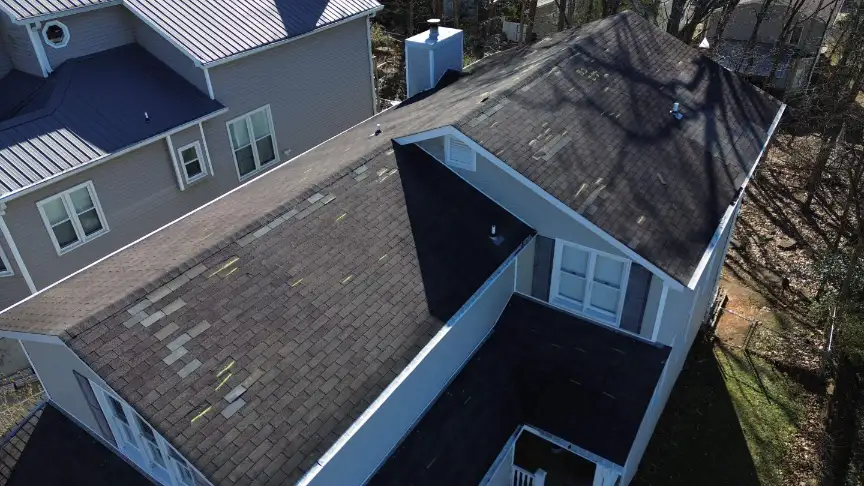
A missing shingle, one flashing leak, algae staining, or a small ceiling spot does not automatically mean you need a new roof. Those are roof-damage symptoms that need diagnosis. If you are trying to identify damage in general, start with our guide to common signs of roof damage.
This article answers a narrower question: when has deterioration progressed far enough that replacing the roofing system deserves serious consideration?
1. Your Roof Is Near the End of Its Life—and Its Condition Shows It
Age matters, but age alone is not a replacement diagnosis. A 20-year-old roof that remains flat, dry, well-adhered, and structurally sound is a different situation from a 20-year-old roof with brittle shingles, repeated repairs, bare spots, and leaks.
For context, our guide to roof lifespan in Alabama places basic three-tab asphalt shingles at roughly 15–20 years and architectural shingles around 20–30 years under suitable conditions. Those numbers are useful planning ranges, not expiration dates.
The stronger replacement signal is age combined with deterioration across the roof system. If an older roof is also showing several of the warning signs below, continued spot repairs may simply postpone work that is already becoming necessary.
2. Shingles Are Curling, Buckling, or Becoming Brittle Across Multiple Slopes
Healthy asphalt shingles should lie relatively flat and remain flexible enough to tolerate normal temperature changes and wind. As they age, the asphalt can dry out and the shingles may curl at the edges, distort, crack, or become brittle.
One damaged patch can often be repaired. Replacement becomes more likely when the same deterioration appears on several roof planes or throughout large sections of the roof. At that point, replacing individual shingles does not address the condition of thousands of surrounding shingles that are aging at roughly the same rate.
Brittleness matters too. When surrounding shingles crack or break during an otherwise routine repair, creating a durable patch becomes more difficult. The repair itself can disturb adjacent material that no longer has enough flexibility to work with safely.
3. Granule Loss Is Widespread Enough to Leave Bald or Patchy Areas
Asphalt shingles are covered with mineral granules that form the exposed surface of the roof. Some loose granules are normal, especially when a roof is new or after severe weather. The more concerning condition is uneven, widespread loss that leaves large areas looking smooth, dark, shiny, or bald.
A handful of granules in a gutter does not prove the roof needs replacement. What matters is the pattern. If substantial granule loss appears across multiple slopes and is accompanied by cracking, curling, or brittleness, the roof covering itself is deteriorating rather than suffering from one isolated defect.
This is a useful example of why replacement decisions should be based on the whole system. The question is not simply, “Are there granules in the gutter?” It is, “How much protective surface remains across the roof?”
4. Missing or Loose Shingles Are No Longer Confined to One Repairable Area
A few shingles lost to wind can occur on an otherwise healthy roof. That is normally a repair conversation, not an automatic reason to replace everything.
The situation changes when missing, lifted, cracked, or poorly bonded shingles appear in multiple sections of the roof. Repeated wind loss can mean the remaining material has weakened, fastening problems are more extensive, or the roof has reached a stage where one patch simply reveals the next weak area.
That distinction helps prevent unnecessary replacement. If the damage is limited and the rest of the roof still has useful life, a professional roof repair evaluation may be the sensible route. If several slopes are deteriorating together, however, replacement deserves a closer look.
5. Leaks Keep Returning—or Water Is Entering in Multiple Areas
A single leak does not necessarily mean the roof has failed. Water can enter around one pipe boot, flashing detail, vent, valley, or storm-damaged shingle while the rest of the roof remains serviceable.
Replacement becomes more plausible when leaks are recurring after previous repairs, showing up in different areas, or accompanied by widespread staining and moisture in the attic. Multiple leak points suggest that the problem may no longer be one failed component. Instead, several parts of the roof system may be reaching the end of their service life together.
Recurring leaks also change the economics. Repeatedly paying to diagnose and patch new failures makes less sense when the surrounding roofing material is continuing to deteriorate.
If you are genuinely on the line between another repair and replacement, use our repair-or-replace decision framework for the deeper comparison. This article intentionally does not duplicate that decision model.
6. The Roof Deck Is Soft, Deteriorated, or Visibly Sagging
This is one of the more serious warning signs. The roof deck is the structural surface underneath the roofing material. When it has been exposed to moisture for an extended period, sections can soften, deteriorate, or lose their ability to hold the roof covering properly.
From outside, structural deterioration may appear as a dip, wave, or sag in the roofline. In an attic, warning signs can include widespread staining, deteriorated wood, or multiple areas where moisture has affected the decking.
A visibly sagging roof should be evaluated promptly. Do not climb onto a roof or press on questionable decking from above to test it yourself. If the underlying wood or framing has lost strength, adding a person’s weight can be unsafe.
Localized decking damage can sometimes be replaced as part of a repair. Widespread soft decking or a sagging roofline is different because the problem reaches beneath the shingles and into the supporting roof assembly.
7. Repairs Keep Solving One Problem While Another One Appears
One of the clearest replacement-level patterns is not a single dramatic defect. It is a sequence: one section is patched, another begins leaking; shingles are replaced on one slope, then another slope starts shedding material; flashing is repaired, but aging shingles around a different penetration fail months later.
At that point, the roof may still be technically repairable one defect at a time. The more useful question is whether that strategy still makes sense.
A roof is a system. When repeated failures are being caused by the age and condition of the system rather than one isolated defect, replacement allows the roof covering, underlayment, flashing details, ventilation components, and damaged decking to be evaluated together.

Repairable Damage vs. Replacement-Level Failure
| What you see | More consistent with repair | More consistent with replacement evaluation |
|---|---|---|
| Missing shingles | A small storm-damaged area | Missing or loose shingles across several sections |
| Leaks | One identifiable leak source | Recurring or multiple leak locations |
| Granule loss | Limited or uneven wear in one area | Large bald or patchy areas across multiple slopes |
| Shingle condition | Surrounding shingles remain flexible and intact | Widespread curling, cracking, or brittleness |
| Decking | Small damaged section around a known leak | Multiple soft areas or visible sagging |
| Repair history | A first isolated repair | New failures continue after previous repairs |
The table is a screening tool, not a substitute for inspecting the roof. The important pattern is concentration versus distribution: localized defects tend to support repair; widespread deterioration pushes the decision toward replacement.
What Does Not Automatically Mean You Need a New Roof?
Moss or algae staining by itself is not proof that a roof requires replacement. Neither is one missing shingle, a single flashing problem, one small ceiling stain, or a sudden increase in energy use. Those conditions may deserve attention, but they can have several causes.
This is where some “signs you need a new roof” articles become too aggressive. They turn every roof symptom into a replacement pitch. That is not useful to a homeowner and can blur the search intent between roof repair, roof damage, maintenance, and replacement.
The case for replacement becomes stronger when the problem is widespread, recurring, structural, or combined with an aging roof.
Why Huntsville Homeowners Should Look at the Pattern, Not Just the Roof’s Age
North Alabama roofs deal with long periods of heat and humidity along with thunderstorms, wind, and occasional hail. Those conditions do not make every older roof a replacement candidate, but they can expose weaknesses in aging roofing material.
Two homes built in the same year can have roofs in very different condition depending on the shingle product, attic ventilation, installation quality, tree cover, maintenance history, and storm exposure. That is why a calendar age should start an inspection conversation rather than end it.
If several replacement-level signs are present, Huntsville Roofing Solutions can inspect the roofing material, flashing, attic conditions, and accessible decking, then explain whether the evidence supports another repair or a full residential roof replacement in Huntsville.
What Should You Do If You See Several of These Signs?
Start with an inspection rather than assuming the answer. Ask the inspector to show you where failure is occurring, whether it is localized or widespread, what condition the surrounding shingles are in, and whether the decking shows signs of deterioration.
If replacement is recommended, the explanation should connect the recommendation to observable conditions on your roof. “The roof is old” is not enough by itself. A stronger explanation is: the roof is near the end of its expected life, several slopes have brittle or bald shingles, previous repairs are failing, and moisture has affected multiple areas of decking.
Likewise, if the roof can still be repaired responsibly, replacement should not be presented as the only option. A candid inspection sometimes ends with, “You do not need a new roof yet.”
Frequently Asked Questions
Does a 20-year-old roof automatically need to be replaced?
No. Age is a planning factor, not a diagnosis. A 20-year-old roof deserves closer evaluation, but replacement should be based on its material, condition, repair history, decking, and the extent of deterioration.
Does one missing shingle mean I need a new roof?
Usually not. A small number of missing shingles on an otherwise sound roof can often be repaired. Replacement becomes more likely when shingle loss is widespread or the surrounding shingles are too brittle or deteriorated to support a durable repair.
Is moss or algae a sign that a roof needs replacement?
Not by itself. Growth or staining can indicate persistent moisture and may contribute to deterioration, but it does not automatically mean the entire roofing system has failed. The condition of the shingles and decking matters more.
Can a leaking roof still be repaired instead of replaced?
Yes. A leak caused by one failed flashing detail, penetration, or small damaged section may be repairable. Recurring leaks, multiple leak locations, widespread shingle deterioration, or extensive decking damage make replacement more likely.
The Bottom Line
The most dependable signs you need a new roof are not isolated cosmetic problems. They are patterns: widespread shingle deterioration, extensive granule loss, failures on multiple roof sections, recurring leaks, deteriorated decking, sagging, and repairs that no longer stay ahead of the roof’s overall decline.
If those signs are present together—especially on an older asphalt roof—it is reasonable to have replacement evaluated. If the damage is still limited to one area and the surrounding roof remains sound, repair may be the better investment.

Jordan is the founder and owner of Huntsville Roofing Solutions, a locally owned, fully licensed and insured roofing company serving Huntsville and North Alabama. He and roofing supervisor Barry Minor have handled residential and commercial roofs across the region — replacements, repairs, storm damage, and insurance claims — earning a 4.9-star Google rating along the way.