
HOA roof replacement rules in North Alabama vary by community, so there is no single statewide list of approved shingles, colors or contractors. Before replacing a roof, check your recorded covenants, current architectural-control guidelines and any approval form required by your homeowners association. Confirm whether the HOA must approve the color, roofing material, product profile or project documents before work starts. HOA approval is separate from local permits and contractor licensing. The safest sequence is to obtain the current rules, submit the proposed roof specifications, receive written approval, verify permitting and licensing requirements, and only then lock in the installation schedule.

That order matters more than many homeowners realize.
A roofing contractor may tell you that a particular shingle is appropriate for the house. Your insurance company may agree to pay for replacement after storm damage. Your city may issue the required roofing permit. None of those decisions necessarily answers the separate question of whether your homeowners association requires architectural approval.
And the reverse is also true: receiving HOA approval does not automatically satisfy municipal permitting, contractor licensing or building-code requirements.
Do You Need HOA Approval Before Replacing a Roof?
You may. The answer comes from the governing documents for your particular property, not from a universal North Alabama roofing rule.
An HOA declaration, covenants, conditions and restrictions—often called CC&Rs—may give the association or an architectural review committee authority over exterior changes. Separate architectural-control regulations can then describe how that authority applies to roofing.
Depending on the community, a roof replacement may require advance written approval even when the homeowner intends to use asphalt shingles again.
Other associations may only require approval when the homeowner changes something visible, such as the color or roofing material. Some may have a list of pre-approved products or colors. Others may ask the homeowner to submit a manufacturer, product line and sample before the committee makes a decision.
That variation is precisely why the first question should not be, “What does an HOA normally allow?” It should be, “What do the current recorded documents and architectural guidelines for my property require?”
What Does Alabama Law Say About HOA Architectural Rules?
Alabama has a Homeowners’ Association Act, but homeowners should not assume every Alabama community is governed by exactly the same statutory framework.
For associations subject to the Act, Alabama Code §35-20-13 requires the association, following a qualifying written request, to provide or direct a member or potential purchaser to current covenants, conditions and restrictions, including amendments, along with current architectural-control regulations. The statute provides a period not exceeding 30 days for the association to make required records available after the request and payment of reasonable associated costs, if any.
That is useful when a homeowner has an old copy of the neighborhood covenants but is not sure whether architectural standards have changed.
Do not rely only on the paperwork handed over when you originally purchased the house. Ask for the current version, including amendments and architectural guidelines.
There is another important limitation: Alabama’s HOA statutes distinguish ordinary homeowners associations from condominium regimes. If you own a condominium or another property where the roof may be a common element, responsibility for replacement and approval can be materially different. This guide is primarily about individually owned homes in HOA-governed neighborhoods, not condominium roof ownership.
What Roof Details Can an HOA Potentially Regulate?
The exact scope depends on the declaration and architectural standards, but roofing restrictions often focus on exterior appearance rather than the internal technical design of the roof.
An association may address roof color, material type, visible profile, consistency with neighboring homes or submission requirements for exterior alterations. A community with mostly architectural asphalt shingles, for example, may have standards intended to preserve a consistent appearance. Another community may permit metal roofing but restrict certain finishes or colors.
Do not assume that a manufacturer’s marketing name is enough for approval. “Gray,” for example, could describe dozens of products ranging from pale silver to nearly black.
If your HOA controls roof appearance, identify the exact manufacturer, product line and color you plan to install. You can compare the site’s available shingle colors and styles before submitting the final selection to your association.
The important distinction is that an HOA’s aesthetic approval and a roofer’s technical recommendation answer different questions. A roofing system still needs to be appropriate for the structure, weather exposure and applicable construction requirements even when the HOA approves its appearance.
HOA Approval and a Roofing Permit Are Not the Same Thing
This is one of the most common sources of confusion.
| Requirement | What It Usually Addresses | Who Controls It |
|---|---|---|
| HOA approval | Community covenants, exterior appearance and architectural restrictions | HOA or architectural review body |
| Roofing/building permit | Local construction and inspection requirements | City, county or applicable permitting authority |
| Contractor licensing | Legal authorization to perform qualifying residential roofing work | State licensing authority |
| Insurance authorization | Whether and how a covered claim will be paid | Homeowner’s insurer under the policy |
For example, the City of Madison identifies new roofs among alterations that generally require a permit and publishes a roofing permit application. Huntsville has its own separate permitting requirements.
A homeowner elsewhere in North Alabama may be under another city or county jurisdiction, so the requirement needs to be checked for the actual property address.
The practical rule is straightforward: an HOA approval letter is not a building permit, and a building permit is not HOA approval.
What Should You Submit to the HOA Before Roof Replacement?
Submit enough information for the architectural committee to understand exactly what will be visible when the job is finished.
A useful approval packet can include:
- The HOA’s completed architectural-change or exterior-modification application, if one exists.
- The roofing manufacturer’s name, product line and exact color.
- A product sheet, color sample or manufacturer image when requested.
- The contractor’s name and any license or insurance information the association requires.
- A brief scope explaining whether the project is a full replacement or storm-damage replacement.
- The proposed installation period if the HOA regulates work hours, access or construction activity.
Do not send only a roof estimate if the estimate does not identify the exact product being installed. A committee cannot reliably approve “architectural shingles” if several colors or product lines are still under consideration.
Equally important, save the written approval. A phone conversation with a board member is harder to prove later than an email or formal approval notice that identifies the accepted roof specification.
Do You Need Approval If the New Roof Is the Same Color?
Possibly.
A like-for-like replacement may seem as though nothing is changing, but the governing documents may define roof replacement itself as an architectural modification requiring review.
There is also more ambiguity in “same color” than it appears. Your existing roof may have weathered for 15 or 20 years. A new product sold under a similar color name can look noticeably different once installed across the entire roof.
Product lines also change over time. A shingle that was installed when the neighborhood was built may no longer be manufactured, even though the new option appears similar.
For that reason, check the approval requirement before ordering material rather than assuming that visual similarity creates an automatic exemption.
What If You Want to Change From Shingles to a Metal Roof?
A material change deserves particular attention because it is much more visible than replacing one asphalt shingle with another.
If the governing documents specify permitted roofing materials, a metal roof may require explicit architectural approval or may not fit the existing standard at all.
Do not order panels before confirming the rule.
If the association permits metal roofing, the next questions may involve the panel profile, finish and color. Those are HOA appearance questions. The structural and installation requirements are a separate roofing conversation.
This is a good example of why homeowners should complete architectural review before final material ordering. Custom or special-order materials can be much harder to change after the HOA rejects a selection.
What Happens When Storm Damage Forces a Roof Replacement?
Storm damage can make the timeline urgent, but it does not automatically erase private architectural requirements.
If wind, hail or falling debris creates active exposure, temporary steps to protect the structure from additional damage may need to happen quickly. Permanent replacement is a separate stage.
Notify the association early and ask whether it has an emergency or expedited architectural-review process for storm-damaged homes. If several homes in the same development were affected by the same storm, the HOA may already have procedures for replacement submissions.
Also remember that an insurance company’s agreement to pay a claim is not approval of the roof’s appearance under your community rules.
The insurer, HOA and contractor are solving different parts of the project. The homeowner needs those parts aligned before permanent materials are installed.
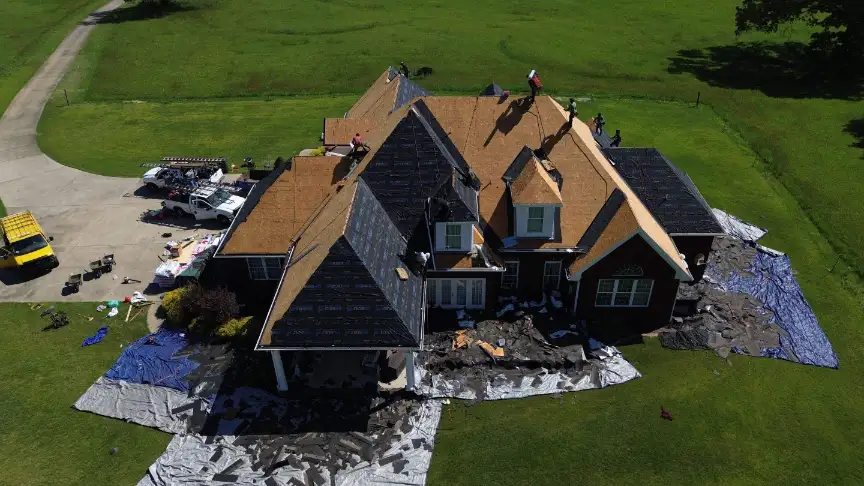
Does the HOA Choose Your Roofing Contractor?
Not necessarily.
Some associations may require contractors working in the community to provide insurance information, follow construction-hour rules or comply with access requirements. That is different from saying the HOA selects the contractor for you.
The actual authority depends on the governing documents.
Regardless of HOA requirements, Alabama homeowners should independently verify the contractor’s credentials. Under Alabama residential licensing rules, roofing work above the applicable threshold can require a state residential roofing or qualifying home-builder license. The current threshold for residential roofing work covered by the state rule is $2,500.
The site’s guide to verifying an Alabama roofing contractor’s license and insurance covers that check separately so this page does not duplicate the licensing topic.
Should You Sign the Roofing Contract Before HOA Approval?
Be careful about creating a financial commitment before you know the selected system can be approved.
Before signing, understand what happens if the HOA rejects the proposed color or material. If you are proceeding before architectural approval, the agreement should make clear how a required specification change will be handled.
The cleaner sequence is usually to obtain a roof assessment and proposed specification, submit the relevant product information, receive the HOA decision, and then finalize scheduling and material ordering.
If your existing roof is already at replacement stage, the roof replacement process explains the installation side after those preliminary decisions have been made.
A Practical HOA Roof Replacement Sequence for North Alabama Homeowners
| Stage | What to Confirm |
|---|---|
| 1. Confirm roof condition | Determine whether replacement is actually required and define the work. |
| 2. Get current HOA documents | Review the declaration, amendments and current architectural-control regulations. |
| 3. Select the proposed roof | Identify the exact material, manufacturer, product line and color. |
| 4. Submit for HOA review | Provide the information the architectural committee requires. |
| 5. Obtain written approval | Keep a copy identifying the approved specification. |
| 6. Confirm local permits | Check the requirements for the actual city or county jurisdiction. |
| 7. Verify the contractor | Confirm appropriate state licensing and insurance. |
| 8. Schedule installation | Order the approved material and establish the project date. |
This sequence may feel slower than simply choosing a shingle and putting the project on the calendar, but it reduces the risk of the most expensive HOA roofing mistake: installing a completed roof and discovering afterward that the visible specification was never approved.
What If the HOA Rules Are Unclear?
Ask for the rule in writing.
If someone says a particular color, material or product is prohibited, ask which declaration provision or architectural standard applies to the decision. Likewise, if someone tells you approval is unnecessary, confirming that position in writing gives you a much better record than relying on an informal conversation.
For associations subject to Alabama’s HOA records provisions, current architectural-control regulations are among the records members can request.
If the issue involves a legal disagreement about the meaning or enforceability of a covenant, that moves beyond roofing advice. A qualified Alabama attorney can interpret the governing documents and advise on the homeowner’s rights and obligations.
A roofer can document the condition of the roof, recommend materials and provide the product information needed for a submission. The roofer should not pretend to decide what a private covenant legally allows.
Why Handling HOA Approval Before Installation Matters
Most HOA roof issues are easier to solve before installation than afterward.
A different approved shingle color can be selected before the order is placed. A missing product sheet can be added to an architectural application. A permit can be obtained before work begins. Contractor credentials can be verified before a deposit is paid.
After thousands of square feet of roofing have already been installed, those same disagreements can become much more expensive.
That is why a good roofing process starts with documentation rather than assuming every North Alabama subdivision follows the same rules.
If you want to understand the company that would be inspecting or replacing the roof, you can read more about Huntsville Roofing Solutions. If you already have your HOA requirements or need roof specifications for an architectural submission, contact our team to discuss the property and the proposed replacement.
Frequently Asked Questions About HOA Roof Replacement Rules
Does every HOA in North Alabama have the same roof replacement rules?
No. HOA roof replacement rules come from the governing documents and architectural standards applicable to the individual property. One neighborhood may regulate specific colors or materials while another may have a simpler approval process.
Can an HOA require approval for the same color roof?
Potentially. A community’s governing documents may require approval for roof replacement itself, even when the homeowner intends to keep a similar color or material. Check the current architectural rules rather than assuming a like-for-like project is automatically exempt.
Does HOA approval replace a roofing permit?
No. HOA approval and government permitting are separate requirements. The association administers its private governing documents, while a city or other authority administers applicable permit and construction requirements.
Can insurance approve a roof that the HOA does not approve?
An insurer’s coverage decision and an HOA’s architectural decision address different issues. Insurance may pay for covered roof damage, while the HOA may separately regulate the appearance or material of the replacement under the community’s governing documents.
How do I get my HOA’s current roofing rules?
Request the current declaration, amendments and architectural-control regulations from the association. For Alabama associations subject to the Homeowners’ Association Act, current covenants and architectural-control regulations are among the records available to members through the statutory records-request process.
Do Alabama condominiums follow the same HOA roof rules?
Not necessarily. Condominium ownership can involve separate Alabama statutes and roofs may be treated as common elements controlled or maintained by the condominium association. Condominium owners should review their declaration and association documents rather than relying on guidance written for individually owned HOA homes.
This article provides general educational information about roofing and HOA procedures in North Alabama and is not legal advice. Governing documents, statutory coverage, permit requirements and individual circumstances can differ by property.
About the author: Jordan Woolf is the founder and owner of Huntsville Roofing Solutions, a locally owned roofing company serving Huntsville and North Alabama with residential and commercial roof replacement, repair, storm-damage and maintenance services.

Jordan is the founder and owner of Huntsville Roofing Solutions, a locally owned, fully licensed and insured roofing company serving Huntsville and North Alabama. He and roofing supervisor Barry Minor have handled residential and commercial roofs across the region — replacements, repairs, storm damage, and insurance claims — earning a 4.9-star Google rating along the way.